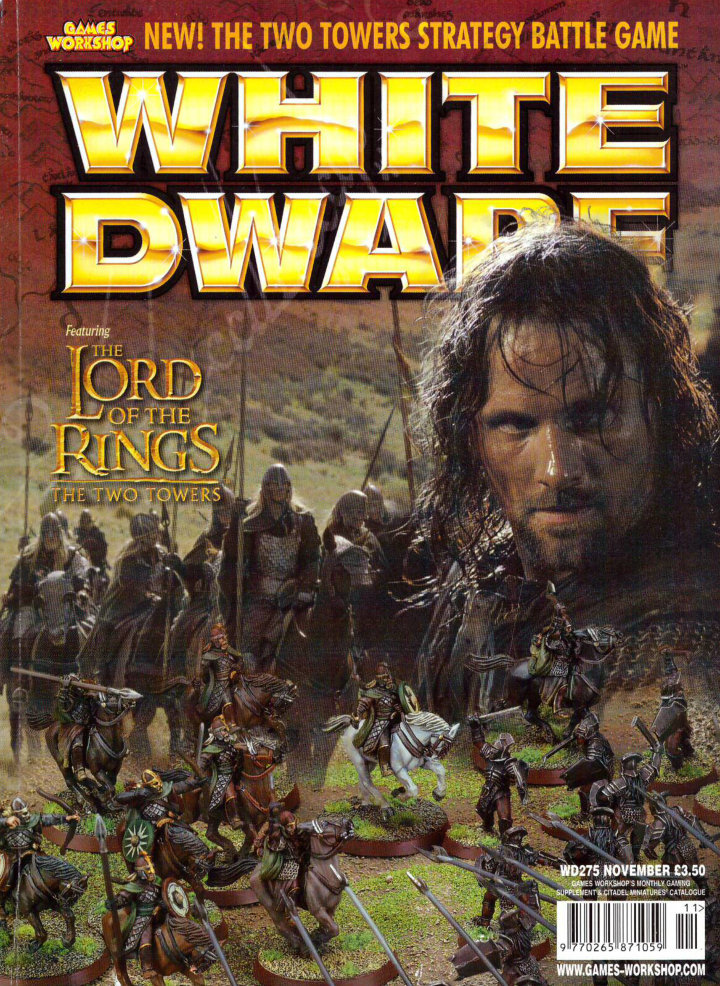
EditorialWD 275 · p. 1
Paul Sawyer describes conversion as a source of individuality and enjoyment, from a simple head swap to a completely reposed miniature. He introduces the tools used for cutting, pinning and sculpting joins, and points to Chaos as an especially fertile subject. Planned future coverage will explain both accessible conversions and more ambitious examples from hobbyists.
CommunityWD 275 · pp. 2–4
The news previews the first dedicated Tomb Kings army book, a large Forge World Chaos Mammoth and developments in the Daemonhunters and vehicle ranges. It also introduces new rules compilations and the Verdican card-game expansion. The announcement of The Blood Bowl describes a national championship linked to the NAF, while online updates promise new Chaos background and studio campaign coverage.
Warhammer Fantasy BattlesWarhammer 40,000
ShowcaseWD 275 · pp. 8–13
Graham McNeill explains the visual rules behind the studio Black Legion army. Black armour, warm gold shoulder trim and silver edging establish a shared identity, while restrained red and yellow accents distinguish details. Specialised units, god-marked troops, vehicles and characters vary this pattern without losing the army’s coherence; conversions are concentrated where they communicate a unit’s role.
Warhammer 40,000Black Legion
ShowcaseWD 275 · pp. 11–12
The Black Legion’s allegiance allows specialised cult troops to remain recognisably part of the same army. Red helmets and shoulder guards distinguish its Berzerkers, while pink shoulder plates identify Noise Marines. Obliterators emphasise the violent union of weapons and flesh, and the Possessed use extensive mutations and brighter flesh colours within the established armour scheme.
Warhammer 40,000Black Legion
ShowcaseWD 275 · p. 13
The army’s leaders retain the common palette but gain additional colour and individual conversions. Darren Latham’s Aspiring Champion receives a combi-melta and handmade lightning claw, while Tammy Haye’s Berzerker Champion carries an enlarged axe and a Khornate banner. The examples show how a limited number of changes can establish rank and character.
Warhammer 40,000Black Legion
ModellingWD 275 · pp. 16–17
Matt Hutson combines the Chaos Hatch and Spiky sprues to customise a Rhino while preserving access to its doors and hatches. Chains, trophies, icons and alternative dozer blades establish its allegiance. The guide compares several mountings for the combi-bolter, havoc launcher, searchlight and dirge caster, and explains how compatible crew parts can connect the vehicle to a particular Legion.
Warhammer 40,000Chaos Space Marines
ModellingWD 275 · p. 17
Components from the Chaos Hatch sprue also fit the Land Raider and forthcoming Predator. Daemonic heads replace ordinary gun muzzles, while alternative hatches support several weapon and crew arrangements. A large glyph is designed to cover the Imperial eagle, turning the loyalist vehicle’s most obvious badge into a Chaos emblem.
Warhammer 40,000Chaos Space Marines
PaintingWD 275 · pp. 18–19
Matt Hutson paints the Rhino’s interior before completing the hull, placing the highlights as if light enters through the rear door. Thin red layers, dark recesses and sharp edge highlights carry the same scheme outside. Control-screen lettering, painted windows and devotional script add detail, while worn metal, mud and trophies make the vehicle look used. Several fittings remain unglued so they can be exchanged later.
Warhammer 40,000Word Bearers13 paint colours
PaintingWD 275 · p. 19
The Rhino’s trophies receive separate treatments suited to their materials. A washed and re-highlighted bone recipe defines the skulls, while a muted yellow-brown mixture represents a Tau helmet. The Necron head uses the same shaded metallic method as the vehicle’s machinery.
Warhammer 40,000Word Bearers6 paint colours
LoreWD 275 · p. 20
The Traitor Legions still operate transports that served them during the Heresy. Barbarus, a World Eaters Rhino, is repeatedly identified across ten millennia of warfare. Its association with Sergeant Solax supports the suggestion that its original commander has become Kossolax the Foresworn and still leads the warband that uses it.
Warhammer 40,000World Eaters
LoreWD 275 · pp. 20–23
Andy Hoare examines the armoured vehicles retained, captured and manufactured by the Traitor Legions. Ancient Rhinos preserve links to the Heresy, while research into Iron Warriors Predators reveals unusually intimate unions between crews and machines. A captured Word Bearers Land Raider becomes the subject of a disastrous Inquisitorial investigation. Descriptions of the four gods’ vehicle modifications connect battlefield equipment with the corruption behind it.
Warhammer 40,000Chaos Space Marines
LoreWD 275 · p. 21
Techmarine Lysol Blane studies the Iron Warriors’ practice of permanently integrating tank crews with their vehicles. His findings allow the Imperial Fists to target vulnerable points during a successful counter-attack. The proposed inclusion of this research in the Codex Astartes is blocked by the Iron Hands, whose own augmentation traditions make its implications contentious.
Warhammer 40,000Iron Warriors
LoreWD 275 · pp. 21–22
Inquisitor Le Guinn prevents the destruction of a captured Word Bearers Land Raider so that he can study the intelligence within it. His investigation during the voyage to Nemesis Tessera breaches the restraints and exposes him to the possessing entity. The returning vessel contains only the dead, and the Inquisition leaves it adrift rather than risk releasing what remains aboard.
Warhammer 40,000Word Bearers
FictionWD 275 · p. 23
Fragmentary journal entries record Le Guinn’s increasingly dangerous attempts to undo the seals around the captured vehicle. The loss of assistants and the Navigator does not halt the work; he interprets each escalation as a reason to press on. His final declarations reveal a collapse of judgement and identity as the investigator becomes bound to the power he intended to master.
Warhammer 40,000Inquisition
CampaignWD 275 · pp. 26–28
Paul Sawyer’s limited painting time delays the latest additions to his monthly Chaos project, but the growing army joins Dylan Owen’s studio campaign. In a small battle against Orcs, Chosen Knights prove decisive despite poor distance judgement, a missed crewman’s attacks and the death of Vradchuk. The first victory produces practical lessons about screening, modelling equipment and supporting a chariot-borne character, before Sawyer selects Marauder Horsemen as the next purchase.
Warhammer Fantasy BattlesWarriors of Chaos
PaintingWD 275 · pp. 30–31
Kirsten Mickelburgh pins the multi-part dragon before developing its body through red, purple and blue regions. Mixed transition colours join these areas, and thin ink glazes strengthen their finish. Dark wings and scales contrast with pale exposed flesh, individually coloured eyes and layered bone details. The base continues the unsettling theme with differently treated flesh and faces among the textured ground.
Warhammer Fantasy BattlesWarriors of Chaos26 paint colours
CampaignWD 275 · pp. 32–35
A new warband system draws inspiration from the older Realm of Chaos books while using a more structured recruitment process. Normal Warhammer rules, small skirmishing groups and a few independent characters make the battles quick enough for short sessions. Favour buys opportunities to recruit followers and equipment, preserving random discoveries while allowing players some control over the force they develop.
Warhammer Fantasy BattlesWarriors of Chaos
RulesWD 275 · pp. 33–34
A free Champion and an initial pool of Favour provide the starting point. Players choose an allegiance, roll for common or unusual followers and decide which recruits they can afford, with extra Favour available to alter results. Equipment tables and minimum unit-strength rules turn the resulting collection into small formations suitable for ordinary Warhammer battles.
Warhammer Fantasy BattlesWarriors of Chaos
ShowcaseWD 275 · p. 35
The example warband begins with a Slaaneshi Champion inspired by the studio army’s pale flesh and black armour. Existing Chaos models supply the randomly generated followers, then receive additional detail to fit their allegiance. Chosen and Warriors form one group, Beastmen another, while mounted fighters and the Champion operate according to their different battlefield roles.
Warhammer Fantasy BattlesWarriors of Chaos
RulesWD 275 · pp. 40–42
Andy Hoare replaces the rulebook’s priest entries with a delegation intended for Imperial Guard forces. Missionaries, Confessors and Preachers join squads rather than operating independently, and their presence can prevent specialist deployment abilities. A restricted Ministorum Auxilia armoury distinguishes them from priests in an Ecclesiarchy army; they neither generate nor spend Faith Points.
Warhammer 40,000Imperial Guard
RulesWD 275 · pp. 41–42
The delegation’s equipment list combines ordinary Imperial weapons with religious artefacts and distinct spending limits for senior and junior priests. The accompanying explanations cover a two-handed power weapon, a blade that worsens enemy morale, a brazier with a single heavy-flamer attack, adjustable fallback distance and the Rosarius’s protective field.
Warhammer 40,000Adeptus Ministorum
RulesWD 275 · pp. 43–45
Phil Kelly previews the developing Daemonhunters rules through an Ordo Malleus Inquisitor and a selectable retinue. Imperial Guard and Space Marine armies can include the unit as an Elite choice, using the Space Marine armoury provisionally until the new book appears. Different henchmen improve characteristics or provide specialist abilities, and the accompanying concept models illustrate the range of characters such a retinue can represent.
Warhammer 40,000Inquisition
RulesWD 275 · p. 44
Psychically linked constructs and altered creatures increase an Inquisitor’s alertness and supply additional minor psychic powers. Servo-skulls, cherubim and psyber-eagles provide different modelling interpretations. The rules specify which benefits persist when a Familiar is lost and remove the Familiars themselves when their master dies.
Warhammer 40,000Inquisition
RulesWD 275 · p. 44
Devout attendants reinforce their master’s faith through prayers and exorcisms. Their presence improves Leadership and makes it harder for daemons to assault the unit. A retinue containing several Hierophants also weakens the Leadership of nearby daemonic enemies.
Warhammer 40,000Inquisition
RulesWD 275 · p. 44
Prospective Inquisitors learn first as Explicators and then as Interrogators while serving an experienced master. On the battlefield an Acolyte can receive a wound intended for the Inquisitor before saving throws are attempted. A small equipment allowance lets the apprentice carry suitable tools and protection.
Warhammer 40,000Inquisition
RulesWD 275 · p. 44
A rare battlefield psyker detects daemonic manifestations and other sudden arrivals. When an enemy appears nearby through summoning or deep strike, the Mystic allows the Inquisitor’s unit to fire before it moves. Multiple Mystics can instead direct a nearby friendly unit to take the free shot.
Warhammer 40,000Inquisition
RulesWD 275 · p. 45
Veteran Guardsmen and heavily altered Servitors supply the retinue’s direct combat support. Their presence improves the Inquisitor’s Weapon Skill, while the attendants themselves carry better armour and ranged training than ordinary henchmen. Separate weapon options distinguish versatile human veterans from specialist gun and combat Servitors.
Warhammer 40,000Inquisition
RulesWD 275 · p. 45
An augmented information specialist turns observation and calculation into battlefield assistance. A Sage improves the Inquisitor’s shooting accuracy, while a second allows a missed shot within the unit to be rerolled. Autosavants, Lexmechanics and Calculus Logi are offered as different forms of the same role.
Warhammer 40,000Inquisition
CommunityWD 275 · pp. 48–49
Jervis Johnson launches a regular column on the Specialist Games studio’s work. The main announcement is Necromunda Redux, intended to restore the out-of-print rulebook and terrain while replacing the plastic Goliaths and Orlocks with metal models. Additional updates cover new spacecraft, the developing Epic rules, Pit Fighter playtesting and future support for older games.
NecromundaEpic
CommunityWD 275 · p. 49
The studio update points readers towards an early playable version of the next Epic rules and describes Mark Bedford’s new Imperial ships and system craft. Jervis recounts an unsuccessful Pit Fighter outing against colleagues and introduces the first painted models from Gary Morley’s Amazon warband.
EpicBattlefleet GothicImperial Navy
CommunityWD 275 · p. 49
Jervis explains why Fanatic cannot return Warhammer Quest to print: the original production files were lost, and rebuilding them exceeds the team’s resources. Responsibility passes to the Special Projects Group, without a promise of a reprint. He separately mentions the possibility of adapting Man O’ War and Mighty Empires ideas into future Warmaster supplements.
Warhammer QuestWarmaster
CampaignWD 275 · pp. 50–53
Andy Hall presents a branching campaign built around rival Inquisitors pursuing the telepath Vosis Pyel on Zarona. The Radicals want him as a bargaining counter with a trader, while the Puritans need his knowledge. Prison raids, pursuit and a disrupted exchange reveal that the trader is a Chaos Magus; a mysterious Eldar intervention forces the Inquisitors to decide whether to cooperate against the greater threat. Profiles and presentation advice help a gamesmaster adapt the framework to existing warbands.
InquisitorInquisition
RulesWD 275 · p. 51
The Radicals attack a makeshift prison while the Puritans protect their captive. An opening negotiation determines who acts first, giving spoken roleplay a direct consequence on the table. Pyel tries to escape both sides, but the gamesmaster is instructed to preserve him for the later campaign branches.
InquisitorInquisition
RulesWD 275 · pp. 51–52
After capturing Pyel, the Radicals prepare a concealed ambush for their pursuers outside Trojaan. Secretly marked booby traps complicate the Puritans’ advance, while the prisoner’s sudden flight pushes the two warbands towards one another. Victory depends on regaining control of him and leaving by the appropriate edge.
InquisitorInquisition
RulesWD 275 · p. 52
A night raid offers the Radicals another chance to recover Pyel before interrogation reveals his information. Only three infiltrators may approach closely, carrying alien devices that can teleport them and the prisoner away. Patrolling sentries, reduced visibility and a short withdrawal deadline once the alarm is raised govern the attempt.
InquisitorInquisition
RulesWD 275 · pp. 52–53
The Radicals meet Forne to negotiate the prisoner exchange as the Puritans intervene. A hidden Eldar marksman kills Pyel at the crucial moment, destroying the information both sides seek. Forne’s anger breaks his disguise and reveals the Chaos Magus, carrying the surviving warbands directly into the final confrontation.
InquisitorInquisition
RulesWD 275 · p. 53
The Puritans attempt to transport Pyel through Trojaan’s spaceport while the Radicals pursue. The captive’s escape attempt gives the hidden Eldar an opportunity to kill him before he reaches the shuttle. Forne then arrives openly with his followers, replacing the struggle for the prisoner with a confrontation against the Magus.
InquisitorInquisition
RulesWD 275 · p. 53
With Pyel dead and Forne revealed, the rival Inquisitors face a powerful common enemy. The scenario deliberately leaves their cooperation uncertain, allowing either an alliance or a three-sided fight. The unresolved artefact, hidden information and Eldar motives offer routes for continuing the campaign after the confrontation.
InquisitorInquisition
LoreWD 275 · pp. 54–55
The introduction connects the Old World’s monsters with the magical contamination released by the polar gates’ collapse. The most unstable creatures depend on the stronger energies of the north, while Beastmen survive farther afield in hidden lairs. Their conflict with the Wood Elves centres on places of magical power, where herdstones and waystones serve opposing purposes.
Warhammer Fantasy BattlesBeastmen
RulesWD 275 · pp. 54–62
Gav Thorpe introduces a work-in-progress Beastmen army that integrates with Hordes of Chaos. The general determines which parts of a mixed Chaos force count as Core or Special, while new ambush and herd mechanics distinguish the beasts from mortal warriors and daemons. The preview includes characters, mixed Gor and Ungor herds, chariots and larger monsters, together with a restricted range of new magical equipment.
Warhammer Fantasy BattlesBeastmen
RulesWD 275 · pp. 55–56
A general’s brayhorn can summon waiting units onto the battlefield, with Leadership deciding whether they arrive at the intended point. Mob Rule combines skirmishing movement with ranked combat, while mixed herds expose Ungors to shooting and push Gors forward in melee. The accompanying diagrams explain the rearrangement of the herd and the allocation of casualties.
Warhammer Fantasy BattlesBeastmen
RulesWD 275 · p. 57
The preview adds weapons, a talisman, a shamanic staff and a banner suited to Beastmen. Their effects range from bypassing armour and increasing attacks to extending charges or providing a reliable movement spell. Beast characters are barred from enchanted items, and several of the new selections are restricted to particular leaders or units.
Warhammer Fantasy BattlesBeastmen
RulesWD 275 · pp. 58–62
The army entries define Beastmen leaders and shamans alongside the powerful Doombull, then list herds, Bestigors, chariots and Warhounds. Ogres, Trolls and Minotaurs provide specialised support, while Dragon Ogres, a Dragon Ogre Drake and a Giant fill the rare selections. Marks, equipment and the general’s identity determine how these units can combine with the existing Chaos book.
Warhammer Fantasy BattlesBeastmen
RulesWD 275 · p. 63
Official answers address Chaos Dwarf blunderbusses, spells affecting combats and the use of Magic Resistance against area effects. Other rulings cover the Anvil of Doom’s defenders, characters joining flying units, victory points for war machines and the order of Fear tests when standing and shooting. The introduction states that these answers supersede earlier versions.
Warhammer Fantasy BattlesChaos Dwarfs
ShowcaseWD 275 · pp. 68–69
Bruno Rizzo’s gallery brings together elaborately detailed Chaos and Ork models. Close views of a Chaos Dreadnought and Terminators reveal decorated armour and individually treated surfaces, while Ork leaders display contrasting equipment and personal ornament. A mounted Chaos Lord on a Juggernaut completes the selection across the two game ranges.
Warhammer Fantasy BattlesWarhammer 40,000Chaos Space Marines
ModellingWD 275 · p. 70
Keith Robertson develops an Egyptian theme through a winged Lord, altered helmets and sculpted loincloths. A Raptor head, feathered Griffon wings and a composite staff turn a familiar Chaos Lord into a Tzeentchian character, accompanied by an older Familiar. Blue armour, gold or bone trim and warm bases connect the conversions, with plans to expand the retinue’s sorcerous character.
Warhammer 40,000Thousand Sons4 paint colours
ModellingWD 275 · pp. 70–73
Andy Hoare gathers five studio hobbyists’ approaches to the elite warriors of Chaos. Egyptian imagery shapes a Thousand Sons retinue, swollen flesh unifies Death Guard Terminators, and a giant bull-headed warrior embodies one Slaaneshi character’s history. Khornate kit combinations and Black Legion mutations show further ways to make each Chosen model an individual while retaining an army identity.
Warhammer 40,000Thousand Sons6 paint colours
ModellingWD 275 · p. 71
Neil Hodgson uses cloven feet, swollen stomachs and damaged armour to link a small elite Death Guard force. Zombie heads, sculpted boils and protruding machinery give each Terminator its own decay. Pale mixed colours and thin irregular ink layers create a crusted finish, while epoxy resin supplies slime on an extensively sculpted Beast of Nurgle.
Warhammer 40,000Death Guard2 paint colours
ModellingWD 275 · p. 72
Phil Kelly converts Logan Grimnar into a towering member of Lucius’s retinue. A Beastman head, a Chaos power maul and a bead-based second weapon establish Vaust’s brutal appearance while preserving the original model’s dynamic pose. Background and game equipment then turn the conversion into a specific villain rather than a purely visual exercise.
Warhammer 40,000Emperor’s Children
LoreWD 275 · p. 72
Vaust’s long descent into Slaaneshi excess changes a meticulous torturer into a creature driven by overwhelming physical violence. His speech disappears and his head becomes bovine as his patron rewards the transformation. The accompanying equipment interprets his paired crushing weapons, immense strength and destructive bellow through the Chaos army’s existing rules.
Warhammer 40,000Emperor’s Children
ModellingWD 275 · p. 72
Bo Tolstrup approaches his new Khornate army through a wide-ranging collection of spare parts. Older Gargoyle and Genestealer pieces, Chaos Spawn components and a Flesh Hound head combine with Chaos Space Marine models. The examples emphasise how an accumulated bits box can support a force of varied, heavily mutated individuals.
Warhammer 40,000Chaos Space Marines
ModellingWD 275 · p. 73
Graham Davey traces several characters to their starting components, including Kharn, an Aspiring Champion and a Space Marine Chaplain. Other Chosen use Strigoi Vampire parts and sculpted flesh bursting from broken armour, with guitar wire representing severed cables. A tentacled icon bearer uses its standard as a physical support, linking the mutation to the miniature’s pose.
Warhammer 40,000Black Legion
Battle reportWD 275 · pp. 76–94
Andy Hoare’s Iron Warriors attack Pete Haines’s Black Legion for control of a breach on Perdictor II. Deep-striking Terminators disrupt the advance, and a devastating Basilisk hit almost destroys the defenders’ command group. The surviving icon bearer summons Bloodletters that reverse the assault and bring down the Daemon Prince. The battle ends in a draw because the Iron Warriors still contest the objective, despite the Black Legion’s stronger surviving position.
Warhammer 40,000Iron Warriors
RulesWD 275 · pp. 100–101
The revised core rules allow unengaged friends to move aside for a retreating combatant and refine attacks across defended barriers. New thrown weapons and crossbows expand shooting options, while pikes can support a third rank. Dedicated cavalry rules make mounted charges especially dangerous, and additional explanations clarify when Heroes may spend Might.
Middle-earth Strategy Battle GameRohan
RulesWD 275 · pp. 100–103
Alessio Cavatore explains how the second version of the game extends the existing system while preserving compatibility with earlier forces and scenarios. Clarified movement and combat sit alongside new mounted and siege rules, additional weapons and expanded profiles. He also outlines the newly acquired book licence and the planned Shadow and Flame supplement, connecting the immediate film release with a wider future for Middle-earth gaming.
Middle-earth Strategy Battle GameRohan
RulesWD 275 · p. 102
The new siege section adapts the game’s individual-model approach to fighting around walls, towers and battlements. It covers climbing ladders, defending fortifications and breaking through walls and gates. Battering rams and Saruman’s explosive charges provide different ways for an attacker to breach a strong position.
Middle-earth Strategy Battle GameRohan
RulesWD 275 · pp. 102–103
New profiles introduce the Rohirrim, Rangers, Warg Riders and several major characters while retaining the earlier book’s usable profiles. Gandalf the White gains stronger abilities, Aragorn and Legolas receive new equipment options, and Gimli gains a throwing axe. Gríma interferes with enemy Might use, while Gollum’s shifting control creates a particularly unpredictable model on the battlefield.
Middle-earth Strategy Battle GameRohan
CommunityWD 275 · p. 103
A new licence allows the game to draw from Tolkien’s books as well as the films, opening the way to omitted characters and additional settings. Cavatore identifies Balin’s expedition to Moria as the subject of Shadow and Flame and hints at further characters in its appendices. Work on The Return of the King and expanded magazine coverage is also planned.
Middle-earth Strategy Battle GameDwarves
PaintingWD 275 · pp. 104–105
Seb Perbet gives the Elves of Helm’s Deep layered metallic armour with warm shading and brighter lower scales. Rich red leather and Haldir’s glazed red cloak contrast with the troops’ blue-grey cloaks. The guide shares recipes for flesh, fair hair, footwear and bows, then finishes the models with a consistent sand-and-grass base.
Middle-earth Strategy Battle GameLothlórien25 paint colours
Battle reportWD 275 · pp. 108–119
Dave Cross’s Rohirrim surround Alessio Cavatore’s Orcs and Uruk-hai as they try to escape with Merry and Pippin. The Evil force sacrifices a rearguard and tries to keep its captors moving towards Fangorn, while the Riders maintain pressure rather than pausing to shoot. Éomer’s heroic actions and the late loss of Uglúk’s Might prove decisive: both guards fall, the Hobbits escape and the last pursuers are defeated.
Middle-earth Strategy Battle GameRohan
RulesWD 275 · pp. 110–111
The Riders of Rohan attack an Orc camp near Fangorn, unaware that two Hobbits are held inside it. Evil wins by taking either captive into the forest, while Good must free both or destroy the enemy. Named guards move their prisoners, cannot pass them between models and can recapture a freed Hobbit; shooting at a guard risks hitting the captive as well.
Middle-earth Strategy Battle GameRohan
RulesWD 275 · p. 115
A mounted warrior charging infantry receives an additional attack. If the cavalry wins, opposing infantry are knocked down and become trapped, doubling the strikes against them. The explanation also identifies the conditions that preserve or remove these bonuses when further models join the fight.
Middle-earth Strategy Battle GameRohan
ModellingWD 275 · p. 115
Warriors of Rohan can represent riders who have lost their horses, but a mixed force needs a clear way to distinguish them from ordinary infantry. Suggested solutions include markers, distinctive bases or small equipment conversions. Adding a shield to an archer or a bent-wire bow to a shield-bearing warrior reproduces the rider’s combination of gear.
Middle-earth Strategy Battle GameRohan
RulesWD 275 · p. 115
Throwing spears and axes can be used after a full move, making them useful to rapidly advancing troops. They can also be thrown during a charge at the intended opponent. Killing that target allows the charger to redirect towards another legal enemy within reach.
Middle-earth Strategy Battle GameRohan
Contents-listed articles and substantive separately titled features are indexed. Advertisements, release catalogues, store directories, event listings and art-only pages are excluded.