EditorialWD 274 · p. 1
Paul Sawyer looks forward to Games Day and the Golden Demon competition, then turns to the ordinary tools that support the hobby. The revelation that Chaos Black paint is the company’s best-selling item becomes a reminder of the importance of paints, dice, glue and other everyday supplies. An accompanying competition offers signed copies of the Predator cutaway poster.
2 paint colours
CommunityWD 274 · pp. 2–4
Tournament reports identify Adrian McWalter and Nigel Atkinson as the first heat winners, with painted-army recognition for Dan Tunbridge and Marco Schultze. Studio notes preview a new chariot base, the Inquisitor Annual, Mordheim characters and Imperial ships for Battlefleet Gothic. Black Library news follows Gotrek and Felix to Albion in Giantslayer, where Teclis will join the story.
Warhammer Fantasy BattlesWarhammer 40,000
CommunityWD 274 · pp. 10–17
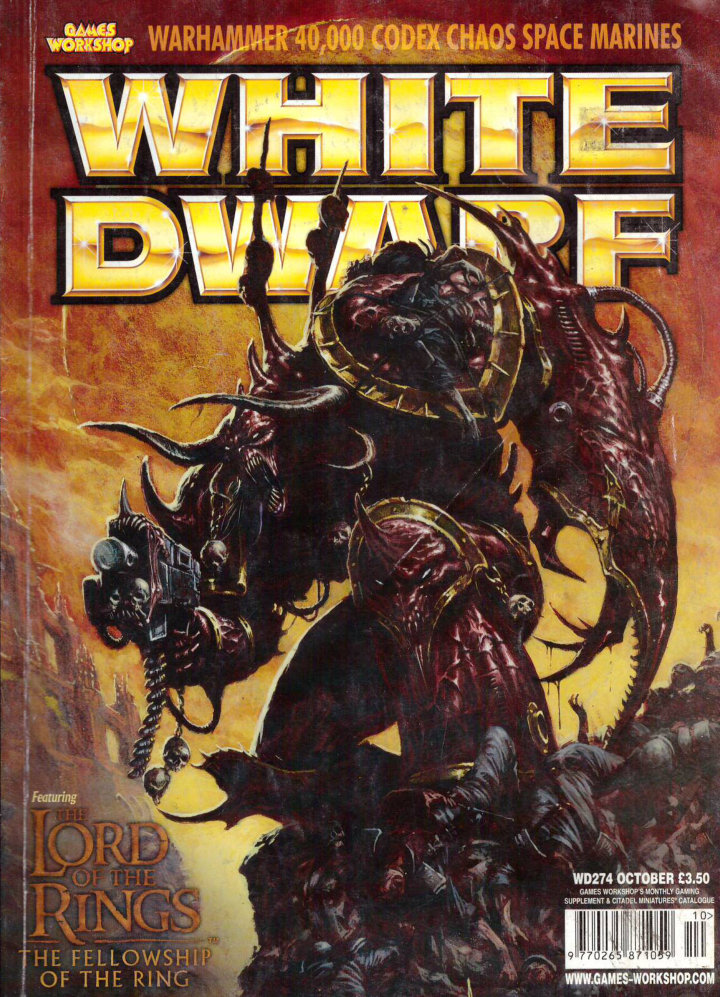
Pete Haines and Andy Chambers explain how the revised codex supports distinct Traitor Legions and individually developed villains. Veteran skills, daemonic gifts and chosen Possessed abilities connect army construction with a model’s history and appearance. Haines also describes improving Raptors and Obliterators and developing a uniquely Chaotic daemon engine, while Chambers discusses using suggestive background and dangerous weapons to encourage players’ own stories.
Warhammer 40,000Chaos Space Marines
CommunityWD 274 · p. 16
Pete Haines explains the reasoning behind the Defiler: ten millennia of Chaos warfare should produce vehicles beyond inherited Imperial designs. Epic’s daemon engines provide the conceptual starting point, but the new machine requires its own visual development. Artists’ sketches lead to a design being realised by Jes Goodwin and Tim Adcock.
Warhammer 40,000Chaos Space Marines
CommunityWD 274 · p. 17
Andy Chambers describes researching earlier Chaos writing, including an unpublished treatment by Rick Priestley, before choosing how much to reveal in the codex. His aim is to communicate the character of Chaos while leaving readers enough uncertainty to make their own connections and create their own antagonists.
Warhammer 40,000Chaos Space Marines
CommunityWD 274 · p. 17
Andy Chambers treats psychic powers and daemon weapons as devices for generating a character’s history. A weapon’s origin and its struggle against the wielder can give an army a continuing story, making the risks as significant as its battlefield strength.
Warhammer 40,000Chaos Space Marines
PaintingWD 274 · p. 18
Martin Footitt defines Abaddon’s black armour with restrained brown-grey edges and warm washed metallic trim. Pale skulls and a bruised face contrast with the dark suit, while the Talon and daemon sword receive different ink treatments. The guide also covers the red topknot, trophy helmet, ammunition ports and a textured grass base.
Warhammer 40,000Black Legion23 paint colours
PaintingWD 274 · p. 19
Ahriman’s limited blue, yellow and gold palette keeps the intricate miniature legible. Separate assembly improves access to the chest and shoulders, and a drilled pistol adds depth. Layered cloth, warm metallic glazes, outlined robe patterns and contrasting eye-like gems complete the richly decorated sorcerer.
Warhammer 40,000Thousand Sons20 paint colours
ShowcaseWD 274 · pp. 20–25
Pete Haines traces his Iron Warriors from a Chaos collection bought from Andy Chambers to a mechanised army shaped by successive campaigns. The history he invents for Murchad Kite connects the force to a fleet and supplies reasons for its changing equipment. Maintaining a flexible roster lets squads acquire reputations, while Cityfight and the revised codex prompt another reorganisation rather than abandonment of the army.
Warhammer 40,000Battlefleet GothicIron Warriors1 paint colour
LoreWD 274 · pp. 20–25
Pete Haines’s army background begins with a Thousand Sons Techmarine whose mechanical interests set him against his Legion’s sorcery. He seizes the Infernal Device during the approach of the Space Wolves and becomes a corsair. Later he recruits the defeated Iron Warriors of the 12th Grand Company, purges rival loyalties and turns the force towards capturing technology and spirit stones for his experiments.
Warhammer 40,000Battlefleet GothicIron Warriors
ModellingWD 274 · pp. 26–27
Compatible Chaos Marine, Berzerker and mutation components produce running squads, heavy-weapon specialists and individual champions. The examples align heads with weapons and use trailing hair, trophies and grenades to reinforce motion. Blu-Tac trials establish a pose before gluing, while characteristic mutations distinguish followers of each god.
Warhammer 40,000Chaos Space Marines
PaintingWD 274 · pp. 30–31
Graham Davey uses a black undercoat and washed silver trim as the basis of a quick army scheme. Bright yellow details are built through white, diluted orange and yellow ink, while small red eyes and grey edges sharpen the figures. Separate recipes cover bone and skin, and conversion examples show a Berzerker and an icon bearer assembled from compatible plastic kits.
Warhammer 40,000Black Legion13 paint colours
LoreWD 274 · pp. 32–37
Phil Kelly and Graham McNeill survey daemons through Imperial attempts to classify their forms, habitats and methods of war. The account distinguishes the four powers’ servants, explains the dependence of manifestation on warp energy or possession, and relates daemon weapons and engines to the same principle. Daemonic hierarchies and the Ordo Malleus’s extreme response show both the scale of the threat and the costs of Imperial containment.
Warhammer 40,000Chaos Daemons
FictionWD 274 · p. 33
A pict-record captures an attempted daemon binding whose restraints fail before the ritual is complete. The entity kills the attending Genetor, priests and Inquisitor despite psychic weaponry and sealed doors. Automatic acid sprays become the last containment measure as the recording itself is destroyed.
Warhammer 40,000Inquisition
LoreWD 274 · p. 37
Amnaich spreads a benevolent-looking religion across the Golwyn Belt while preparing a mass sacrifice that will bind entire populations to his golden statues. The Inquisition discovers the plan and coordinates orbital strikes against the immense idols at the ritual’s climax. The surviving population is then brought under Imperial worship, replacing the daemon’s promised salvation with obedience enforced by overwhelming force.
Warhammer 40,000Daemons of Slaanesh
RulesWD 274 · pp. 40–41
Tim Eagling develops patrol games that fit a school club’s short sessions. Restricted 400-point forces exclude especially resilient characters, armour and vehicles while retaining each army’s character. Simple firefights use small tables, limited deployment separation and a morale threshold at half casualties, with the result decided by damage if time runs out. The article explains reasonable exceptions and the practical value of prepared rosters and painted models.
Warhammer 40,000
ShowcaseWD 274 · p. 41
Che Webster’s Tau patrol centres on Fire Warriors and the largest vehicle allowed by the format. Gareth Harvey’s Imperial Guard reconnaissance force combines two Chimeras, mobile infantry and a sniper, while Mark Wells uses a Rhino, Blood Claws and Grey Hunters for a flexible Space Wolves patrol. Each contributor explains the choices made for short games.
Warhammer 40,000T’au Empire
LoreWD 274 · pp. 46–47
Tzeentch’s shifting form, competing names and complex plans define a god whose influence extends from northern shamans to secret urban covens. Scholars and magicians seek knowledge and power at the cost of mutation and dependence. An opening battlefield vignette contrasts the ordered High Elves with Horrors, Screamers and a flying champion whose attacks transform reality itself.
Warhammer Fantasy BattlesWarriors of Chaos
PaintingWD 274 · pp. 48–49
The studio’s Tzeentch host combines cold metallic armour with rich trim and coloured robes. Enclosed helmets and unmutated rank-and-file warriors make the champions’ transformations more conspicuous. Rainbow-tinted weapons and discs bridge the mortal and daemonic units, while restrained pinks and blues keep the Horrors vivid without overwhelming the army. A champion display by Kirsten Mickleburgh accompanies the discussion.
Warhammer Fantasy BattlesWarriors of Chaos7 paint colours
LoreWD 274 · pp. 50–53
Space McQuirk tells how Melekh enters the Realm of Chaos to recover the true name of his tribe’s patron daemon and rescue his mutated son from a jealous shaman. Mastering his fear gives him command over Horrors, whose chanting reveals the name he needs. He returns to find twenty years have passed; his son kills the shaman, fulfilling a prophecy as Archaon claims father and son for his host.
Warhammer Fantasy BattlesWarriors of Chaos
PaintingWD 274 · p. 54
Matt Hutson paints two Blue Horrors together, working from the deepest surfaces outwards. Blue ink shades the skin before turquoise and pale highlights, while pink mouths, spotted tongues and unexpected pink patches give the creatures an unnatural finish. The shared basing method adds coloured inks to an otherwise muted sand surface.
Warhammer Fantasy BattlesWarhammer 40,000Daemons of Tzeentch11 paint colours
PaintingWD 274 · p. 55
Matt Hutson batches four Pink Horrors with purple shadows and sharp pink highlights. A coloured glaze brings the contrasting stages together, while darker tentacles and the shared mouth and eye treatment retain definition. Ink-stained bases extend the daemonic palette into the ground.
Warhammer Fantasy BattlesWarhammer 40,000Daemons of Tzeentch10 paint colours
PaintingWD 274 · p. 55
The Flamer combines the Pink Horror skin method with blue flames highlighted through turquoise to pink. Its mouth uses the same detailed treatment as the accompanying Horrors, and a shared sand-and-ink base connects all three daemon types.
Warhammer Fantasy BattlesWarhammer 40,000Daemons of Tzeentch12 paint colours
LoreWD 274 · pp. 56–59
Galrauch begins as a noble dragon fighting beside the Elves, but killing a Lord of Change allows the daemon to possess and split his body. The dragon’s surviving spirit continues to resist its captor. Later legends follow his awakening beneath Karak Vlag, the destruction of the Dwarf hold and revenge against a Bretonnian city displaying the skulls of his offspring.
Warhammer Fantasy BattlesWarriors of Chaos
RulesWD 274 · p. 59
Galrauch combines a mighty flying dragon with a high-level Tzeentch wizard, occupying several army-selection slots and carrying a mutation-inducing breath attack. His divided nature introduces a recurring risk: failed leadership can make him fight himself or temporarily pass under the enemy player’s control.
Warhammer Fantasy BattlesWarriors of Chaos
PaintingWD 274 · pp. 60–61
Neil Green contrasts pale, blue-shaded flesh with purple horns, dark structural details and a deep red loincloth. Careful pinning secures the large components before painting. Metallic blade patterns, black tattoos and a separately painted skull give the model detailed focal points, while a muted sand base keeps attention on the daemon.
Warhammer Fantasy BattlesWarhammer 40,000Daemons of Slaanesh20 paint colours
PaintingWD 274 · pp. 62–63
Tammy Haye pins the daemon’s components and repairs feather textures before painting purple skin, blue wings and pale robes. Gold details receive a warm wash, while repeated irregular green patches and fine veins create the staff’s marble effect. Red gems and bright yellow ornaments provide smaller contrasting accents.
Warhammer Fantasy BattlesWarhammer 40,000Daemons of Tzeentch27 paint colours
Battle reportWD 274 · p. 64
In a small pitched battle, Paul Sawyer’s Knights remove a troublesome Ratling Gun but fail to support his Warriors against Rat Ogres. The resulting exposure lets Clanrats attack the cavalry’s flank, and the surviving Marauders are overwhelmed. Paul concludes that his force needs more durable infantry and another fast striking unit.
Warhammer Fantasy BattlesWarriors of Chaos
CommunityWD 274 · pp. 64–67
Paul Sawyer’s new Chaos Knights fail to reverse his army’s fortunes against Skaven and Dark Elves. Both games expose the risks of unsupported charges, vulnerable Warhounds and small Marauder units. He develops a chariot conversion for Vradchuk and spends the next allowance on another chariot, a mounted sorcerer and a Spawn to give the force more options.
Warhammer Fantasy BattlesWarriors of Chaos
ModellingWD 274 · p. 65
Paul Sawyer repurposes his existing champion for a chariot by replacing the axe with the crewman’s whip and pinning the figure in place. Plastic horse heads make alterations easier, and inserted dress pins create the spiked steeds he wants. Two square bases joined over plasticard provide a base with the same rim as the rest of the army.
Warhammer Fantasy BattlesWarriors of Chaos
Battle reportWD 274 · p. 66
Paul Sawyer attacks Matt Hutson’s Dark Elves in a Breakthrough game, splitting his Warhounds to gain flexibility. Dark Riders remove one screen, and a poorly positioned cavalry charge leaves Vradchuk unable to fight the Corsairs. The Chaos force is defeated piecemeal, reinforcing Paul’s need for coordinated movement and an answer to fast cavalry.
Warhammer Fantasy BattlesWarriors of Chaos
ModellingWD 274 · p. 66
Paul Sawyer distinguishes the mounted champion without changing the character of Brian Nelson’s Knights. A sculpted skirt of Green Stuff and spikes cut from Marauder picks add another layer of brutal decoration to the horse.
Warhammer Fantasy BattlesWarriors of Chaos
ModellingWD 274 · p. 74
Roy Morris builds an Inquisitor-scale Ravenwing bike around Artemis, combining plasticard and sculpted components with a model-car engine and heavy bolters used as larger-scale boltguns. Equipment makes the rider appear to live on his machine. A second conversion turns the Devout Sister into a Dark Eldar Wych through extensive filing, sculpting and carefully selected smaller-scale parts.
InquisitorDeathwatch
CommunityWD 274 · pp. 76–77
Andy Wheale visits the new Battle Bunkers at Newport, Carlisle and Middlesbrough, where separate rooms give older hobbyists space for games and painting. Interviews follow members from their first games to current armies and campaigns, including a mechanised Steel Legion force and Stuart Hill’s enormous collection of Imperial tanks. The reports emphasise regular opponents, communal projects and room to explore different games.
Warhammer 40,000Warhammer Fantasy BattlesAstra Militarum
LoreWD 274 · pp. 78–82
Graham McNeill and Gav Thorpe connect the Salamanders’ character to volcanic Nocturne and Vulkan’s example of craftsmanship, endurance and self-sacrifice. The Primarch’s contest with the Emperor establishes a respect for life above pride. Recruitment through apprenticeships, close ties to civilian settlements and a seven-company structure distinguish the Chapter, while its short-range warfare and careful maintenance of equipment follow naturally from that culture.
Warhammer 40,000Salamanders
LoreWD 274 · p. 81
The Salamanders attack Ork rock-forts while devoting substantial effort to protecting Armageddon’s civilians. Tu’Shan’s anger at the Marines Malevolent’s bombardment of a refugee camp reflects that priority. After the main campaign, remaining companies and Techmarines continue defending settlements and restoring essential infrastructure.
Warhammer 40,000Salamanders
LoreWD 274 · p. 82
Tu’Shan earns Dante’s respect by holding a vital Stygies River bridge during the Second Armageddon War. His later return combines stubborn battlefield defence with protection of infrastructure and refugees, including the water plant that allows much of Hive Tempestora’s population to escape.
Warhammer 40,000Salamanders
RulesWD 274 · pp. 83–85
The Salamanders’ army rules exchange speed for persistence and access to specialised craftsmanship. They can prolong a battle, ignore solitary-model morale and purchase distinctive armour and weapon options, including heat-resistant vehicle protection. The list limits fast attack elements and supplies revised Librarian, Terminator, Tactical, Assault and Bike entries with an emphasis on flamers and melta weapons.
Warhammer 40,000Salamanders
PaintingWD 274 · pp. 86–87
Gary Roach builds an army scheme around solid green armour, bright edge highlights and washed gold chest emblems. Weapons remain separate for access, while yellow eyes, red lenses and layered purity seals add definition. Desert bases connect the squad to Armageddon, and a small cut helps transfers conform to the curved shoulder pads.
Warhammer 40,000Salamanders16 paint colours
ModellingWD 274 · pp. 90–91
Tammy Haye creates the mounted Noble required for the battle report by combining an Executioner Champion torso with Cold One Knight legs and equipment. A sculpted scaled cloak, altered horse and rocky base complete the conversion. The accompanying painting guide uses black and gold to fit the studio army, with pale hair, red eyes and a white shield device.
Warhammer Fantasy BattlesDark Elves20 paint colours
FictionWD 274 · p. 92
Diaketh’s exhausted garrison sees a pursued Dark Rider reach the watchtower as the warning beacon flares. What first appears to be another northern raid reveals itself as a disciplined Chaos army, and the commander orders his City Guard to prepare.
Warhammer Fantasy BattlesDark Elves
Battle reportWD 274 · pp. 92–109
Gav Thorpe’s Dark Elf garrison must delay Anthony Reynolds’s Slaanesh army until a mounted relief force arrives. Concentrating the defenders on one side of the watchtower draws the Chaos attack away from ground the reinforcements can occupy. The City Guard are eventually destroyed, but their resistance buys enough time; Dark Riders defeat the arriving Screamers, and the last cavalry clash ends in another Dark Elf success. Gav holds the pass despite losing the entire original garrison.
Warhammer Fantasy BattlesDark Elves
RulesWD 274 · p. 93
A 1,500-point Chaos army attacks a smaller Dark Elf City Garrison, with a separate Watchtower Patrol arriving on the third turn. Chaos must clear the designated garrison area within the time limit, while the defenders need only preserve a presence there. Random Screamers and Harpies are attracted by magical disturbances and destroyed units.
Warhammer Fantasy BattlesDark Elves
RulesWD 274 · p. 101
Gav Thorpe resolves a multiple combat in which casualties leave one participating unit without an enemy in contact. It still contributes to that round’s result and takes any resulting Break test, but is free to act normally in subsequent turns if contact has ended.
Warhammer Fantasy Battles
FictionWD 274 · p. 108
Kelebet watches Harpies descend on the fallen after the Chaos retreat and recognises that the invasion will not end with this attack. He orders word sent to the Witch King and refuses his lieutenant’s attempt to leave the isolated post. Blood running down the valley walls gives the pass’s name a new immediacy.
Warhammer Fantasy BattlesDark Elves
CommunityWD 274 · pp. 110–111
Che Webster reports the first combined Warmaster and Mordheim tournament at Warhammer World. Jervis Johnson and Steve Hambrook’s preparation supports a day of games, modelling and design demonstrations, with experienced competitors helping newcomers. Patrick Dunford wins Mordheim, while Neil Parsons takes both the Warmaster overall and sportsmanship awards; the organisers consider expanding the event into a wider Specialist Games weekend.
WarmasterMordheim
ShowcaseWD 274 · pp. 115–116
Daren Parrwood recreates three film moments on finished display bases. The Fellowship forms a defensive circle around Balin’s tomb, Arwen escapes a Ringwraith with Frodo, and Aragorn and Arwen reunite on a bridge framed by autumn trees at Rivendell. Close views show how the arrangement of the figures makes each scene recognisable.
Middle-earth Strategy Battle GameThe Fellowship
ShowcaseWD 274 · p. 117
Ross Sampson’s Brandywine Ferry scene places a Ringwraith beside the landing stage. Individual Aragorn, Boromir and mounted Arwen models by Neil Bosher, John Taylor York and Ray Dranfield accompany Bo Tolstrup’s converted Uruk-hai, whose varied poses stand on matching snowy bases.
Middle-earth Strategy Battle GameThe Fellowship
RulesWD 274 · pp. 120–123
Alessio Cavatore proposes a tournament format in which each player divides a shared points allowance between Good and Evil forces. Model limits, hero requirements and restrictions on missiles and exceptional characters keep the games manageable. Players can swap sides over paired games, with graded victory scores encouraging balanced collections; three generic scenarios preserve objectives beyond simply defeating an opposing army.
Middle-earth Strategy Battle Game
RulesWD 274 · p. 122
The Good force must cross the battlefield and escape through the enemy edge while Evil tries to inflict decisive losses. A major breakthrough requires a surviving hero among the escaping troops. A time limit can produce a draw before either side achieves its objective.
Middle-earth Strategy Battle Game
RulesWD 274 · pp. 122–123
A divided Good force escorts a valuable item through an ambush, with its missing models arriving individually from random edges. The opposing side can take the item only by killing its bearer in close combat; ranged death or flight loses the object and forces a draw. The bearer’s escape route and survival determine the degree of victory.
Middle-earth Strategy Battle Game
RulesWD 274 · p. 123
Both forces deploy in alternating halves for a direct engagement, with first-turn priority determined randomly. The game ends when an army reaches half its original strength or time expires. Preserving a hero converts a successful result into a major victory, while simultaneous losses can leave the battle drawn.
Middle-earth Strategy Battle Game
ShowcaseWD 274 · pp. 126–129
The next edition expands the game with cavalry and siege warfare as the story moves to Rohan and Isengard. Photographs preview plastic Riders of Rohan and fighting Uruk-hai, the Heroes of Helm’s Deep and the coming range of characters and siege troops. The feature also outlines planned painting, modelling and scenario support.
Middle-earth Strategy Battle GameRohan
Contents-listed articles and substantive named features are indexed. Commercial catalogues, advertisements, store directories and art-only pages are excluded. The image-only scan was researched using OCR and visual inspection.