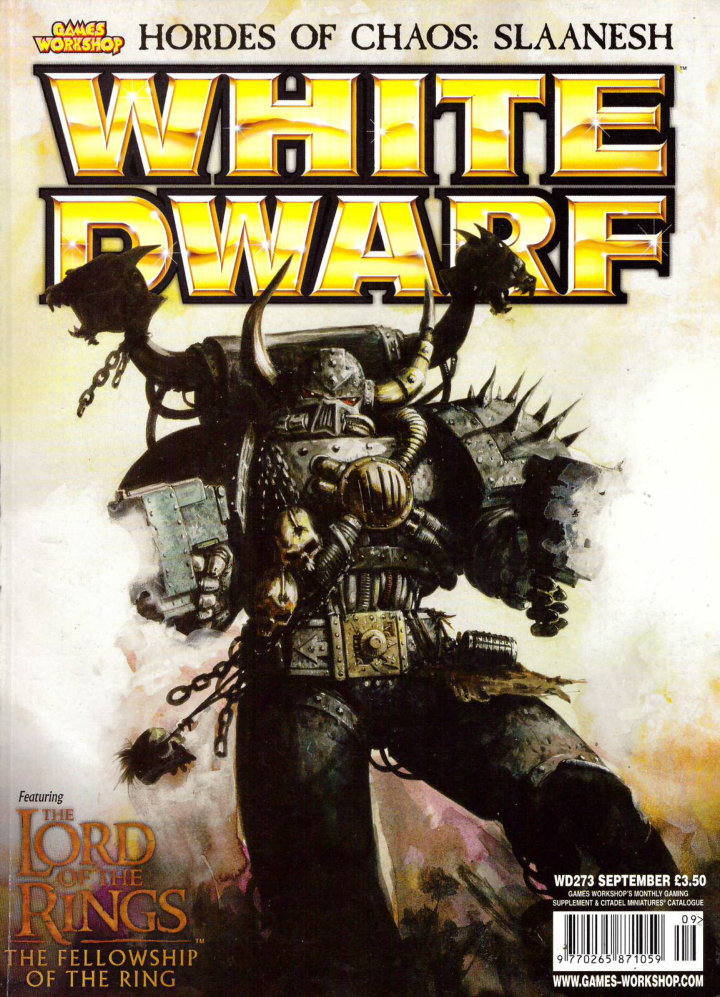
EditorialWD 273 · p. 1
A conversation with Alan Merrett prompts Paul Sawyer to distinguish the demands of competition display pieces from those of a coherent gaming army. He explains how a restricted palette, an effective theme and manageable techniques can produce satisfying armies without treating every model as a Golden Demon entry. The choice of finish ultimately belongs to the person collecting, painting and playing the army.
CommunityWD 273 · pp. 2–5
The news previews Tomb Kings and the revised Chaos Space Marines range, reports work on Lizardmen, and announces the reopening of the Warhammer World museum. A searchable White Dwarf article database, developed with Andrew and Ian Fawcett of Critical Hit, extends back to issue 100. Other items cover the next Gaunt’s Ghosts novel, online battle-report coverage and European tournaments.
Warhammer Fantasy BattlesWarhammer 40,000
ShowcaseWD 273 · pp. 6–8
The Monolith introduces a large plastic centrepiece for the Necron army, combining a transport portal, floating hull and multiple weapons. Tim Adcock’s design retains moving weapon mounts and a sliding portal door, while the accompanying battlefield photographs show how its height and mass distinguish it from the infantry it supports.
Warhammer 40,000Necrons
RulesWD 273 · p. 9
The vehicle entry explains the Monolith’s slow movement, unusually resistant living metal and arrival by deep strike. Its power matrix can either fire the particle whip or operate the portal, with arriving reserves taking priority over nearby troops. Teleporting an eligible Necron unit also gives failed repair rolls another chance, making the vehicle a means of preserving the army as well as delivering it.
Warhammer 40,000Necrons
ModellingWD 273 · pp. 10–15
Paul Rudge and Tim Adcock work from washed and dry-fitted components towards a square, securely joined hull. The guide explains the order of the central mechanism, upper spines and side panels, and identifies the weapon pivots and portal parts that should remain movable. Painting inaccessible areas early and fitting the clear green components with PVA after varnishing prevent avoidable damage. A final sequence demonstrates waterslide transfers.
Warhammer 40,000Necrons1 paint colour
TacticsWD 273 · pp. 18–19
Pete Haines considers how Destroyers and Heavy Destroyers compensate for the slow advance of a Warrior-based army. Their mobility creates firing angles and answers enemy units that would otherwise dictate the engagement, while the heavier weapon deals with targets ordinary gauss fire cannot reliably remove. Their placement must still account for repair support and the army’s phase-out threshold.
Warhammer 40,000Necrons
PaintingWD 273 · pp. 20–21
Paul Rudge and Jes Goodwin explain how assembly order, torso rotation and an altered arm position give Destroyers more purposeful poses. The painting sequence contrasts washed brass with dark green armour, building highlights before a unifying green ink glaze. Weapons remain separate while the surrounding surfaces are painted, and the transparent rods are fitted last.
Warhammer 40,000Necrons8 paint colours
LoreWD 273 · pp. 24–25
An Imperial scholar’s annotated translation describes the Eldar’s struggle against the Yngir and their first encounter with the power of the Nightbringer. Khaine’s bargain with Vaul produces a circle of armed defenders, but one imperfect blade breaks its protection. Khaine wounds the enemy after learning when to strike its physical form, yet the shattered god leaves a lasting contamination: death becomes a source of fear even for the formerly reincarnating Eldar.
Warhammer 40,000Aeldari
FictionWD 273 · pp. 26–27
An account of a Harlequin performance shows the Laughing God deceiving a star-devouring enemy into consuming its own kind. Triumph gives way to an uneasy ending: the defeated power contracts into a fragile orb that the dancers continue to guard. Cracks in its surface leave the audience with the prospect of an eventual return rather than a secure victory.
Warhammer 40,000Aeldari
LoreWD 273 · pp. 28–29
Inquisitor Horst questions a Tech-Priest about the Eldar’s account of Vaul’s war against the Dragon. Soul-driven iron warriors delay the Necron host while the smith god prepares six immense weapons powered by seers and the warp. The surviving story does not resolve the final attack, and the interview ends abruptly when the possibility of the Dragon’s hidden refuge becomes its most urgent implication.
Warhammer 40,000Aeldari
PaintingWD 273 · pp. 30–31
Darren Latham, Martin Footitt and Neil Green develop the Deceiver’s metallic skin from dark bronze through copper and gold to pale silver highlights. Coloured glazes enrich the surface, while the cloth is blended into the neighbouring gold to suggest flowing living metal. A fallen Necron, green crystals and restrained ground colours complete the scenic base.
Warhammer 40,000Necrons20 paint colours
ModellingWD 273 · pp. 32–33
Dave Andrews and Mark Jones build modular Necron tomb scenery that can also serve as a mission objective. Foamcard supplies the angular structure, while carved and chamfered polystyrene pieces become crystal growths. The painting instructions use a brushed black foundation to protect the foam, then edge the crystals in brighter greens and drybrush the ground.
Warhammer 40,000Necrons4 paint colours
LoreWD 273 · pp. 36–37
The introduction to Slaanesh connects the god’s many northern names with pleasure, ambition and the pursuit of sensation. Artists and aristocrats can be drawn into the cult as readily as warriors, while charismatic champions demand devotion from their followers. An opening vignette shows a sentry’s fascination with Daemonettes preventing him from warning his companions.
Warhammer Fantasy BattlesWarriors of Chaos
LoreWD 273 · pp. 38–40
Styrkaar grows up under the guidance of an unseen companion whose whispers turn youthful ambition into authority over his tribe. After mutilating his father in a public challenge, he embraces Shornaal and merges with the presence that has shaped him. Victories over rival champions bring a growing host and a daemonic mount, before Archaon offers a wider war in which Styrkaar hopes to earn immortality.
Warhammer Fantasy BattlesWarriors of Chaos
CommunityWD 273 · pp. 42–47
Paul Sawyer takes his developing Chaos army into its first games. Warhounds and Warriors win three small skirmishes against Empire, Undead and Dark Elf opponents, but larger battles expose the force’s lack of speed and coordinated deployment. His next purchases therefore shift towards Knights and a Chariot, even though mounted Marauders had been the original plan.
Warhammer Fantasy BattlesWarriors of Chaos
RulesWD 273 · p. 43
A smaller defending force must destroy a bridge before the attackers cross the river. The crossing has its own durability and limits on how many models can damage it; the ford offers an alternative at the risk of being swept away. Victory depends on the state of the bridge and the attackers’ surviving presence beyond the river, with optional consequences for a later battle.
Warhammer Fantasy Battles
RulesWD 273 · p. 44
Attackers equipped with ladders and a ram must overcome a smaller force on a fortified wall before reinforcements arrive. Defenders can use rocks and boiling oil, and the scenario refers to the main siege rules for the fighting itself. If neither side has been routed or destroyed, control of the wall decides the result.
Warhammer Fantasy Battles
Battle reportWD 273 · pp. 45–46
Paul Sawyer expands his Chaos force with borrowed cavalry, chariots and a mounted sorcerer for two battles against Magnus Forslund’s Empire army. Scattered deployment and failed charges let cannons and handguns remove the attackers in pieces. A rematch ends even more abruptly after fleeing Knights and destructive artillery fire, prompting Paul to reconsider both his deployment and his army’s mobility.
Warhammer Fantasy BattlesWarriors of Chaos
FictionWD 273 · pp. 48–50
Disowned after a forbidden cult is exposed, Gotthard flees north while imagining revenge against the society that rejected him. A guarded monument appears to anticipate his arrival, yet he continues to choose the path it offers. Mutation, a monumental stairway and a duel with an uncorrupted image of himself lead to a final transformation into the armoured champion he once believed he could refuse to become.
Warhammer Fantasy BattlesWarriors of Chaos
ShowcaseWD 273 · pp. 56–57
Matt Parkes presents a mounted warrior crossing a ruined bridge, a vividly clothed wizard, a Dwarf Thane and Lucrezzia Belladonna. Christian Blair’s Dark Elf pieces include an assassin stalking Empire guards through ruined masonry. Jakob Nielsen’s mounted High Elf Noble and Bretonnian Damsel complete a selection that emphasises character through pose, colour and scenic surroundings.
Warhammer Fantasy BattlesMordheimThe Empire
TacticsWD 273 · pp. 62–65
Mike Walker uses an encounter between Dwarfs and Dark Riders to explain four jobs for fast cavalry: decoying, deflecting, harassing and striking. He distinguishes a fleeing lure from an angled sacrifice that directs an overrun, and explains why those tricks change against different opponents. Small units with musicians can threaten vulnerable targets or support a larger combat, but must avoid spending their limited durability on a task they cannot accomplish.
Warhammer Fantasy BattlesDark Elves
CommunityWD 273 · pp. 68–69
Matt Ash describes the club’s return to an expanded Warhammer World after meetings continued in Bugman’s during refurbishment. Regular nights cater to different ages and styles of play, while campaign activity, tournaments and inter-club challenges give members projects beyond isolated games. Painting facilities and support for Specialist Games broaden the club’s role.
CommunityWD 273 · p. 69
Club members see forthcoming Chaos models with Tammy Haye, Juan Diaz and Seb Perbet, while Anthony Reynolds runs a demonstration game. John Holloway’s Bretonnians win the Swords of Chaos campaign encounter, and the club recognises Nathan Holland’s painted army and accompanying background.
Warhammer Fantasy Battles
ShowcaseWD 273 · pp. 70–71
A preview of the expanded Chaos Space Marines codex emphasises the distinct identities of the original Traitor Legions. Photographs of new and painted Chaos Lords illustrate the different appearances of the Black Legion, World Eaters, Death Guard, Thousand Sons and followers of Slaanesh.
Warhammer 40,000Chaos Space Marines
FictionWD 273 · p. 71
Rival Traitor forces assemble in the daemon city of Urthwart, setting aside their mutual hatred before Abaddon. The Iron Warriors’ absence is linked to their prize at Hydra Cordatus. The gathered host is offered a renewed assault on the Imperium, with the failure of Horus invoked as something the new campaign must overcome.
Warhammer 40,000Chaos Space Marines
RulesWD 273 · pp. 72–83
Andy Chambers presents a complete experimental assault sequence, explicitly dependent on agreement between players. Shooting constrains charges and can remove the charging bonus; engaged models and supporting fighters define a danger zone for attacks and casualties. Majority characteristics simplify mixed units, while revised pursuit, consolidation, pile-in and fallback rules change how combats continue. Separate guidance addresses characters, monsters, special weapons and models outside the immediate fighting.
Warhammer 40,000
TacticsWD 273 · pp. 84–85
Phil Kelly examines the trial assault rules through Eldar specialists. Protected Exarchs and a carefully managed danger zone improve the reliability of several Aspect units, while choosing Fleet of Foot instead of pistol fire can preserve an extra attack. He also considers Warlock powers, the Seer Council and how the Avatar and Wraithlord should approach enemies carrying power fists.
Warhammer 40,000Aeldari
TacticsWD 273 · p. 86
Pete Haines tests the implications for his Iron Warriors counterattack force. His lord needs enough reachable victims, his Dreadnought must avoid surviving power fists, and transported infantry must choose between shooting and the charge bonus. The revised casualty rules make a well-equipped Aspiring Champion a more dependable investment within an ordinary squad.
Warhammer 40,000Iron Warriors
TacticsWD 273 · pp. 86–87
Agis Neugebauer revises his Wych squad to favour close combat attacks over blaster fire under the trial rules. A larger Raider-borne unit with a Succubus and agoniser aims to defeat opponents decisively, while the wider army retains enough shooting to avoid depending on a single assault plan.
Warhammer 40,000Drukhari
TacticsWD 273 · pp. 87–88
Phil Kelly uses successive waves of Tyranids to exploit prolonged combats. Gaunts engage and obstruct enemy fire, leaping Hormagaunts bring more fighters into reach, and later monsters attack after dangerous enemy weapons have been contained. He distinguishes situations where Termagant shooting is worthwhile from units whose specialised combat attacks should be preserved.
Warhammer 40,000Tyranids
TacticsWD 273 · pp. 88–89
Paul Rudge compares how the trial rules affect his transported Space Wolves. Blood Claws benefit from foregoing inaccurate shooting, while Grey Hunters can use their guns without surrendering a bonus that True Grit already denies them. Protected power fists strengthen squad leaders, Storm Caller becomes more defensive, and support weapons gain opportunities against models outside a combat’s danger zone.
Warhammer 40,000Space Wolves
Battle reportWD 273 · pp. 94–109
Andy Chambers and Pete Haines test the new assault rules in a 1,500-point Cleanse battle between Orks and Black Templars. The early destruction of Pete’s Land Raider threatens his plan, but the Emperor’s Champion destroys the Battlewagon and helps hold the Orks in a narrow pass. Repeated assaults reduce both armies to fragments, and the surviving forces hold one quarter each for a draw. Commentary explains the revised charging, mixed-unit and pursuit rules as they arise.
Warhammer 40,000Orks
FictionWD 273 · p. 95
Chaplain Cotea watches the Emperor’s Champion prepare for the approaching Ork army. Akeris’s practised swordwork reassures the Chaplain, and his promise to kill the enemy leader makes the coming battle seem already decided.
Warhammer 40,000Black Templars
FictionWD 273 · p. 109
Cotea praises the Emperor’s Champion after the slaughter in the pass, but Akeris judges himself by the enemy leader who escaped. He accepts penance for failing his vow despite the extraordinary number of foes he has defeated.
Warhammer 40,000Black Templars
LoreWD 273 · pp. 112–113
Steve Hambrook introduces the fighting pits that supply Mordheim with escaped slaves and hardened mercenaries. Stylised armour imitates the Empire’s enemies, while heavily protected fighters and lightly equipped Pursuers perform different roles in the arena. The warband’s Pit King, veterans, Ogre and Dwarf Slayer are described alongside Mark Bedford’s models; the full game rules are referred to Town Cryer 21.
MordheimPit Fighters
CommunityWD 273 · p. 115
The reissued Blood Bowl set receives an updated handbook combining the main game, Death Zone league material and the 2002 rules changes. The accompanying publishing note explains Blood Bowl Magazine’s move to a smaller comic format with experimental rules, tactics and league coverage.
Blood Bowl
RulesWD 273 · pp. 118–121
Alessio Cavatore answers questions on Might, supporting spearmen, equipment, table edges and magical movement. Several answers explicitly replace earlier interpretations: compelled models may charge but cannot be made to risk direct harm, while powerful creatures resist being knocked down by smaller blasted models. The discussion also identifies problems with the Ring’s timing and repeated use that the forthcoming Two Towers rules will address.
Middle-earth Strategy Battle Game
ShowcaseWD 273 · pp. 122–123
Forge World’s circular Weathertop model recreates the ruined watchtower of Amon Sûl at the scale of the gaming figures. Simon Egan worked from the film-set plans to produce the large multipart terrain piece, shown with the Hobbits, Strider and Ringwraiths for the familiar confrontation.
Middle-earth Strategy Battle GameThe Fellowship
PaintingWD 273 · pp. 124–125
Tammy Haye balances Arwen’s dark blue dress and pale sleeves against Asfaloth’s white coat. Frodo receives a different cloak mixture and a yellowed facial glaze to distinguish the wounded passenger. Detailed instructions cover the horse’s mane, leather, silver ornament and gold fittings, followed by a sand base washed and drybrushed in natural tones. An accompanying foot model by Kirsten Mickleburgh uses the same face, dress, sword and basing methods.
Middle-earth Strategy Battle GameRivendell24 paint colours
RulesWD 273 · pp. 126–128
Alessio Cavatore turns Arwen’s escape with Frodo into a moving chase game. Terrain scrolls backwards and is recycled at the front of the table, while riders choose between speed, turning and reining in. Collisions and hurried one-to-one attacks threaten the fleeing pair, and a short decision limit keeps play moving. Arwen wins by reaching the ford or surviving all nine pursuers; shooting and magic are omitted.
Middle-earth Strategy Battle GameRivendell
Battle reportWD 273 · pp. 134–143
Matt Hutson and Rob Wood command the Last Alliance against Alessio Cavatore’s Sauron and Orcs. The allies clear away the Orcs but struggle to unite their heroes against the Dark Lord, who uses the rocks to restrict attacks and kills Elendil, Gil-Galad and much of the army. On turn twenty-one, Elrond finally inflicts the wounds that exhaust Sauron’s protection, leaving the battered alliance victorious. The players emphasise preserving heroes and their Might for the final confrontation.
Middle-earth Strategy Battle GameHigh Elves
Contents-listed articles and substantive named features are indexed. Commercial catalogues, advertisements, store directories and art-only pages are excluded. The image-only scan was researched using OCR and visual inspection.