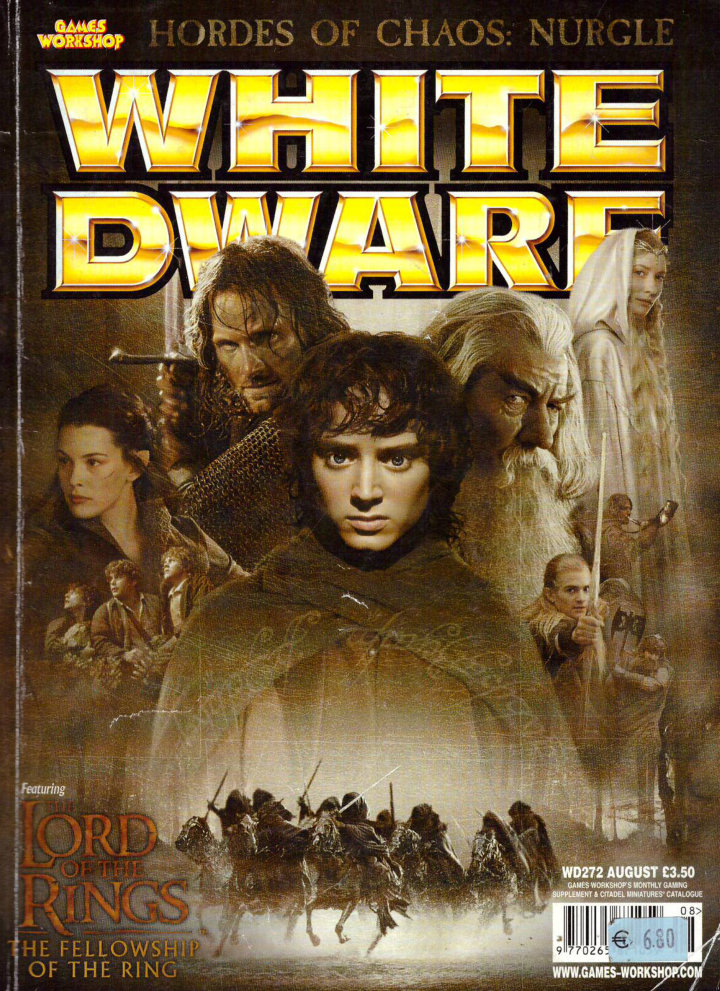
EditorialWD 272 · p. 1
Paul Sawyer surveys a summer of Chaos armies, Predator tanks and Sauron before previewing the next wave of releases. He describes the forthcoming Warhammer 40,000 assault rules as official but optional, anticipates The Two Towers and its larger battles, and points towards the Beasts of Chaos preview and Tomb Kings army book.
Warhammer Fantasy BattlesWarhammer 40,000
CommunityWD 272 · pp. 2–3
The news introduces dedicated Battle Bunker gaming rooms for older players and reports the arrival of Forge World’s Warhound Titan. Black Library previews include Liber Chaotica and forthcoming Dan Abnett fiction, while shorter notices cover an Inquisitor Eldar Ranger, the developing studio campaign and planned Games Day aerial combat.
Warhammer 40,000Warhammer Fantasy Battles
LoreWD 272 · pp. 10–11
Nurgle’s worship grows from despair during famine, disease and the apparent collapse of ordinary hopes. The account contrasts his horrific physical decay with the affection he shows his followers, whose acceptance of corruption frees them from pain and fear. An opening battlefield vignette demonstrates that resilience through a champion spreading infection among his enemies.
Warhammer Fantasy BattlesDaemons of Nurgle
PaintingWD 272 · p. 12
Anthony Reynolds paints small batches of Plaguebearers with a pale foundation, dark washes and rough highlights. Additional brown and red staining creates distinct wounds and patches of rot, while bright eyes and streaked weapons remain legible against the dirty skin. Gloss varnish and patches of glue slime complete the diseased effect.
Warhammer Fantasy BattlesDaemons of Nurgle11 paint colours
ShowcaseWD 272 · p. 13
Anthony Reynolds presents the developing character of his Chaos army through its converted champion and matching Plaguebearers. Two Dark Elf blades turn an axe into an oversized weapon, while a Necron Flayed One hand supplies a beckoning gesture. A restricted black-and-bone scheme and consistent bases connect the disparate models.
Warhammer Fantasy BattlesWarriors of Chaos
ShowcaseWD 272 · pp. 14–16
Space McQuirk and Tammy Haye explain the conversions and textures that distinguish the studio’s Nurgle host. Static grass and filler give armour a corroded surface; Zombie parts, extra eyes and sculpted wounds transform the Marauders. A three-bearer palanquin, a plague banner and marshy bases with glossy gas bubbles extend the same theme across characters and regiments.
Warhammer Fantasy BattlesWarriors of Chaos9 paint colours
LoreWD 272 · pp. 17–19
Feytor’s desperate prayers save his family from a plague only by leaving them visibly corrupted. Driven from their farm, they shelter in the mountains until soldiers burn their refuge while Feytor is hunting. His revenge and flight north lead him to a tribe that recognises Nurgle’s favour; he eventually takes command and spreads disease through neighbouring peoples before joining Archaon’s invasion.
Warhammer Fantasy BattlesWarriors of Chaos
PaintingWD 272 · pp. 20–21
Neil Green pins the large components before developing the Bloodthirster’s red skin through repeated highlights and coloured ink glazes. Dark bronze armour, brighter steel edges and pale horns separate its surfaces, while the wings and whip receive distinct red and leather treatments. The final sand base uses a dark wash and restrained drybrushing.
Warhammer Fantasy BattlesWarhammer 40,000Daemons of Khorne17 paint colours
PaintingWD 272 · pp. 22–23
Keith Robertson mixes enough green-brown base colour to keep the monster consistent while working on one area at a time. Increasingly pale highlights distinguish swollen flesh and pustules; differently coloured glazes stain recesses and exposed details. The guide also covers maggots, skulls, tongue, corroded sword and a simple textured base.
Warhammer Fantasy BattlesWarhammer 40,000Daemons of Nurgle16 paint colours
ModellingWD 272 · pp. 24–29
Matt Parkes develops a Chaos attack on an Empire drawbridge from a small storyboard and mock-up into a carefully measured display. He removes figures that do not advance the action, uses the canal to divide wild ground from ordered fortifications, and pins moving horses securely. Construction and painting notes explain the plasticard framework, textured ground, tinted resin water and the hurried defenders raising the bridge.
Warhammer Fantasy BattlesWarriors of Chaos7 paint colours
CommunityWD 272 · pp. 30–31
Paul Sawyer adjusts his Chaos collecting project to fit the time he can actually spend painting. Unspent money and the next month’s allowance fund Warhounds, while completed Warriors establish a practical target for the rest of the army. Small games remain the intended reward, although the first month has produced painted models rather than battles.
Warhammer Fantasy BattlesWarriors of Chaos
PaintingWD 272 · pp. 31–33
Paul Sawyer explains the black armour, warm gold trim and red cloaks of his first Chaos Warriors. Separate assembly makes the details accessible, but careless positioning creates ranking problems. Mutations distinguish Vradchuk, while thin highlights, painted wood grain and carefully placed gem reflections provide detail without abandoning an army-painting approach.
Warhammer Fantasy BattlesWarriors of Chaos21 paint colours
PaintingWD 272 · p. 33
Paul Sawyer uses fine technical pens to restore crisp dark boundaries after painting his Warriors. Two nib widths help reach different recesses, and mistakes can be repainted once the ink has dried. The method offers a controlled way to sharpen small details without repeatedly using a brush.
Warhammer Fantasy BattlesWarriors of Chaos
PaintingWD 272 · p. 33
A painted base rim and glued sand provide the foundation for Paul Sawyer’s army bases. A flesh-coloured wash darkens the sand before successive drybrushes, and small patches of static grass finish the surface without covering the texture.
Warhammer Fantasy BattlesWarriors of Chaos4 paint colours
Battle reportWD 272 · pp. 38–39
Graham McNeill reports the fight between Graham Davey’s Black Legion and Craig Bodycote’s Blood Angels for the statue in Angel Square. Both armies lose elite assault troops in the close fighting, and the Blood Angels bring down the Bloodthirster. An extra final round lets the surviving Chaos Lord and Juggernaut finish the defenders and topple the monument.
Warhammer 40,000Black Legion
RulesWD 272 · p. 39
The square’s history links its monument to a former Blood Angels victory. A non-Imperial occupier can destroy the statue, gaining the location while temporarily lowering the leadership of Imperial armies across the campaign.
Warhammer 40,000Blood Angels
RulesWD 272 · p. 40
A custom Hierodule variant adds a large Synapse creature to the palace defence. Its rules combine massive durability, restricted movement, a bio-acid spore-mine launcher and a brood of transported Hormagaunts. The accompanying note distinguishes this scenario creation from the published Forge World Hierodule.
Warhammer 40,000Tyranids
Battle reportWD 272 · pp. 40–41
Paul Sawyer’s White Scars attack the palace held by Phil Kelly’s Tyranids, hoping to turn a narrow campaign lead into a decisive advantage. A specially devised giant creature survives heavy fire before a power fist kills it, while Hormagaunts and bio-acid bombardment punish the attackers elsewhere. The Tyranids retain the palace and deny Paul its large victory-point reward.
Warhammer 40,000White Scars
ShowcaseWD 272 · p. 41
Owen Rees’s Imperial Guard and Alex Boyd’s Orks continue fighting over the palace grounds after the main campaign has ended. The open park lets the players return to ordinary Warhammer 40,000 terrain and tactics after their prolonged battles through Vogen’s streets.
Warhammer 40,000Astra Militarum
RulesWD 272 · p. 41
The palace is a heavily fortified objective that may only be attacked by a player with an established campaign position. Grand Assault and Fire Sweep determine the available battles; losing the palace in a Grand Assault also costs nearby territories. Background notes explain the fortress’s maze-like construction and the rebellion that overwhelmed its defenders.
Warhammer 40,000
RulesWD 272 · p. 41
Each half of the palace grounds forms a separate campaign territory. Games use open-country terrain and ordinary Warhammer 40,000 rules, and players cannot fortify either half. The location provides a deliberate change from the dense urban fighting elsewhere in Vogen.
Warhammer 40,000
Battle reportWD 272 · p. 42
A four-way Carnage battle offers the remaining contenders a chance to seize the palace. Shifting priorities leave the Orks and Chaos forces entangled while the Eldar take heavy casualties. A wounded Carnifex survives incoming fire and the final Possessed attacks, preserving the Tyranid hold on the objective; Graham Davey and Pete Haines therefore share the campaign victory.
Warhammer 40,000Black Legion
CampaignWD 272 · p. 43
Pete Haines concludes Murchad Kite’s campaign diary with repeated Ork resistance, fighting around the palace and a late attack on the Cadian headquarters. His retrospective credits the spaceport and fortified positions but admits that he pursued the wrong palace strategy. The diary also assesses the campaign’s veteran rules and the continuity they gave surviving units.
Warhammer 40,000Iron Warriors
RulesWD 272 · pp. 46–48
Official answers supersede earlier rulings on redirected charges, irresistible magic, magical equipment and multi-wound attacks. Further explanations address mounted characters joining units, ranks and targeting, abandoned war machines and a series of Steam Tank interactions. Brief army-specific answers cover Skaven leadership, Screamers and Bretonnian panic.
Warhammer Fantasy BattlesThe Empire
RulesWD 272 · pp. 48–49
Replacement passages amend the Skaven Storm Banner, magic affecting the Steam Tank, High Elf Swordmaster honours and Teclis’s War Crown. Core-rule corrections clarify combat results, character selection, mounted shooting, artillery targeting and destruction, grapeshot and spell casting. The pages are arranged as cut-out amendments for the relevant books.
Warhammer Fantasy BattlesSkaven
TacticsWD 272 · pp. 52–55
Pete Haines chooses armoured support around the infantry’s intended role. Assault armies need protected transports and mobile cover, while defensive armies benefit from firing positions, reserves and weapons that punish concentrated attackers. He compares Rhino, Razorback, Land Raider, Predator, Vindicator and Whirlwind configurations, then argues for a balanced force able to change plans when an opponent proves stronger in one area.
Warhammer 40,000Space Marines
TacticsWD 272 · p. 54
Andy Hoare distributes anti-tank weapons through his Iron Warriors so one casualty or disabled unit cannot remove the army’s answer to armour. Chainfists, combi-meltas and squad weapons provide overlapping options; specialised Havocs or Raptors become worthwhile when the opposing force contains enough tanks to justify their cost.
Warhammer 40,000Iron Warriors
RulesWD 272 · pp. 58–61
Steve Hambrook supplies a trial Dark Elf army with infantry, cavalry, Harpies, Hydras and character mounts. Repeater crossbows trade accuracy for close-range volume, Witch Elves pursue combat relentlessly, and monsters bring terror and concentrated striking power. The army selector and special rules establish the force’s limits while inviting further playtesting.
WarmasterDark Elves
RulesWD 272 · p. 59
The spell list combines direct damage with interference in enemy movement. Doombolt can strike several units along a line, Beast Master disrupts mounted troops and monsters, Dominion pins an enemy in place, and Soul Stealer lets an accompanying Sorceress contribute armour-piercing attacks in combat.
WarmasterDark Elves
EditorialWD 272 · p. 60
Steve Hambrook explains the difficulty of differentiating Dark Elves within Warmaster’s compact rules. The team rejects additional choices that would simply improve on the High Elf list, experiments with crossbow ranges and Cold One attacks, and settles on less dependable leadership, distinctive magic and selected monsters to express the army’s character.
WarmasterDark Elves
CommunityWD 272 · pp. 62–63
Wayne Rozier describes organising a Farnborough tournament in which every player receives four randomly generated army lists. Advertising, advance testing and carefully prepared paperwork allow the unusual format to run smoothly. Winner Erwin Jackson and best general Christian Burnett recount the unfamiliar forces and tactical surprises that made the event enjoyable.
Warmaster
RulesWD 272 · pp. 64–66
Pete Haines and Andy Hoare preview the forthcoming Chaos codex’s revised Daemon mechanics. Icons determine where summoned units appear, instability replaces ordinary morale, and a secretly designated Aspiring Champion can invite or resist possession by a Greater Daemon. A shared vocabulary of gifts and abilities supports the accompanying unit entries; the introduction stresses that the preview is not yet official.
Warhammer 40,000Chaos Space Marines
RulesWD 272 · p. 67
The four Greater Daemons receive distinct profiles and gifts within a common framework of possession, monstrous attacks and invulnerable protection. Their presence also acts as an icon for lesser Daemons. Psychic powers distinguish the three sorcerous patrons, while the Bloodthirster combines martial strength with protective brass armour.
Warhammer 40,000Daemons of Chaos
RulesWD 272 · p. 68
The lesser Daemon entries differentiate Bloodletters, Plaguebearers, Horrors and Daemonettes through their patron’s combat or shooting abilities. Horrors may become Flamers, while Nurglings form vulnerable but elusive swarms. Nurgling numbers depend on the army’s Nurgle followers, and their unreliability prevents them claiming objectives.
Warhammer 40,000Daemons of Chaos
RulesWD 272 · p. 69
Flesh Hounds, Screamers and Furies provide fast summoned units with different battlefield behaviour. Flesh Hounds move as cavalry and must seek combat, Screamers strike and break away, and the unaligned Furies supply flying attackers. All three use the preview’s shared summoning, protection and instability rules.
Warhammer 40,000Daemons of Chaos
RulesWD 272 · p. 70
Pete Haines and Phil Kelly extend the vehicle-design system to Tau technology, limiting transport passengers, speed and close-combat capability. Weapon costs and targeting upgrades accompany rules for landing gear, escape pods and airborne Drone racks. Landing gear is also explicitly added to existing Hammerhead and Devilfish vehicles.
Warhammer 40,000T’au Empire
ModellingWD 272 · p. 71
Stephane Langlois creates a heavier Tau gunship by narrowing the hull and building a new twin-railgun turret from plasticard and putty. Repositioned engines, tubular connectors and missile pods preserve the army’s smooth technological appearance. An accompanying vehicle-design profile gives the conversion a tabletop role.
Warhammer 40,000T’au Empire
LoreWD 272 · pp. 76–79
Space McQuirk continues the invasion of Ulthuan as Malus Darkblade and Malekith outmanoeuvre the defenders and breach the Dragon Gate. Their attempt to capture Alarielle almost succeeds when Eltharion’s desire for revenge delays her escape. Tyrion’s arrival saves the Everqueen, and Eltharion wounds Malekith; the defeated invaders withdraw while Eltharion proposes taking the war to Naggaroth.
Warhammer Fantasy BattlesHigh Elves
FictionWD 272 · p. 79
Eltharion intercepts Malekith’s attack on the Everqueen and studies the Witch King’s defences while enduring his taunts. Tyrion’s arrival gives him the clarity to exploit a weakness in the armour. The wound proves his enemy can be hurt, but renewed hatred costs him the chance to finish the duel before Malekith escapes.
Warhammer Fantasy BattlesHigh Elves
FictionWD 272 · pp. 82–83
An extract from Graham McNeill’s novel follows an ancient crescent-shaped vessel harvesting a star’s energy and transferring it into a planetary pyramid. A heterogeneous alien fleet interrupts the process, overwhelming the ship despite catastrophic losses. Its attempted escape draws both sides into oblivion, leaving the abandoned pyramid to disappear beneath the desert.
Warhammer 40,000Necrons
PaintingWD 272 · p. 84
Mark Jones develops the Nightbringer’s skin and scythe through carefully placed purple and blue-grey blends. Pale lines and dots create the strange reflective finish, with warmer recesses adding contrast. The guide also covers pinning the model, staining the metallic Scarabs and painting the textured base.
Warhammer 40,000Necrons16 paint colours
FictionWD 272 · p. 86
Captain Marcellus prepares his Deathwatch teams to teleport into action as a Guard column enters the Necron ambush. He understands that the soldiers are being sacrificed to expose the enemy’s hidden route home. The opening fiction establishes the grim purpose behind the linked tabletop battles.
Warhammer 40,000Deathwatch
Battle reportWD 272 · pp. 86–101
Andy Chambers referees two linked battles inspired by Necron fiction. Graham McNeill’s Necrons destroy Andy Hoare’s Guard column, but the diversion lets Pete Haines’s Deathwatch enter the tomb defended by Phil Kelly. The kill teams fight through Scarabs and Tomb Spyders, destroy the power node and escape without gathering the requested observations. The combined objectives produce a draw despite the surface massacre.
Warhammer 40,000Necrons
RulesWD 272 · p. 87
The desert battle brings Necrons onto the table in successive waves while the Deathwatch tags a casualty and follows it into a separate tomb encounter. Damaged Necrons appear underground as the surface battle proceeds, linking the available defenders to events on the other table. Repair procedures, a destructible power node and a withdrawal deadline give the raid its own objectives.
Warhammer 40,000Necrons
ModellingWD 272 · pp. 106–107
Paul Rudge uses the spear-armed Cave Troll to explain cleaning castings, preparing a stable base and strengthening joints with wire pins. Paint marks transfer the correct drilling positions between components. Additional examples show how to improve the fit of large hollow castings and blend filled seams into surrounding fur or scales.
Middle-earth Strategy Battle GameMoria
ModellingWD 272 · pp. 110–113
The American studio builds a table around the Fellowship’s escape across the Silverlode. Its plan combines fixed river scenery with movable tree bases, allowing the board to serve other scenarios. A removable forest canopy keeps the dense woodland appearance while giving players access to models beneath it.
Middle-earth Strategy Battle GameLothlórien7 paint colours
ModellingWD 272 · p. 111
Reposed plastic Goblins become the numbered counters for Haldir’s concealed archers. Brass-wire arrows and tiny plasticard flights identify each casualty by the number of arrows, and painted feather lines make the small details readable. Matching grass matting ties the counters to the board.
Middle-earth Strategy Battle GameMoria3 paint colours
ModellingWD 272 · p. 111
A carved channel, stones and sand establish the riverbed and its crossing points. Grey drybrushing defines the submerged texture, then blue-tinted resin builds the water in layers; the final pour supplies ripples. The fixed river controls movement through the scenario.
Middle-earth Strategy Battle Game4 paint colours
ModellingWD 272 · p. 112
Five detachable tree tops form the forest canopy. Putty-covered brass tubes provide hollow lower trunks, while dowels allow the upper sections to slot into place; wire armatures support the branches and foliage. The resulting woodland can be opened in sections during play.
Middle-earth Strategy Battle Game
Battle reportWD 272 · pp. 114–119
John Shaffer’s Fellowship attempts to escape Dave Taylor’s Moria force, which substitutes two Cave Trolls for many of the usual Goblins. Legolas and Boromir fall, and Gimli holds off a surrounding mob for six turns. Timely Heroic Moves and Haldir’s archers keep the Hobbits ahead of the pursuit until they and Aragorn reach safety, securing a narrow Good victory.
Middle-earth Strategy Battle GameThe Fellowship
Contents-listed articles and substantive named features are indexed. Commercial catalogues, advertisements, store directories and art-only pages are excluded. The image-only scan was researched using OCR and visual inspection.