EditorialWD 271 · p. 1
Paul Sawyer invites readers to contribute tested scenarios, practical tactics and accounts of their painting or modelling. His submission guidance asks for a synopsis, sample writing, relevant photographs and an introduction to the contributor’s own hobby experience. He stresses familiarity with the setting, clear spelling and realistic page lengths, while distinguishing the material wanted from unsolicited army lists, fiction and special characters.
CommunityWD 271 · pp. 2–3
The news previews new Chaos Space Marine miniatures, Forge World’s Warhound Titan and a delayed, expanded Insignium Astartes. Other reports cover a Gaming Club Network web battle, a forthcoming Warmaster Hydra, the Inquisitor caption-competition winners and events in the studio Warhammer campaign.
Warhammer 40,000Warhammer Fantasy Battles
RulesWD 271 · pp. 10–17
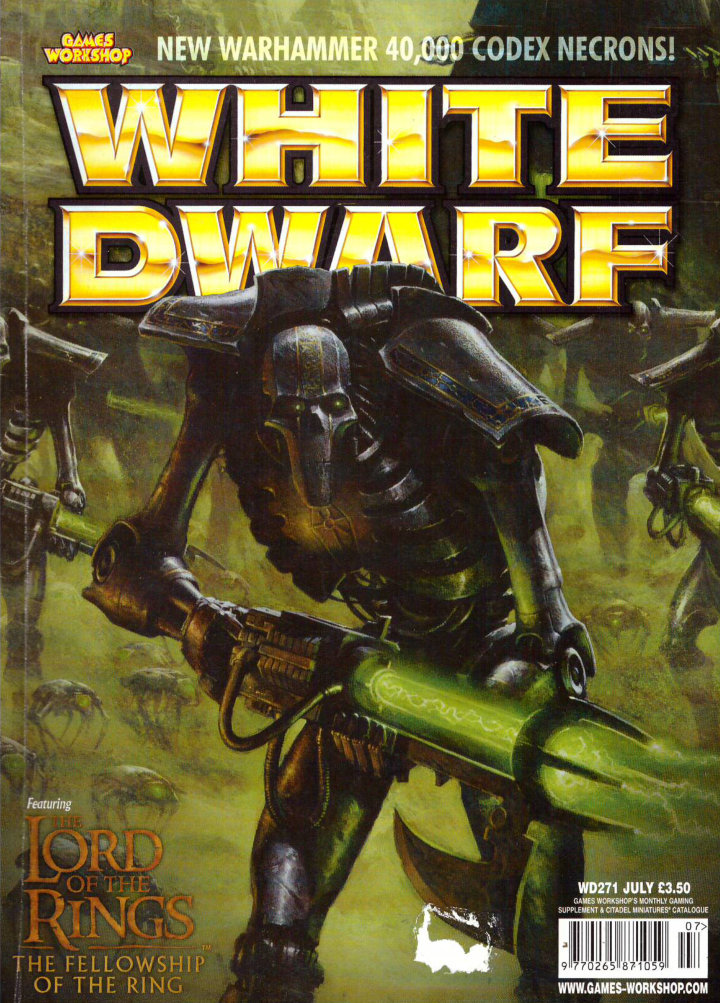
The design team explains how a small raiding force became a complete Necron army. Andy Chambers connects earlier hints about the C’tan with the death-mask imagery developed alongside Jes Goodwin. Pete Haines describes the complementary battlefield roles of Warriors, Scarabs, assault specialists, Pariahs and the Monolith. Graham McNeill links the Codex’s horror and hidden clues to Nightbringer, while Andy Hoare and Phil Kelly discuss the wider history and fear effects.
Warhammer 40,000Necrons
PaintingWD 271 · p. 18
Paul Rudge uses two metallic drybrush stages over black to produce a quickly painted Warrior. Black gun furniture and a bright green power cable separate the weapon from the body. The transparent rod is fitted with PVA only after painting and varnishing, and a grey drybrushed sand base gives the army a consistent finish.
Warhammer 40,000Necrons5 paint colours
PaintingWD 271 · p. 19
Darren Latham demonstrates twelve alternative Warrior schemes, showing how a restricted palette can unify Necrons without a conventional uniform. The examples include pale bone and white finishes, coloured armour, gold and brass, and steel altered by blue inks. Each miniature is accompanied by its principal colours.
Warhammer 40,000Necrons21 paint colours
LoreWD 271 · pp. 20–23
Phil Kelly presents an Imperial assessment of a threat that remains difficult to study because damaged Necrons repair themselves or vanish. The report surveys their skeletal bodies, tomb worlds, military hierarchy and the destruction of Sanctuary 101. Their gauss weapons, phase blades and manipulation of matter exceed Imperial understanding, while their apparently selective raids leave their ultimate purpose uncertain.
Warhammer 40,000Necrons
LoreWD 271 · p. 21
Inquisitor Lord Luthus Griadne argues that scattered raids have concealed the awakening of an entire civilisation. He warns that Imperial attention has been diverted by other wars, while the Mechanicus obstructs destruction of tomb worlds and cannot explain the enemy’s technology. His petition calls for an immediate increase in the Necrons’ threat classification.
Warhammer 40,000Necrons
LoreWD 271 · p. 23
A survivor describes Necrons slaughtering his settlement but carrying away a feared young girl. The account undermines the assumption that their only goal is extermination. Imperial investigators suspect psychic potential, yet a recent Black Ship visit detected none, leaving the abduction unexplained.
Warhammer 40,000Necrons
RulesWD 271 · p. 23
A compact Warrior entry provides squad size, gauss flayer armament and disruption-field options. It also explains the gauss weapon’s ability to glance otherwise impenetrable vehicles and the basic self-repair roll that returns damaged Necrons to the battle.
Warhammer 40,000Necrons
LoreWD 271 · pp. 28–29
Khorne’s followers worship through battle and value strength, courage and direct killing. The account describes his skull throne, Flesh Hounds, hostility to sorcery and the symbols adopted by his champions. Their need to shed blood and prove superiority makes rivalry within a warband as dangerous as the enemies beyond it.
Warhammer Fantasy BattlesChaos
PaintingWD 271 · p. 30
Neil Green paints the foot champion in red armour shaded with magenta, with similarly warm skin separating the bare arms from the metal. Brass and steel receive different highlights before shared dark washes. Pale skulls and horns, black leather and a shaded wooden axe handle complete the figure.
Warhammer Fantasy BattlesWarriors of Chaos19 paint colours
PaintingWD 271 · p. 31
Neil Green keeps the rider, horse head and shield separate while painting. Grey highlights define the black horse, while red barding and bright gold distinguish the armoured rider. Coloured inks weather the sword; layered browns treat skulls, horns and cloak; sand and stones finish the base.
Warhammer Fantasy BattlesWarriors of Chaos22 paint colours
ShowcaseWD 271 · pp. 32–33
Space McQuirk examines the studio Khorne army’s red-and-brass scheme and its repeated banner icon. Different wash and highlight treatments distinguish Daemonic flesh from mortal armour. The force’s characters use combinations of older Bloodletter, Orc, Archaon, Marauder and Berzerker components, with a pale helmet making Haargroth stand out.
Warhammer Fantasy BattlesWarriors of Chaos9 paint colours
LoreWD 271 · pp. 34–37
An abused orphan finds a blood-drinking axe and turns its power against the tribe that despised him. Successive victories bring followers, physical transformation and ever wider raids, until his demand for a worthy opponent is answered by Archaon. Defeated, Haargroth joins the Everchosen’s host while secretly anticipating another challenge once he has grown stronger.
Warhammer Fantasy BattlesWarriors of Chaos
PaintingWD 271 · pp. 38–39
Matt Hutson paints Bloodletters and Flesh Hounds together, working from recessed areas outwards. Red flesh gains depth from black shading and a final red glaze, while warm brown fur and horn striations create texture. Metallic axes receive bright lines and blood-coloured washes, and dark grey sand bases unify the Daemonic units.
Warhammer Fantasy BattlesWarhammer 40,000Daemons of Chaos15 paint colours
FictionWD 271 · pp. 42–44
Be’lakor guides Archaon to the First Shrine of Chaos, hoping the final trials will destroy him. Archaon resists disease, mutation, doubt and seduction before drawing on the bound Daemon U’zuhl to defeat a Bloodthirster. Forced to crown the victor, Be’lakor watches the united host acclaim its new leader; a twin-tailed comet introduces an ominous counterpoint to the triumph.
Warhammer Fantasy BattlesWarriors of Chaos
PaintingWD 271 · pp. 46–47
Keith Robertson paints Archaon and his mount in separate assemblies, contrasting the steed’s grey-black skin with red-edged armour and a gold crown. Rust breaks up the chainmail, while fur, bone and leather receive distinct textures. The sword combines coloured ink glazes on its metallic exterior with a fiery interior, and cool green stone spikes frame the finished model.
Warhammer Fantasy BattlesWarriors of Chaos26 paint colours
CommunityWD 271 · pp. 48–49
Gav Thorpe and Paul Sawyer begin an army-collecting series built around playing while a force is still growing. Sawyer chooses an Undivided mortal host so that later additions can include different gods’ Daemons and Archaon. His first purchases are halberd-armed Warriors, flail-equipped Marauders and a flexible champion, limited to what he can realistically paint in lunch breaks.
Warhammer Fantasy BattlesWarriors of Chaos
CommunityWD 271 · pp. 50–51
Space McQuirk visits a club whose collaborative Games Day project grew into a ruined cathedral and industrial hive display. Members build transportable sections from foam, balsa, plaster cake pillars, pipe and a dismantled radiator. Late contributions of Grey Knights, the Devout twins and a Nurgle Marine supply the combatants. The project strengthens the club and leaves reusable scenery for later games.
InquisitorWarhammer 40,000
LoreWD 271 · pp. 54–57
Andy Hoare traces the Predator from a colonial answer to Ork attacks to a sacred component of Space Marine warfare. The account explains its relationship to the Rhino, the Space Wolves’ improvised Annihilator and the Mechanicus’s slow acceptance of that variant. Construction rituals, armoury organisation and battlefield roles show how Chapters maintain the tanks, while Tallarn illustrates their importance in a war where the surface itself is lethal.
Warhammer 40,000Space Marines
LoreWD 271 · p. 56
A template recovered during the Great Crusade gives the Blood Angels a Predator suited to close assaults. Its assault cannons and optional heavy flamers provide mobile support against infantry in cover, matching the Chapter’s aggressive doctrine.
Warhammer 40,000Blood Angels
LoreWD 271 · p. 57
Tilvius’s search for lost technology yields the data behind the Razorback, but his fellow disciples of Arkhan Land pursue a more elusive discovery. Hidden compatibility within existing vehicle templates suggests an armoured design between Predator and Land Raider. Their attempt to prove that this missing vehicle exists becomes an obsession regarded sceptically by other Tech-Priests.
Warhammer 40,000Adeptus Mechanicus
PaintingWD 271 · pp. 60–61
Paul Rudge assembles a Predator while preserving rotating weapons and unobstructed turret movement. Grey armour receives rusty recesses, chipped edges and dusty lower panels. Layered diagonal reflections and gloss create glass, while a small red lens and painted parchment add detail. Masked joints and separately painted tracks help the finished model remain functional.
Warhammer 40,000Space Wolves14 paint colours
CommunityWD 271 · pp. 64–67
Jervis Johnson reports on the tournament celebrating Blood Bowl’s return to the permanent range. Teams reset between matches but gain a chosen skill, preserving an element of league development within a short event. Simon Merton’s Lizardmen win overall and Anthony Watts’s Norse take the painting award. Geoff Porritt accepts the published result despite discovering that a scoring-form mistake cost him victory, reinforcing his sportsmanship award.
Blood Bowl
RulesWD 271 · pp. 70–72
Phil Kelly turns Savlar’s criminal recruits into an experimental Imperial Guard force motivated by plunder and fear of returning home. Its army selection and special rules represent unrestricted scavenging, altered respirators, unreliable archeotech and unusually durable mounts. The regiment consolidates rather than pursuing in combat, while its inhalers change the consequences of morale failures. The list is explicitly recommended optional and requires an opponent’s agreement.
Warhammer 40,000Astra Militarum
FictionWD 271 · p. 72
Rojo’s squad attacks a rebel bunker through toxic waste, distracted even under fire by opportunities to steal from its own dead. Grenades and a flamer breach the position, after which Rojo uses a captured helmet to send a false all-clear message. The victors promptly strip the bodies while continuing to rob one another.
Warhammer 40,000Astra Militarum
ModellingWD 271 · p. 72
Phil Kelly builds a Chem-Rider around a Gorkamorka Mutie steed. Attilan legs, a Tallarn body and lance, a Chaos Terminator head and a Necromunda backpack give the rider a scavenged appearance. Green stuff joins the mount and finishes the mixed components.
Warhammer 40,000Astra Militarum
ModellingWD 271 · p. 72
Dave Taylor combines tank crews and Orlock gangers with respirator-like Chaos Terminator heads and bulky Necromunda packs. Sculpted ragged cloaks and rounded helmets disguise the joins, while fuse-wire hoses connect masks to backpacks. Different head angles help individualise repeated base models.
Warhammer 40,000Astra Militarum
RulesWD 271 · pp. 73–75
The experimental Elysian list exchanges tanks and prolonged firefights for mass aerial deployment, elite infantry and rapid withdrawal. Modified Guard and Catachan entries provide command, assault and reconnaissance units, with Storm Troopers available in several roles. Special rules govern a first-turn landing wave, accurate reserves, mission selection and ending a battle early; new support choices supply special weapons and preliminary air strikes.
Warhammer 40,000Astra Militarum
ModellingWD 271 · p. 75
Dave Taylor converts Space Marine Scouts into armoured drop troopers with tank-crew heads, sculpted pressure helmets and quilted sleeves. Scout Biker shotguns reinforce their close-range role. A dark blue drybrush, grey clothing and pale triangular camouflage finish the force inspired by John Wigley’s illustrations.
Warhammer 40,000Astra Militarum6 paint colours
RulesWD 271 · pp. 76–77
Cut-out errata update the Black Templars army selection and mixed-armour wording, the Salamanders Bike Squadron and weapon options, and Armageddon Sentinel armaments. Other changes clarify Speed Freek vehicle upgrades and heavy support choices, plus the Land Raider Crusader’s status and transport capacity. The replacements extend the policy of supplying reprint corrections to owners of the original book.
Warhammer 40,000Black Templars
CampaignWD 271 · pp. 82–86
Graham McNeill and Phil Kelly explain how the studio converted the Cityfight setting into a low-administration map campaign. Players expand from assigned starting locations, fight over contested districts and compete for strategic sites worth different victory points. Fortification turns and allied substitutes accommodate busy players, while unknown defenders keep unexplored areas unpredictable. The printed rules cover movement, elimination, alliances, experience and resolving several contested locations through one battle.
Warhammer 40,000
RulesWD 271 · p. 84
The spaceport’s history explains its destruction and recapture during the rebellion. In the campaign it grants strategic mobility rather than victory points: its owner can establish footholds in unnamed districts and bring reserved units into suitable battles by Deep Strike.
Warhammer 40,000Astra Militarum
RulesWD 271 · p. 85
Two linked location types turn Vogen’s central approaches into hazardous objectives. Claimed gun towers bring automated heavy weapons and always use the High Ground mission. The two halves of Sniper’s Alley use The Gauntlet, with an Imperial Vindicare Assassin available in the northern section.
Warhammer 40,000Inquisition
RulesWD 271 · p. 86
A former execution ground becomes a fortified artillery position overlooking the city. Capturing its laser silos provides preliminary bombardments in subsequent games and permits the removal of enemy fortifications during the campaign, making it valuable beyond its own victory-point award.
Warhammer 40,000
CampaignWD 271 · p. 87
Pete Haines records the opening campaign moves in the voice of Iron Warrior Murchad Kite. He chooses a strategy of constriction, feinting towards the palace while securing the spaceport and Gibbet Hill. Battles against Crimson Fists and Orks turn those positions into a fortified base from which he can bombard the city and deploy elsewhere.
Warhammer 40,000Iron Warriors
FictionWD 271 · p. 90
Volkmar senses the corruption spreading south ahead of Archaon’s invasion. Knowing that his crusading army cannot destroy the entire host, he challenges its leader while their forces are relatively equal. He accepts that his own death may be the price of even a small chance to avert the coming catastrophe.
Warhammer Fantasy BattlesThe Empire
Battle reportWD 271 · pp. 90–107
Gav Thorpe’s Chaos host meets Alessio Cavatore’s Empire crusade in a 3,000-point battle centred on Archaon and Volkmar. Imperial shooting cripples the Chaos Warriors and the Free Company defeats the Marauders, but Archaon kills the Grand Theogonist and terror disrupts the firing line. Screamers eliminate the artillery, while the surviving Chaos characters combine to break the Spearmen. A final doomed charge by the Knights of the Blazing Sun completes the Chaos victory.
Warhammer Fantasy BattlesWarriors of Chaos
FictionWD 271 · p. 107
After mastering the Daemon within his sword, Archaon reflects on Volkmar’s death as proof of divine favour. The victory dispels the doubt raised by the twin-tailed comet at his coronation and strengthens his expectation that the southern lands will soon praise the Chaos gods and their chosen champion.
Warhammer Fantasy BattlesWarriors of Chaos
RulesWD 271 · p. 110
Alessio Cavatore lowers Elrond’s Fight value to bring him into line with other leading heroes, making the amendment effective before its incorporation into The Two Towers manual. Short corrections also add Boromir’s shield and optional Elven cloak, and confirm swords among Arwen’s and Isildur’s equipment.
Middle-earth Strategy Battle GameRivendell
RulesWD 271 · pp. 112–113
Alessio Cavatore supplies Sauron’s profile, equipment and magical powers alongside a brief account of his rise and defeat. His presence prevents either army from breaking, his mace can strike every opponent in a fight, and the One Ring repeatedly preserves his final wound. The spell list combines control, loss of courage and will, and direct injury.
Middle-earth Strategy Battle GameMordor
RulesWD 271 · pp. 114–115
The Last Alliance prepares to finish the surviving Orcs on the slopes of Mount Doom when Sauron enters the battle. A turn-based arrival roll determines when the Dark Lord appears, and the encounter continues until he falls or the Good player concedes. Listed historical forces and a points-match alternative support different collections.
Middle-earth Strategy Battle GameMordor
PaintingWD 271 · p. 116
Seb Perbet builds Sauron’s armour from dark copper and steel, using several coloured glazes between bright edge highlights. Subdued cloth and chainmail keep the focus on the layered armour. The mace receives a related metallic treatment, while the One Ring’s tiny runes are picked out and glazed to create a concentrated bright accent.
Middle-earth Strategy Battle GameMordor17 paint colours
PaintingWD 271 · p. 117
Seb Perbet paints the two kings with shared red robes, polished steel and defined gold decoration. Layered flesh and individually coloured hair distinguish their faces, while black cloaks and pale linings frame the armour. Washed sand, grey-brown drybrushing and static grass complete their bases.
Middle-earth Strategy Battle GameGondor21 paint colours
RulesWD 271 · pp. 118–119
Gwaihir must cross a battlefield covered by Orc archers, collect an exhausted Gandalf from Orthanc and escape through his starting corner. Saruman becomes active only after the rescue begins, while Gandalf retains limited resources for resisting spells. Fixed forces and an alternative Evil selection accompany the deployment map and victory conditions.
Middle-earth Strategy Battle GameThe Fellowship
RulesWD 271 · p. 119
The clarification identifies the rider as the usual target of magical powers and explains how a heroic mount can contribute resources to resistance. Sorcerous Blast is treated separately, affecting both rider and mount and potentially throwing the rider. Further answers cover Gwaihir carrying a passenger, falling damage, Fate and unobstructed shooting at a flying Eagle.
Middle-earth Strategy Battle Game
RulesWD 271 · pp. 124–127
Alessio Cavatore turns Gandalf’s confrontation with Saruman into a self-contained hex-board game. Players secretly choose attacks that push or crush and defences that counter those effects. Priority determines movement and which spell resolves first, while the palantír gives limited knowledge of an opponent’s choices. Walls and the central stand turn forced movement into damage; the printed spell chart and board complete the game.
Middle-earth Strategy Battle GameThe Fellowship
Contents-listed articles and substantive named features are indexed. Commercial catalogues, advertisements, store directories and art-only pages are excluded. The image-only scan was researched using OCR and visual inspection.