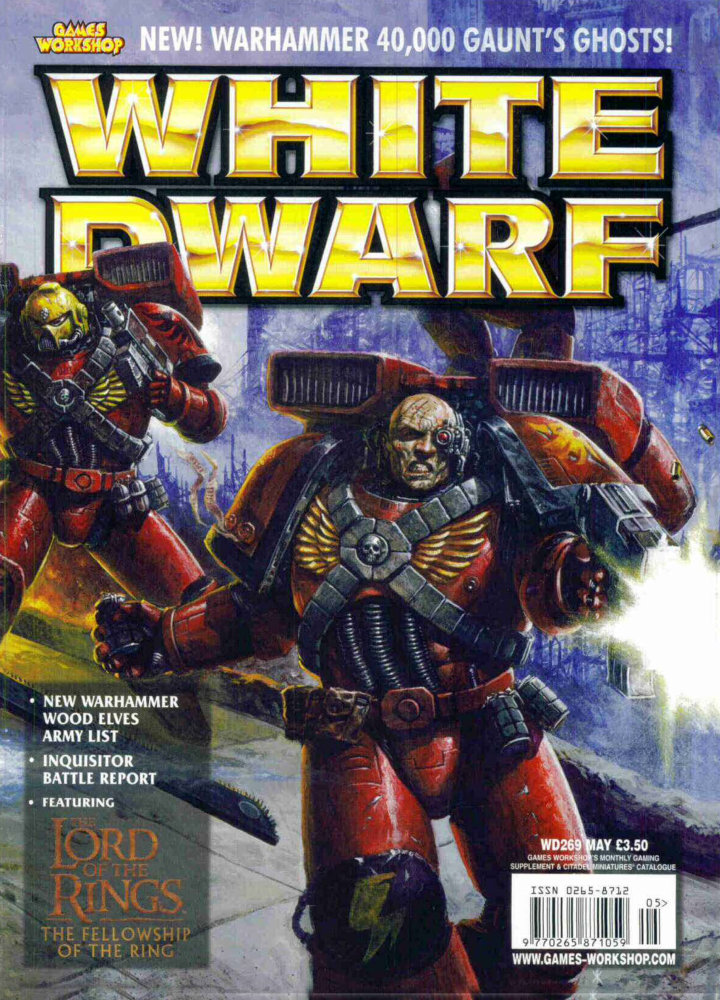
EditorialWD 269 · p. 1
Paul Sawyer considers the traffic between Black Library fiction and the tabletop as Gaunt’s Ghosts receive dedicated models and rules. The new release accompanies The Guns of Tanith, but his comparison with Gotrek and Felix places it in a longer tradition of adapting established fictional characters for games.
Warhammer 40,000
CommunityWD 269 · pp. 6–7
The news announces an official Dark Eldar update, forthcoming novels and online support for the Chaos and Necron releases. It also introduces Dark Eldar ships for Battlefleet Gothic and Forge World Rhino doors. A separate announcement opens UK Grand Tournaments to Games Workshop employees on the same purchasing and competition terms as other entrants, with additional independent judges planned.
Warhammer 40,000Battlefleet Gothic
LoreWD 269 · pp. 10–13
Graham McNeill traces the Rhino from a colonial exploration vehicle to the Imperium’s ubiquitous armoured transport. The loss of Standard Template Construct knowledge transforms practical engineering into closely guarded ritual, restricting access to trusted Imperial organisations. Accounts of the recovery of wrecked vehicles, the Salamanders’ ancient Nocturne’s Hammer and the rites surrounding construction show why even a simple transport becomes a sacred relic.
Warhammer 40,000Space Marines
LoreWD 269 · p. 12
Sister Martika survives an Ork ambush on a convoy evacuating Saint Emiline’s remains. She infiltrates the raiders’ camp, uses grenade traps to create confusion and escapes with the relics in their captured Rhino. A punishing pursuit through the forest ends under the protecting guns of Caprium, after which the repaired vehicle becomes her personal transport.
Warhammer 40,000Adepta Sororitas
RulesWD 269 · p. 13
The transport entry specifies the Rhino’s weapons, upgrades, passenger access and roof firing position. Its repair rule allows the driver to attempt to overcome immobilisation instead of firing. The accompanying notes distinguish the protection enjoyed by power-armoured passengers from an Ork looted Rhino, whose firing hatch makes it open-topped.
Warhammer 40,000Space Marines
ShowcaseWD 269 · pp. 16–19
Matt Hutson describes the growth of the Quaran Crusade from a shooting-oriented starter force into a close-combat army shaped by playtesting and the Armageddon campaign. Replacing weapons on existing squads and Dreadnoughts lets him adapt the collection as the Chapter’s rules develop. Halos, litanies, reversed veteran helmet colours and a growing motor pool give the force a consistent crusading identity.
Warhammer 40,000Black Templars
PaintingWD 269 · p. 19
A compact recipe leaves most of the armour black with sharp grey highlights, reserving painting time for handwritten litanies and other details. Separate white undercoating for shoulder pads and veteran helmets simplifies the contrasting areas before assembly. The accompanying palette records the red and metallic colours used elsewhere in the army.
Warhammer 40,000Black Templars5 paint colours
PaintingWD 269 · pp. 20–21
Matt Hutson paints the passenger compartment before enclosing it, placing highlights to suggest light entering through the rear ramp. The exterior uses crisp grey edges, ink-shaded metallic fittings and hand-painted Chapter crosses. Removable hatches preserve future options, while small exposed-metal chips and a restrained brown drybrush make the finished transport look used.
Warhammer 40,000Black Templars7 paint colours
PaintingWD 269 · p. 21
The Rhino’s parchment inscription is built from a warm brown base, a flesh-coloured wash and pale highlights. A typeface displayed on a computer supplies a lettering reference, copied onto the miniature with a fine detail brush.
Warhammer 40,000Black Templars4 paint colours
LoreWD 269 · pp. 24–25
Anthony Reynolds profiles Throt the Unclean, whose prolonged warpstone exposure brings extraordinary strength and regeneration at the cost of ceaseless hunger. His experiments at Hell Pit, uneasy dealings with Clan Pestilens and survival of repeated assassination attempts explain his standing in Clan Moulder. A surge in warpstone’s potency and Grimgor Ironhide’s approach provoke new creations that ultimately spill south into the Empire.
Warhammer Fantasy BattlesSkaven
FictionWD 269 · pp. 26–27
A servant delivers a Rat Ogre to Throt’s laboratory and watches the Master Mutator’s casual cruelty towards animals and slaves. The beast’s refusal to enter its cell is solved by offering it a living meal. When Throt decides that his latest experiment also needs a better brain, the servant discovers that he has supplied more than the requested Rat Ogre.
Warhammer Fantasy BattlesSkaven
PaintingWD 269 · p. 28
Throt’s mismatched robes combine brown, dark green and patchwork shading, with warm skin separating him from the surrounding cloth and fur. Brown and green washes age the metal and whip, while the contrasting natural and warpstone eyes provide small bright accents. The guide includes assembly and a sand-and-foliage base.
Warhammer Fantasy BattlesSkaven18 paint colours
PaintingWD 269 · p. 29
The Warlock Engineer receives rich red robes, grey-brown fur and separately treated steel and gold fittings. Thin coloured inks alter the metallic surfaces and stain the bandages and tail flag, while progressively brighter reds give the lenses a glowing appearance. The wooden staff and exposed cable are painted to remain distinct from the ornate weapon.
Warhammer Fantasy BattlesSkaven19 paint colours
PaintingWD 269 · p. 29
The Warlock Engineer’s warpstone uses a dark green foundation with brighter highlights and small luminous patches. Gloss varnish adds a glassy finish to distinguish it from the surrounding cloth, fur and metal.
Warhammer Fantasy BattlesSkaven3 paint colours
TacticsWD 269 · pp. 32–37
Phil Kelly describes building a Skaven army in manageable stages, starting with flexible Clanrat regiments and inexpensive characters before adding weapon teams, specialists and a general. He explains how plastic kits can furnish several unit types, how swarms secure vulnerable flanks and why a battle standard matters to unreliable troops. The later choices explore Greater Clan themes, the contrasting roles of Plague Monks and Rat Ogres, and the trade-off between a Grey Seer’s magic and a Warlord’s leadership.
Warhammer Fantasy BattlesSkaven
ModellingWD 269 · p. 34
Phil Kelly breaks up large blocks of Clanrats with small scenes arranged on shared regiment bases. Skeleton arrows suggest incoming fire, Zombie parts create damaged limbs, and a threatened tail provides a comic interaction between neighbours. These groups express Skaven disorder while making a long infantry-painting project more varied.
Warhammer Fantasy BattlesSkaven
FictionWD 269 · pp. 40–43
In this extract from Dan Abnett’s novel, the Ghosts advance into Cirenholm after unexpectedly fierce Blood Pact resistance. Rawne’s platoon wins a sharp fight in a neglected park, leaving him wounded and the enemy’s equipment exposed. Daur identifies a void-shield generator, and reports from other squads reveal a coordinated trap across the dome’s exits. Gaunt halts to assess what the defenders intend while a spearhead remains dangerously far ahead.
Warhammer 40,000Imperial Guard
RulesWD 269 · pp. 44–47
Phil Kelly adapts the Tanith First and Only as light infantry that can accompany a conventional Imperial Guard army or form its core. Camo-cloaks, infiltration and an exceptional sense of direction distinguish the regiment, while separate entries cover master snipers, hardened veterans and infantry platoons. Taking Gaunt’s command unit unlocks these choices, and the rules require both Codex Imperial Guard and Codex Catachans.
Warhammer 40,000Imperial Guard
RulesWD 269 · pp. 48–51
The five characters in Gaunt’s command platoon each contribute a distinct ability. Gaunt drives nearby troops into assaults and lends his leadership; Corbec assumes command if he falls; Dorden provides unusually effective medical aid while avoiding unnecessary shooting. Milo’s pipes and precognition support morale and protection, and Larkin can pick out individual targets with his customised long-las. Short novel extracts connect the profiles to their fictional counterparts.
Warhammer 40,000Imperial Guard
FictionWD 269 · pp. 54–55
A preview of the coming Chaos release accompanies a story of Seigr’s Baersonling warband ambushing a Dwarf gold caravan. The raiders endure the winter conditions that their victims expected to provide protection. Their leader’s duel with Kharrig Strongback ends when a concealed mutation gives the champion of Slaanesh a lethal advantage. The facing image previews the incoming Chaos army.
Warhammer Fantasy BattlesWarriors of Chaos
FictionWD 269 · pp. 56–59
Space McQuirk describes the siege of Stravtrosgrad, where Boyar Streltski orders a desperate mounted sortie against the Dolgans. War wagons and Winged Lancers initially break the camp before a Tzeentch sorcerer reverses their fortunes. The arrival of the Gryphon Legion and fighting bears briefly restores hope, but the transformed warlord Gurkhan rises from the frozen lake, kills Streltski and drives the defenders into a final rout.
Warhammer Fantasy BattlesKislev
CommunityWD 269 · pp. 66–67
The Store Club programme describes after-hours gaming and hobby sessions for older participants, with members encouraged to organise campaigns, demonstrations and specialist-game leagues. Practical suggestions emphasise welcoming newcomers and sharing modelling or painting skills. Mick Clark’s Maidstone example shows a group spanning novices, veterans and parents, with a regular Blood Bowl league alongside its main games.
Warhammer Fantasy BattlesWarhammer 40,000
ShowcaseWD 269 · pp. 68–69
Bobby Wong’s US Golden Demon 2001 Slayer Sword diorama brings the Bloodquest comic’s exiled Blood Angels together on a shared scenic base. Close views and unpainted models reveal Leonatos’s extensive plastic conversion, Cloten’s scratch-built axe, Proteus’s altered head, Tranio’s commanding pose and Palemon’s covering fire. The captions explain how each conversion echoes the character’s role in the comic.
Warhammer 40,000Blood Angels
CommunityWD 269 · pp. 70–71
A guide to the 2002 Golden Demon event explains entry booking, category tables, repair facilities and the successive judging stages. An arena plan and timetable help entrants find the competition, while the worked entry form and receipt instructions explain how to recover models afterwards. The article also describes trophy presentations, the winners’ studio visit and the final Slayer Sword announcement.
CommunityWD 269 · pp. 72–73
The recurring range introduction explains the decision to retain seven specialist games, with dedicated magazines, annual updates and new miniatures supporting them. This month’s additional news highlights Blood Bowl’s return, new teams and models, and the planned revival of Blood Bowl Magazine. The accompanying questions describe how annuals gather rules and errata for established players.
InquisitorWarmaster
Battle reportWD 269 · pp. 74–79
Jervis Johnson’s Imperial fleet intercepts Andy Hall’s Necron harvesters in a deliberately unequal scenario without matched points values. The Imperials initially isolate and damage enemy ships, but the Tombship’s inertialess drive turns the manoeuvre into a trap. Necron fire cripples the Imperial capital ships and forces their withdrawal, leaving the harvest unhindered. The post-game discussion credits the Imperials for damaging two superior enemy ships and escaping without losing a capital vessel, illustrating how narrative objectives can matter beyond a simple win.
Battlefleet GothicImperial Navy
RulesWD 269 · pp. 82–89
Alessio Cavatore’s work-in-progress list replaces the Ravening Hordes version and invites feedback before the eventual army book. Woodland movement, accurate archery, Tree-Singing and defensive deployment advantages give the army its identity, balanced by additional victory points for opponents penetrating its territory. The complete list covers characters and mounts, archers and cavalry, Wardancer dances, Dryad aspects, Treemen and ambushing Waywatchers, with a selection of magic items.
Warhammer Fantasy BattlesWood Elves
PaintingWD 269 · p. 90
Neil Green combines red skin and orange-edged armour plates with pale talons and jaws. Flesh mixed into red supplies the skin highlights, while magenta ink restores depth; brown and black washes shade the long claws. Dark grey exposed tissue keeps the ribbed gaps separate from the brighter carapace, and the assembly notes describe pinning and filling the arm joints.
Warhammer 40,000Tyranids11 paint colours
PaintingWD 269 · p. 91
Martin Footitt takes the carapace’s yellow and red markings from beetle photographs, setting the patterns against a near-black body. Layered highlights and coloured glazes intensify the markings, while pale barnacles and exposed bone distinguish the damaged areas. The article also treats the hooves, claws and sinew and explains pinning the heavy limbs before painting.
Warhammer 40,000Tyranids14 paint colours
CommunityWD 269 · pp. 92–93
Che Webster and Space McQuirk visit the four-person group behind Tim Eagling’s Games Day 2001 Best Club Contribution award. Their river campaign combines Warhammer skirmishing with crewed vessels treated as mobile scenery, secret referee briefings and an ongoing newspaper narrative. Tim and Matt Owens-Smith build ships and terrain from everyday materials while Heidi Eagling and Jenny Owens-Smith paint them, demonstrating how shared skills sustain an ambitious home campaign.
Warhammer Fantasy BattlesMordheimThe Empire
Battle reportWD 269 · pp. 94–109
Four warbands converge on Paganus Reach as Pharaa’gueotla attempts to possess the psyker known as the Healer. Kaludram’s cultists delay Tyrus, while Lichtenstein and Kessel cooperate against the Daemon; a remotely controlled ammunition truck triggers spectacular destruction. Kessel destroys the manifested creature with his force staff, but Tyrus renews the feud between the Inquisitors. Lichtenstein escapes the final gunfight, leaving Kessel and the injured Chaos Magus in the Witch Hunter’s custody and setting up further campaign adventures.
InquisitorInquisition
RulesWD 269 · pp. 96–97
The scenario gives four rival leaders distinct objectives around a Daemon’s transfer into a new host. Kaludram must protect the transformation, Lichtenstein wants the creature to manifest before destroying it, Kessel intends to prevent manifestation, and Tyrus seeks Lichtenstein’s capture. Their incompatible aims turn a shared battlefield threat into an uncertain negotiation between would-be allies.
InquisitorInquisition
TacticsWD 269 · p. 108
Graham McNeill reflects on running a fifteen-character finale without losing momentum. Urgency, rapid decisions and destructible scenery encourage cinematic action, while the truck sequence tests his vehicle rules. He explains how the game’s aftermath naturally creates new scenarios, from a prisoner rescue to the consequences of an inquisitorial trial.
InquisitorInquisition
TacticsWD 269 · pp. 114–117
Alessio Cavatore explains the tactical consequences of alternating within each phase rather than taking complete player turns. He recommends planning for a possible double move, selecting vulnerable shooting targets and concentrating attackers to trap enemies. Spears, two-handed weapons and shielding have different supporting roles, while Courage and the limited reserves of Might and Will make preserving and timing heroes crucial. Examples show why priority can be a disadvantage before the forces close.
Middle-earth Strategy Battle GameThe Fellowship
PaintingWD 269 · pp. 118–119
Martin Footitt uses subdued green and brown mixtures to separate the panels of Legolas’s tunic, with cool greys on the shirt and trousers. Warm blond hair, individually treated leather straps and quiver, and small gold highlights preserve detail within the restrained scheme. The guide also covers the bow, arrows and the shared sand-and-static-grass basing method.
Middle-earth Strategy Battle GameThe Fellowship20 paint colours
PaintingWD 269 · p. 119
Neil Green gives Gimli a red-brown coat, shaded leather and a warm beard, separating these surfaces from the steel mail and copper detail on his axe. Repeated ink washes deepen the recesses, and a criss-cross highlight suggests the gauntlet’s texture. The backpack introduces a small blue cloth accent, while the shared base recipe uses washed sand and static grass.
Middle-earth Strategy Battle GameThe Fellowship20 paint colours
PaintingWD 269 · p. 119
The alternative Legolas and Gimli models from the Amon Hen set receive matching cloaks. A black foundation is progressively lightened with bone, producing a muted grey-brown finish that suits both characters without introducing another strong colour.
Middle-earth Strategy Battle GameThe Fellowship2 paint colours
RulesWD 269 · p. 122
This alternative encounter has the four Hobbits caught in Bree before meeting Aragorn. Ringwraiths approach from the corners of a densely built table while Frodo tries to reach the Prancing Pony. The scenario includes an equal-points adaptation that retains a Ring-bearing hero and at least one Ringwraith as the essential opposing elements.
Middle-earth Strategy Battle GameThe Fellowship
RulesWD 269 · p. 123
Mounted Boromir must escape an Orc ambush on his journey to Rivendell. Numbered counters conceal the attackers in the mist until the Evil player reveals them or the hero moves close enough to expose their positions. The alternative force-selection method gives the ambushers a points advantage, and a new horse option allows Boromir’s mounted model to be used.
Middle-earth Strategy Battle GameGondor
Contents-listed articles and substantive named features are indexed. Commercial catalogues, advertisements, store directories and art-only pages are excluded. The image-only scan was researched using OCR and visual inspection.