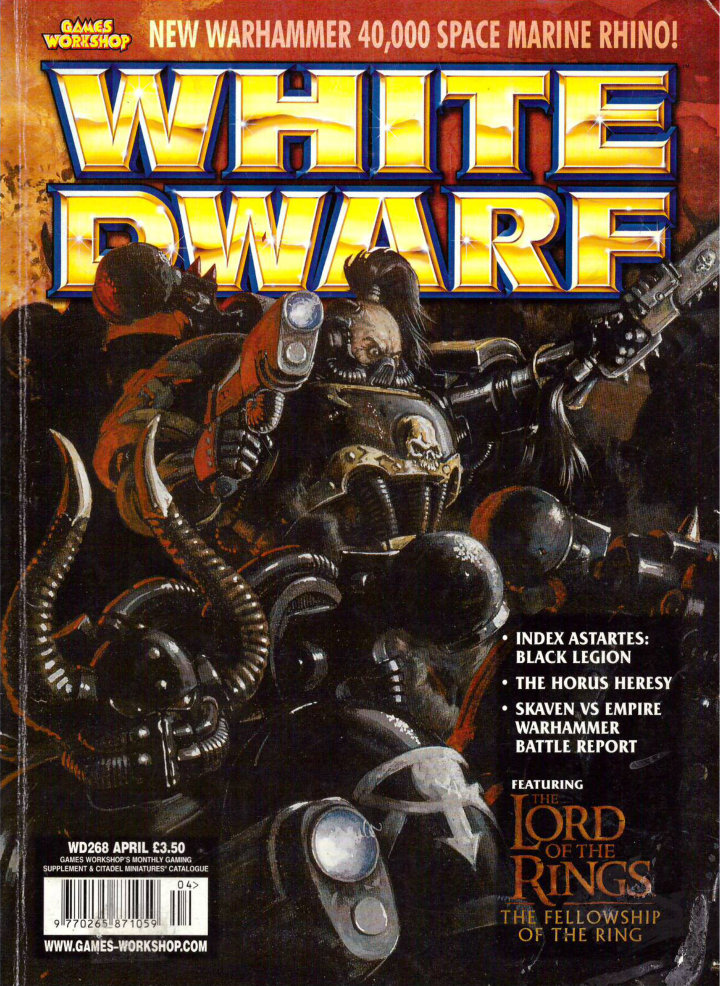
EditorialWD 268 · p. 1
Paul Sawyer welcomes the redesigned Rhino, explaining how its opening rear door, detailed interior and shared Land Raider components expand its conversion possibilities. He also introduces the issue’s Horus Heresy and Chaos coverage, alongside the Skaven Last Stand battle and the Fellowship’s attempt to escape Amon Hen.
Warhammer 40,000Warhammer Fantasy Battles
CommunityWD 268 · pp. 6–7
The news previews the redesigned Necron range and new Chaos Marauders, announces a Wood Elf trial list and highlights forthcoming Gaunt’s Ghosts and Deff Skwadron comics. Forge World’s large Harridan and tiny Epic Tau demonstrate opposite ends of the miniature range, while studio notes point towards Khemri, Daemonhunters and the Chaos Warband campaign.
Warhammer 40,000Warhammer Fantasy Battles
ShowcaseWD 268 · pp. 10–11
The new Rhino is displayed in Dark Angels, Blood Angels, Space Wolves and Black Templars colours. Close views show the opening hatches, painted troop compartment and control panels, while battlefield photographs demonstrate how chapter markings and weathering change the character of the same plastic transport.
Warhammer 40,000Space Marines
InterviewWD 268 · pp. 12–14
Space McQuirk talks to Tim Adcock about rebuilding the Rhino around Jes Goodwin’s sketches and the visual language of the newer Land Raider. Cardboard and plasticard mock-ups develop into enlarged masters and plastic tooling, with ease of assembly, a usable interior and future Predator and Razorback variants considered together. Familiar exhausts and the sloped front retain the old vehicle’s identity while shared details reinforce its Standard Template Construct origins.
Warhammer 40,000Space Marines
FictionWD 268 · p. 15
An Ultramarines transport column comes under missile fire while carrying Devastators towards a captured building. Techmarine Harkus evacuates his passengers before a lodged missile explodes, then discovers that the damaged Rhino can still run. Trusting the machine to finish its task, he collects the squad under covering fire and delivers the heavy weapons needed to hold the objective.
Warhammer 40,000Ultramarines
FictionWD 268 · pp. 18–21
Space McQuirk follows a Skaven Assassin and his Gutter Runners as they infiltrate Middenheim through a concealed barrel. Their slaughter of a tavern’s occupants and a guardroom clears the route to engineer Freidrich Holst, whose experiments have unlocked a new use for warpstone. Holst’s insistence that his discoveries exist only in his memory proves no protection against Clan Skryre’s methods of extracting knowledge.
Warhammer Fantasy BattlesSkaven
ShowcaseWD 268 · p. 22
The plastic Night Runners kit supplies varied heads, weapons and bodies for a full unit of Clan Eshin skirmishers. Photographs of the sprues and assembled regiment illustrate the running and crouching poses that distinguish these lightly equipped raiders from ranked Clanrats.
Warhammer Fantasy BattlesSkaven
PaintingWD 268 · p. 23
Phil Kelly builds a quick Night Runner scheme around a black undercoat and drybrushed brown fur, leaving much of the clothing dark to suit Clan Eshin. Restrained grey edging separates the garments, pale highlights define teeth and tails, and ink washes tone down metalwork. A small amount of dark red staining adds wear without making the weapons the focal point.
Warhammer Fantasy BattlesSkaven9 paint colours
TacticsWD 268 · p. 23
Phil Kelly presents two jobs for Night Runners: a mobile screen protecting more valuable units, or an equipped raiding force working around the enemy’s flanks. Slings let a large unit maintain a stream of short-range shots, while extra hand weapons suit carefully timed rear or flank charges. Splitting a box into two units lets an army use both approaches.
Warhammer Fantasy BattlesSkaven
PaintingWD 268 · p. 26
Tammy Haye’s Thanquol combines subdued grey robes with warm skin and aged copper details. The guide explains layered highlights for cloth and flesh, drybrushed wood on the staff, and repeated ink glazes that unify the metals and horns. Small bright edges on the sword and staff preserve definition within the otherwise muted scheme.
Warhammer Fantasy BattlesSkaven17 paint colours
PaintingWD 268 · p. 27
Boneripper is dry-fitted and pinned through the torso before painting, giving the large model a secure foundation. Brown skin is raised through leather and bone tones before a mixed ink glaze, while pale exposed muscle, dark wrappings and stained metal give the creature its stitched-together appearance. The tutorial finishes with sand, drybrushing and static grass on the base.
Warhammer Fantasy BattlesSkaven18 paint colours
PaintingWD 268 · p. 27
A short shared recipe gives Thanquol’s and Boneripper’s warpstone a luminous green appearance through a dark base and increasingly bright patches. A gloss finish over Boneripper’s bulb distinguishes its glass surface from the surrounding machinery.
Warhammer Fantasy BattlesSkaven3 paint colours
LoreWD 268 · pp. 28–34
William King recounts the siege of the Emperor’s Palace, from the orbital bombardment and treachery at the spaceports to the collapse of the outer defences. The White Scars’ recapture of Lions Gate interrupts the invaders’ supply, while Sanguinius and the Blood Angels hold the palace long enough for Horus to fear approaching reinforcements. Horus lowers his ship’s shields for a final confrontation, ending in his death and the Emperor’s confinement to the Golden Throne. Photographs of the Games Day 1998 siege display accompany this version of the Heresy’s climax.
Warhammer 40,000Imperium
ShowcaseWD 268 · p. 36
A new Iron Warriors squad and Warsmith are shown with metallic armour, black panels and prominent yellow hazard stripes. The squad includes an Aspiring Champion and specialist weapons, while the accompanying siege scene places the models behind fortified lines opposite a Space Marine assault.
Warhammer 40,000Iron Warriors
LoreWD 268 · p. 37
An Inquisitorial report reconstructs Ferrous Ironclaw’s destruction of Auxesia from surviving orbital observations. The Iron Warriors isolate the fortress city of Damia with successive trench lines, overwhelm its shields through prolonged bombardment and breach it with armour, tunnellers and teleporting Terminators. The archive is destroyed despite being left untouched during the assault, suggesting that the invaders’ aim was devastation rather than plunder.
Warhammer 40,000Iron Warriors
LoreWD 268 · pp. 38–41
Graham McNeill traces Abaddon from Horus’s favoured captain to the leader of the Black Crusades, examining his devotion to the Warmaster, acquisition of the Talon and Drach’nyen, and continuing obsession with the Imperium. The Gothic War receives particular attention: the Planet Killer and corrupted Blackstone Fortresses threaten entire systems before an Imperial and Eldar alliance forces his withdrawal. A Forge World portrait model provides a large-scale visual counterpart to the history.
Warhammer 40,000Battlefleet GothicBlack Legion
RulesWD 268 · p. 42
Abaddon’s character entry combines the Talon of Horus, the daemon sword Drach’nyen and unusually protective Terminator armour. The rules distinguish his normal claw attacks from the sword’s single killing strike and explain how the Talon affects nearby Imperial morale, with Blood Angels reacting differently. Army-size restrictions, opponent agreement and the option for a retinue establish the conditions for using him.
Warhammer 40,000Black Legion
RulesWD 268 · p. 43
Abaddon can command a sufficiently large Chaos fleet, bringing strong leadership, regular re-rolls and a flagship with formidable boarding capabilities. His authority carries a dangerous qualification: a ship that fails again after benefiting from his re-roll may be fired on by his flagship, while failure aboard his own vessel costs damage as his followers punish the crew.
Battlefleet GothicChaos fleets
CommunityWD 268 · pp. 46–47
Che Webster and Space McQuirk explain how the Gaming Club Network connects local groups, helps players find regular opponents and supports the exchange of modelling and gaming experience. Advice for starting a club reduces the essentials to people, a meeting place and an activity, with a toolkit intended to help organisers plan the practical details. The article also describes online resources and ways for existing clubs to join.
LoreWD 268 · p. 48
Kevin J. Coleman introduces the diversity hidden beneath the broad labels Orc and Goblin, presenting Goblinoid ecology as a field that Imperial scholars often dismiss but soldiers can find useful. Gav Thorpe frames the accompanying troop variants as unofficial rules for readers to try, while Anthony Reynolds supplies converted examples.
Warhammer Fantasy BattlesOrcs & Goblins
RulesWD 268 · p. 49
Fire Kobolds inhabit volcanic regions and carry distinctive orange-red patches over green skin. Their unofficial troop entry adds short-ranged fire spitting and resistance to fire attacks to a Goblin-style regiment. Anthony Reynolds demonstrates the appearance on an otherwise unconverted plastic Goblin by building bright patches over a dark red base.
Warhammer Fantasy BattlesOrcs & Goblins2 paint colours
RulesWD 268 · p. 50
These sea-dwelling Goblins raid coastal lands and move freely through water, using loose formations and poisoned missiles. Their unofficial rare-unit rules turn waterways into useful cover rather than an obstacle. The accompanying conversion replaces a plastic Goblin’s boots with bare feet and shortens a spear into a javelin, using turquoise skin to establish the aquatic theme.
Warhammer Fantasy BattlesOrcs & Goblins1 paint colour
RulesWD 268 · p. 50
Hill Goblins are larger and stronger than their cousins, inhabiting the grasslands and hills near the Badlands. Their unofficial unit entry offers heavier melee options but makes their bullying a source of extra animosity when other Goblins are present without Orcs to restrain them. A plastic Goblin body, Orc helmet and filed-down shield provide the suggested conversion.
Warhammer Fantasy BattlesOrcs & Goblins1 paint colour
RulesWD 268 · p. 51
Goblins slain in Khemri sometimes return as undead creatures retaining traces of their old malice. Their unofficial rules combine fear and immunity to psychology with unusual exceptions that let them march and react to charges, while blowpipes supply poisoned shooting. The example miniature joins a Skeleton torso and arms to Goblin legs and a Goblin head.
Warhammer Fantasy BattlesOrcs & Goblins
TacticsWD 268 · pp. 58–63
Graham Davey builds an adaptable Chaos army by giving each unit a clear assault or fire-support role. His experience with Black Legion favours hard-hitting Terminators, mobile flank units and distributed heavy weapons, but also identifies the enemy transports and elite units that must be dealt with first. Deployment, estimating threat ranges and protecting the approach matter as much as the roster: counter-charges, distractions and careful casualty management help ensure that the army reaches the right combats.
Warhammer 40,000Chaos Space Marines
TacticsWD 268 · p. 62
Graham Davey examines how the number of eligible characters changes the timing and cost of a Greater Daemon’s arrival. Too few hosts can delay the Bloodthirster or sacrifice an expensive Lord; filling a retinue with Champions accelerates the process but can bring the monster in before it can reach combat. His preferred compromise balances reliable arrival with an assault position worth exploiting.
Warhammer 40,000Chaos Space Marines
CommunityWD 268 · pp. 66–67
A question-and-answer introduction explains the decision to keep seven formerly limited-release games available as the Specialist Games range. It outlines each system’s focus and describes the intended support through dedicated magazines, annual rules compilations, new miniatures and community websites. The article presents the range as a way for established hobbyists to explore different scales and subjects.
InquisitorWarmaster
LoreWD 268 · pp. 68–71
Anthony Reynolds reveals the Dark Master of the Albion campaign as Be’lakor, an ancient Daemon Prince punished for presuming himself the equal of the Chaos gods. His curse forces him to crown successive mortal champions before returning to madness. By corrupting Albion’s Truthsayers and drawing power from the Ogham stones he attempts to seize the Crown of Domination himself; the plan fails, but enough strength remains for him to retain his sanity after crowning Archaon.
Warhammer Fantasy BattlesChaos
LoreWD 268 · pp. 74–79
Graham Davey follows the Luna Wolves from their recruitment among Cthonia’s hive gangs through the Great Crusade, Horus’s rebellion and the Legion’s exile. The account contrasts their former pride and flexible command structure with the leaderless years after Horus’s death, when daemon possession and rival Legions nearly destroyed them. Abaddon’s rejection of the old name and destruction of the Warmaster’s remains establish the Black Legion, whose scattered warbands preserve an emphasis on decisive attacks against enemy leadership.
Warhammer 40,000Luna Wolves
LoreWD 268 · p. 78
Horus draws the Ork armies away from their heartland before striking directly at Urlakk Urg’s fortress. His Terminators fight through the tower while he confronts the overlord, and the public destruction of the Ork leader breaks the defenders’ confidence. Abaddon survives the desperate fighting around the approach, and the wider Imperial campaign fragments the leaderless empire.
Warhammer 40,000Luna Wolves
LoreWD 268 · p. 79
This profile presents Abaddon as the figure who restores the defeated Legion’s confidence and earns the grudging support of other Traitor commanders through personal victories. His daemon blade, expanding warfleet and appropriation of the Blackstone Fortresses illustrate the growing scale of his ambitions, while Imperial observers fear that he could unite the rival powers of the Eye of Terror.
Warhammer 40,000Black Legion
Battle reportWD 268 · pp. 84–99
Graham McNeill’s surviving Empire troops attempt a last stand against Alessio Cavatore’s much larger Skaven force after the fall of Miragliano. Graham concentrates his cavalry and Steam Tank for a breakout, but warp-lightning, plague and poisoned attacks dismantle the assault. Alessio clears almost the entire defending army by the fourth turn, yet the victory calculation changes when his Grey Seer’s protective amulet kills its wearer after the battle. Earlier friendly Ratling Gun fire against his own Warlord also proves decisive, leaving the apparently overwhelming Skaven victory a narrow draw.
Warhammer Fantasy BattlesThe Empire
FictionWD 268 · p. 85
Disgraced Elector Count Leopold von Stroheim faces the pursuit of the Skaven after the retreat from Miragliano. With exhausted troops and little prospect of escape, he must turn the remnants of his force against an enemy whose numbers make survival seem impossible.
Warhammer Fantasy BattlesThe Empire
FictionWD 268 · p. 97
Grey Seer Squelch considers removing Warlord Quickpaw after their success against the humans, but the aftermath of the battle turns against the sorcerer himself. His protective amulet’s uncontrolled power and the ambitions of his supposed allies turn victory into another episode of Skaven betrayal.
Warhammer Fantasy BattlesSkaven
PaintingWD 268 · p. 106
Martin Footitt’s Elrond balances green robes with a deep blue cloak and bright metallic armour. Ink washes cool the cloth and steel, while repeated highlights define the face, leather and hair. The final weathering step adds a muted brown-grey dusty hem so the character fits a battlefield rather than appearing freshly dressed.
Middle-earth Strategy Battle GameRivendell24 paint colours
PaintingWD 268 · p. 107
Matt Parkes paints the two Númenórean leaders with shared dark armour, red cloth and gold trim while distinguishing their faces and beards. The guide includes the pale lining of Elendil’s cloak and the fine border pattern on Isildur’s robes, where an initial gold design is brightened with a bone-and-yellow mix. Sand, an ink wash and a muted drybrush provide the shared basing method.
Middle-earth Strategy Battle GameNúmenor21 paint colours
PaintingWD 268 · p. 107
Neil Green gives Gil-Galad blue cloth and green-tinted metallic armour, using mixed metallic colours rather than relying on a flat gold finish. Bone highlights soften the face and cloak, while a thin green-black glaze unifies the armour. Restrained highlights on dark hair and gloves, a pale spear point and a textured base complete the model.
Middle-earth Strategy Battle GameHigh Elves14 paint colours
Battle reportWD 268 · pp. 110–117
The American White Dwarf team stages the first half of Alessio Cavatore’s linked Amon Hen scenario on its wooded display board. Drew Will’s Aragorn, Legolas and Gimli must break through William Stilwell’s eighteen Uruk-hai; their exit turns determine when they can rescue Boromir and the Hobbits in the second game. Early expenditure of Might lets Aragorn cut through the blocking force, while Legolas and Gimli support him. All the Uruk-hai fall by turn six, and the heroes reach the far edge on turns nine and ten.
Middle-earth Strategy Battle GameThe Fellowship
Battle reportWD 268 · pp. 117–123
Jason Buyaki defends Merry and Pippin with Boromir against Rich Curren’s Lurtz and Uruk-hai, without knowing when the three rescuers will arrive from the first game. Lurtz’s arrows bring down Boromir despite his determined use of Heroic actions, and the Hobbits are captured before Aragorn can intervene. The rescuers kill Lurtz and recover Merry, but a fleeing Uruk-hai carries Pippin over the board edge on the final turn. One Hobbit saved and one lost makes the linked encounter a draw.
Middle-earth Strategy Battle GameThe Fellowship
Contents-listed articles and substantive named features are indexed. Commercial catalogues, advertisements, store directories and art-only pages are excluded. The image-only scan was researched using OCR and visual inspection.