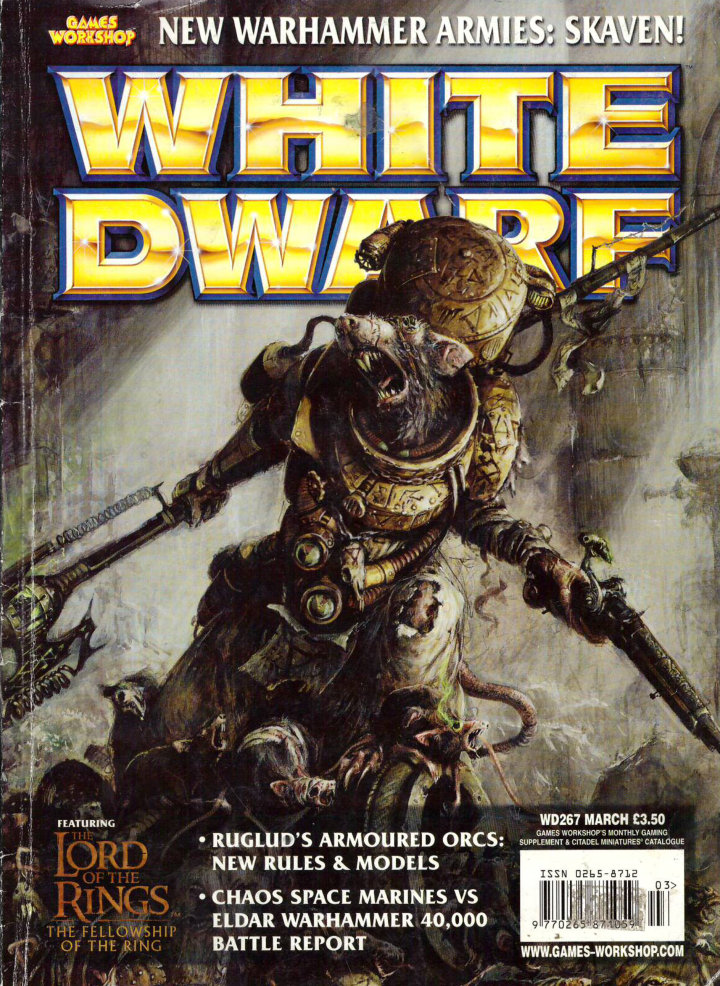
EditorialWD 267 · p. 1
Paul Sawyer distinguishes the practical aims of Painting Workshop from the more demanding techniques in Masterclass. Matt Hutson’s Word Bearers exemplify a strong gaming finish, while the studio recipes offer ideas for further development. Rather than measuring success against an exact copy of a studio model, readers are encouraged to understand the decisions behind a technique and develop their own style.
CommunityWD 267 · pp. 6–7
The news previews Hordes of Chaos artwork and sculpting, Forge World aircraft and the Stormsword, and a Nurgle force for Warmaster. It also reports Games Workshop’s investment in Sabertooth Games, introduces the Coronis card-game campaign and looks ahead to William King’s Farseer and new Gaunt’s Ghosts material.
Warhammer Fantasy BattlesWarhammer 40,000
InterviewWD 267 · pp. 8–13
Alessio Cavatore explains how his enthusiasm for Skaven shaped the new army book. Clan identity, expendable troops and unreliable machinery reinforce their character, while mainstay Clanrats constrain army selection. The discussion links retained traits such as rank-based confidence and firing into combat with new Ratling Guns, the Warp-lightning Cannon and technomantic Warlock Engineers, explaining why some older units were removed.
Warhammer Fantasy BattlesSkaven
PaintingWD 267 · p. 14
The introductory guide builds a coherent Skaven force through related fur colours, dark clothing and consistent bases. A labelled Clanrat demonstrates how a limited group of browns and bone colours can distinguish skin, cloth and equipment, while the surrounding studio models show how a shared scheme survives variations between individual warriors.
Warhammer Fantasy BattlesSkaven7 paint colours
ModellingWD 267 · p. 15
Slaves are distinguished from Clanrats by using fewer armoured components, simpler shields and a more impoverished appearance. Painting metal-looking details as leather and choosing lighter fur further separate them from their masters. A brown wash adds a neglected finish to the remaining metal without requiring elaborate conversions.
Warhammer Fantasy BattlesSkaven1 paint colour
PaintingWD 267 · p. 15
Three approaches demonstrate how drybrushing, washes and a combination of the two change the appearance of sculpted fur. The examples use different brown foundations and highlights to show how a small set of repeatable steps can create variation across a regiment while keeping the process manageable.
Warhammer Fantasy BattlesSkaven9 paint colours
PaintingWD 267 · p. 16
Phil Kelly gives his Clan Skryre warriors red armour, dark clothing and warm brown fur. Broad drybrushing establishes the fur before the skin, equipment and small details are picked out, and a final dark wash ties the model together. The method is designed to produce a consistent regiment efficiently.
Warhammer Fantasy BattlesSkaven9 paint colours
PaintingWD 267 · p. 16
Simple clan marks and repeated patterns give the army a common identity while preserving the rough character of Skaven equipment. The guide contrasts plain wood and rusty metal with more ambitious decoration for elite formations, making the complexity of the design part of the unit’s visual status.
Warhammer Fantasy BattlesSkaven
PaintingWD 267 · p. 17
Gareth Hamilton’s scheme layers pale flesh over dark brown and uses related earthy colours across fur, cloth and equipment. Dark armour and weathered metallics contrast with the skin, while muddy hems and consistent bases unite the regiment. The article revisits his earlier army feature and distinguishes the final varnish treatment of ordinary surfaces from the glossy globes.
Warhammer Fantasy BattlesSkaven14 paint colours
PaintingWD 267 · pp. 20–21
Martin Footitt varies the wood colours to make the cannon look assembled from mismatched pieces, then stipples warm metallics and adds green corrosion. Layered greens and glazes create the glowing warpstone, with a separate blue treatment for the sight. The crew receives pale flesh, dark robes and contrasting red details; the assembly sequence leaves the Engineer removable until the hard-to-reach areas are painted.
Warhammer Fantasy BattlesSkaven39 paint colours
LoreWD 267 · pp. 24–31
The history follows Magnus from Prospero’s scholarly culture through the prohibition of sorcery, his failed warning about Horus and the Space Wolves’ destruction of his home. Conflicting accounts make the sack of Prospero deliberately uncertain. The Rubric preserves the Legion at a terrible cost, leaving sorcerers to command armoured remnants while pursuing hidden knowledge from the Planet of the Sorcerers.
Warhammer 40,000Thousand Sons
LoreWD 267 · p. 28
Mordant Hex’s raid demonstrates the Thousand Sons’ preference for deception over a costly direct assault. Entranced hermits open their own airlock to the attackers, allowing a massacre inside the mountain retreat. The real prize is a forgotten entrance to the Eldar webway, whose capture creates a threat far beyond the isolated monastery.
Warhammer 40,000Thousand Sons
LoreWD 267 · p. 30
Ahriman’s attempt to end the Legion’s mutations leads to the Rubric and his banishment from Magnus’s court. He continues seeking mastery of Chaos through stolen learning, secret cults and raids on repositories of knowledge. His pursuit of the Black Library places the Eldar’s hidden paths at the centre of that ambition.
Warhammer 40,000Thousand Sons
RulesWD 267 · p. 31
This contemporary army variant requires allegiance to Tzeentch and restricts the available formations accordingly. Favoured squad sizes, sorcerous leadership and a Terminator retinue reinforce the Legion’s identity, while a possessed Dreadnought receives a specific exception. The article also points readers towards the optional minor psychic powers published later in the issue.
Warhammer 40,000Thousand Sons
ShowcaseWD 267 · pp. 32–33
Keith Robertson’s Thousand Sons Lord, Terminator and elaborately decorated Land Raider anchor this Chaos showcase. Neil Hodgson’s infantry demonstrate the Legion’s blue-and-gold scheme, while Thomas David’s French Slayer Sword-winning Nurgle Champion provides a contrasting organic finish. The vehicle close-ups highlight freehand imagery, ornamented armour panels and the converted crew.
Warhammer 40,000Thousand Sons
LoreWD 267 · pp. 36–37
After a disastrous encounter with Chaos Dwarfs, Ruglud loses his standing and discovers a new opportunity in an abandoned Dwarf hold. Looted armour and crossbows become the basis of his mercenary company, with the unlikely survival of the Goblin Maggot woven into its legend. The background explains both the regiment’s unusual equipment and its unreliable allegiance.
Warhammer Fantasy BattlesOrcs & Goblins
FictionWD 267 · pp. 38–39
Ruglud joins forces with the Black Spider shaman Stikrit against a gathering of Beastmen and mutants. His interest in the enemy’s imposing armour shapes the encounter as much as any alliance, continuing the regiment’s theme of opportunistic warfare and explaining why promises from these mercenaries deserve suspicion.
Warhammer Fantasy BattlesOrcs & Goblins
RulesWD 267 · p. 39
The regiment’s entry defines who can hire the armoured crossbowmen and how Maggot’s extraordinary luck supports their banner. Their particular form of animosity can send bolts into the nearest convenient target, including allies, while rules for their equipment and reactions distinguish them from ordinary Orc infantry.
Warhammer Fantasy BattlesOrcs & Goblins
CommunityWD 267 · pp. 42–45
Space McQuirk tours the reconstruction of Warhammer World as a medieval courtyard and tavern. Mark Chambers coordinates the project with Dave Andrews, the Perry twins and the builders, translating a model-scale plan into timber, plaster and paving. The report explains how large surfaces, architectural details and gargoyles preserve a Warhammer atmosphere while accommodating the museum, shop and gaming space.
LoreWD 267 · pp. 46–49
Graham McNeill and Phil Kelly show how the broad division between Puritans and Radicals conceals sharply different philosophies. Six factions disagree over resurrection, stability, rebellion, alien influence and the use of Chaos, providing motives for alliances and conflicts within an Inquisitor campaign. The discussion connects those beliefs to named historical advocates and contemporary characters.
InquisitorInquisition
LoreWD 267 · pp. 46–47
Thorians seek the means by which the Emperor might return in a living vessel. Study of extraordinary individuals and apparently miraculous events supports that hope, but competing interpretations and the possible consequences for Imperial unity make their research contentious. Their concerns overlap with some Radical projects despite a different understanding of the desired result.
InquisitorInquisition
LoreWD 267 · p. 47
Monodominants interpret human supremacy as requiring relentless destruction of witches, aliens and other perceived impurities. The article traces the philosophy through Goldo and Jeriminus and connects its uncompromising methods with Tyrus. Their certainty creates conflict even with other servants of the Imperium when cooperation demands tolerating suspect allies.
InquisitorInquisition
LoreWD 267 · pp. 47–48
The gathering at Mount Amalath inspires a belief that the existing Imperial order expresses the Emperor’s plan. Amalathians therefore work to preserve institutions and cooperation, resisting both disruptive reform and internal rivalry. Their alliances with established authorities make stability itself an active Inquisitorial objective.
InquisitorInquisition
LoreWD 267 · pp. 48–49
Xanthites believe the tools of Chaos can be understood and turned against it, a position that makes them targets for other Inquisitors. The history of Xanthus and later controversies establishes the dangers of that approach. Horusian ideas about harnessing immense power complicate the boundary between practical experimentation and ambitions resembling the Thorians’ search for a saviour.
InquisitorInquisition
LoreWD 267 · p. 49
Recongregators view decaying institutions as obstacles to humanity’s survival. They encourage upheaval and manipulate rebellion to replace ineffective rulers, accepting destruction as part of renewal. Their willingness to undermine Imperial structures creates an immediate philosophical conflict with factions dedicated to preserving the existing order.
InquisitorInquisition
LoreWD 267 · p. 49
Istvaanians believe humanity grows stronger through conflict and deliberately provoke the pressures that might produce capable survivors. Examples of witch hunts and military mobilisation show how that principle operates through political action rather than open battle alone. The resulting suffering is treated by adherents as the cost of strengthening the Imperium.
InquisitorInquisition
ModellingWD 267 · pp. 50–51
Mark Bedford demonstrates how booster components can give familiar Inquisitor models new identities. Reference photographs help place equipment convincingly, while head swaps and altered poses change a character’s bearing. Temporary assembly and checking a pose in a mirror support more ambitious conversions, including a reworked Covenant and possibilities offered by mutant heads.
Inquisitor
FictionWD 267 · pp. 58–59
A showcase of Aly Morrison’s Emperor’s Children accompanies Evenus’s encounter with Black Legion envoys. The promise of negotiation quickly collapses under his desire for violent sensation, leaving a survivor to deliver Abaddon’s message. The story sets the Legion’s excesses against obligations that even its self-indulgent champions cannot simply ignore.
Warhammer 40,000Emperor’s Children
RulesWD 267 · p. 60
Salendor combines high magic, paired swords and exceptional reflexes in a profile built for the War of the Beard. His ability to influence deployment reinforces his reputation as a commander. Mark Raynor’s accompanying conversion combines a Shadow Warrior body with Archer components, adding sculpted cloth and details to distinguish the general.
Warhammer Fantasy BattlesHigh Elves
RulesWD 267 · p. 61
Brok’s rules emphasise resilience, runic equipment and his connection with miners. His weapon threatens enemy armaments as well as their bearers, while his army benefits from unusual access to mining formations. Paul Sawyer represents him with a Dwarf Miner Champion, linking the straightforward model choice to the character’s origins.
Warhammer Fantasy BattlesDwarfs
RulesWD 267 · p. 62
Liandra wears her brother’s armour and rides the dragon Borgash, combining the family’s martial legacy with fire magic. Protective equipment supports the dragon-rider profile. Mark Raynor describes a conversion assembled from Elf components, with added scarves and other adjustments to express the disguised warrior’s appearance.
Warhammer Fantasy BattlesHigh Elves
RulesWD 267 · p. 63
Captivity and madness have made Khargrim an isolated Slayer driven by hatred and frenzy. His chained weapon and exceptional reactions shape a character intended to fight alone. Paul Sawyer adapts the Blood Bowl model Grim Ironjaw with vehicle chains and sculpted attachments to reproduce the distinctive equipment.
Warhammer Fantasy BattlesDwarfs
CommunityWD 267 · pp. 64–69
Alan Merrett introduces the competition’s categories and explains the expectations for personal painting work, presentation and fidelity to the setting. The new Lord of the Rings category reflects the film range, while Young Bloods and the Open competition accommodate different entrants. Illustrated examples help distinguish category boundaries and frame the event as a celebration of miniature painting.
CampaignWD 267 · pp. 70–71
Space McQuirk visits a Leeds club campaign organised by Laurie Stewart and Paul Grace. A compact branching structure supports two games in one day, with alternative army sizes accommodating uneven sides. Seven themed tables and a shared commitment to painted forces give the event its character, ending in a narrow Imperial victory without requiring an elaborate administration system.
Warhammer 40,000
LoreWD 267 · pp. 72–75
Space McQuirk follows Grimgor’s search for opponents from Karak Ungor towards Hell Pit and the northern steppes. Throt’s creatures delay but fail to satisfy him, and losses in the mountains do not prevent a victory over Yusak’s Kurgan. By obstructing a northern invasion route, the Orc unwittingly gives the Empire a respite while attracting more Black Orcs to his growing legend.
Warhammer Fantasy BattlesOrcs & Goblins
RulesWD 267 · pp. 78–80
Andy Hoare presents optional minor powers for servants of Tzeentch, Nurgle and Slaanesh, with no equivalent for Khorne. Purchased rolls produce an unpredictable selection, and the introductory rules establish when powers operate. The three tables emphasise manipulation of fate, corruption and beguilement, offering distinctive additions to the existing psychic arsenal.
Warhammer 40,000Chaos Space Marines
RulesWD 267 · p. 81
Pete Haines and Andy Hoare preview a revised set of major powers ranging from direct attacks to bodily transformation and manipulation of enemy resolve. The selection includes Gift of Chaos, Wind of Chaos and Mass Mutation alongside familiar offensive powers, giving a contemporary glimpse of the developing Chaos rules.
Warhammer 40,000Chaos Space Marines
PaintingWD 267 · pp. 82–83
Matthew Hutson works in small batches, building red armour over black and using a red glaze to unite its highlights. Metallic trim, flayed skin and bright eyes supply contrasting details. Freehand flames and lettering establish the Legion’s identity, while impurity seals and careful tidying make the repeatable method suitable for an entire gaming army.
Warhammer 40,000Word Bearers14 paint colours
InterviewWD 267 · pp. 86–87
Alessio Cavatore revisits the 1986 Citadel Journal scenario that introduced the Skaven through an attack on a monastery. Rick Priestley’s original and Dave Andrews’s card abbey inspire a new version, with later roleplaying and magazine appearances providing context. Cavatore explains why a three-sided battle requires special attention to combat resolution and a willingness to use common sense.
Warhammer Fantasy Battles
LoreWD 267 · pp. 88–89
Bagrian’s theft of the Black Ark draws Gnawdoom and Throt to the abbey, where Kemmler and Krell join the assault through an unstable alliance. Tancred answers the abbot’s call for aid, but the conflict ends with Bagrian dead and the artefact reclaimed. The account follows the survivors and connects the siege with later struggles around Montfort.
Warhammer Fantasy BattlesBretonnia
RulesWD 267 · pp. 90–92
A general framework makes three-sided battles workable through a changing turn order, pairwise combat resolution and procedures for competing attempts to dispel magic. Victory points are awarded as losses occur, with shared credit where appropriate. The accompanying discussion concentrates on the interactions that ordinary two-player rules leave unresolved.
Warhammer Fantasy Battles
RulesWD 267 · p. 93
The historical scenario applies the three-army framework to Bretonnians, Skaven and Undead. The abbey’s monks begin within its defences while mounted rescuers arrive separately, creating different objectives and pressures for each force. Control of the building contributes to victory alongside battlefield losses, and the following character profiles supply the principal participants.
Warhammer Fantasy BattlesBretonnia
RulesWD 267 · p. 94
Tancred’s profile represents a Grail champion equipped specifically to confront Undead. His ancient blade threatens them regardless of ordinary armour, while the Grail Shield impairs supernatural enemies fighting him. Protective virtues reinforce his role as the Bretonnian army’s determined answer to Kemmler and his followers.
Warhammer Fantasy BattlesBretonnia
RulesWD 267 · p. 94
Kemmler leads the Undead as an accomplished necromancer able to repeat spells while power remains available. His staff combines several magical aids, while a protective cloak and other equipment support his battlefield role. The entry fixes his equipment and explains how his unusual power affects character selection.
Warhammer Fantasy BattlesVampire Counts
RulesWD 267 · p. 94
Krell accompanies an army led by Kemmler and receives a more dangerous version of his lethal axe attack. Chaos armour and the Crown of the Damned complete his equipment. The compact entry adapts the ancient Wight for this scenario while referring players to the contemporary army book for the underlying item rules.
Warhammer Fantasy BattlesVampire Counts
RulesWD 267 · p. 95
Throt’s profile combines Clan Moulder leadership with regenerative resilience and specialised weapons for controlling and killing large creatures. His appetite can interrupt pursuit after a successful fight, giving his background a direct battlefield consequence. Rules for the whip and Creature-killer distinguish him from an ordinary Skaven character.
Warhammer Fantasy BattlesSkaven
RulesWD 267 · p. 95
Bagrian is presented as a priest of Taal whose magical equipment supports both spellcasting and survival. His staff and protective resources give the abbey’s defender a distinctive role among the scenario’s more aggressive leaders. The profile places the abbot directly within the special forces assembled for the historical siege.
Warhammer Fantasy BattlesBretonnia
ModellingWD 267 · pp. 96–103
Paul Rudge and Dave Andrews design a large abbey around the needs of ranked units, with generous breaches and a courtyard suitable for fighting. Foamboard, textured surfaces and existing architectural components create whitewashed walls, tiled roofs and a detailed interior. The guide covers hinged gates, stained glass, rubble and weathering, keeping removable parts useful for later scenarios.
Warhammer Fantasy Battles12 paint colours
Battle reportWD 267 · pp. 106–121
Phil Kelly’s Ulthwé face Graham Davey’s Black Legion in a 2,000-point Sabotage mission centred on a warp gate. Early contact, blocked approaches and a Wave Serpent’s intervention disrupt the Chaos advance while psychic support sustains the defenders. Eldrad defeats Abaddon in combat, and the remaining attackers cannot destroy the objective before the game ends, securing an Eldar victory.
Warhammer 40,000Ulthwé
PaintingWD 267 · pp. 124–125
A beginner’s sequence builds a Wood Elf Bowman from a black undercoat, separating the layers of clothing, leather equipment and metallic details. Simple mixing darkens the green shirt and lifts black accessories without losing contrast. The final stages explain how to close gaps in the base, apply sand and drybrush it for a consistent finish across a group.
Middle-earth Strategy Battle GameLothlórien13 paint colours
CampaignWD 267 · pp. 126–129
Alessio Cavatore divides the crisis at Amon Hen into two linked scenarios. Aragorn, Legolas and Gimli must first break through the Uruk-hai before they can aid Boromir and the Hobbits, with their arrival depending on the first game’s progress. A simultaneous four-player option connects the two tables turn by turn.
Middle-earth Strategy Battle GameThe Fellowship
RulesWD 267 · p. 127
Aragorn, Legolas and Gimli attempt to escape a blocking force of Uruk-hai and reach their companions. The Evil player’s task is to delay them rather than merely trade casualties. Recording when the heroes leave the board makes the result matter directly to the second half of the linked Amon Hen encounter.
Middle-earth Strategy Battle GameThe Fellowship
RulesWD 267 · pp. 128–129
Boromir protects Merry and Pippin while Lurtz’s force attempts to seize the Hobbits and carry them away. Special procedures handle nonlethal capture, recovery and the risks facing carriers. Reinforcements depend on the preceding rescue game, making Boromir’s resistance and the timing of the other heroes central to the outcome.
Middle-earth Strategy Battle GameThe Fellowship
ModellingWD 267 · pp. 132–135
The US team balances the film location’s wooded slopes with space to move miniatures. Layered insulation foam, dampened grass mat and embedded natural stones create continuous contours, while mixed trees and forest-floor material break up the surface. A carefully shaped riverbank, brush-bristle reeds and balsa boats support escape routes; the Seat of Seeing is reserved for a later addition.
Middle-earth Strategy Battle Game
TacticsWD 267 · p. 135
Play observations from the completed Amon Hen board emphasise the river as an escape route for the slower Hobbits. The stronger heroes can fight their way out but must not lose sight of the need to withdraw together. Evil benefits from surrounding targets with superior numbers, treating Frodo’s capture as an opportunity rather than the only workable plan.
Middle-earth Strategy Battle GameThe Fellowship
PaintingWD 267 · pp. 138–139
The Kings of Men share a warm flesh recipe but receive individual robe, hair and metallic treatments. Textured brown cloth, shaded blue and green garments, and colours mixed with metallic paint distinguish the figures before their transformation. Common silver, gold and basing methods bring the collection together without erasing those differences.
Middle-earth Strategy Battle GameMordor27 paint colours
PaintingWD 267 · p. 139
Cool grey robes are highlighted with bone and blue to give the Twilight Ringwraiths a spectral appearance. Pale hair and flesh built from purple through grey and pallid tones reinforce the effect, while conventional silver weapons and crowns retain clear edges. The recipe separates the figures’ ghostly surfaces from their remaining metal equipment.
Middle-earth Strategy Battle GameMordor13 paint colours
PaintingWD 267 · p. 140
Successive grey drybrushes define the folds of the Ringwraiths’ black robes while keeping the overall figure dark. More controlled highlights pick out the belt, earthy colours add dirt to the hem, and dark washes subdue the swords after their metallic highlights. The approach makes the black clothing readable without turning it uniformly grey.
Middle-earth Strategy Battle GameMordor10 paint colours
PaintingWD 267 · p. 140
The mounted figures use the same robe treatment as the foot models, with dark brown horses providing subtle contrast. Bone lightens the flesh and tail highlights, metallic layers define the armour, and red picks out wounds. An alternative brown foundation introduces variation between the mounts while preserving the ominous shared appearance.
Middle-earth Strategy Battle GameMordor9 paint colours
Contents-listed articles and substantive named features are indexed, including the Lord of the Rings section. Advertisements, commercial catalogues, store directories and art-only dividers are excluded.