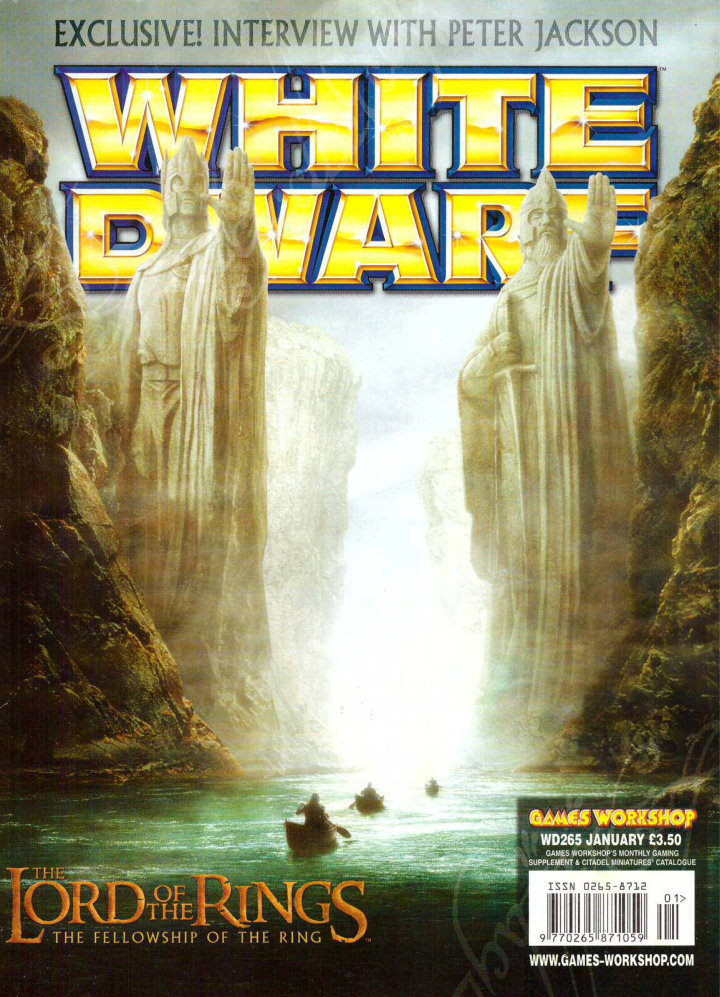
EditorialWD 265 · p. 1
Paul Sawyer describes the rebuilding of Warhammer World’s exhibition hall and store as places that reflect the fantasy settings rather than a conventional exhibition space. Dave Andrews and the Perry twins are contributing designs, and a card mock-up gives readers an early view of the intended architecture. A second update previews the coming Skaven army book, a studio battle and a new Boneripper miniature.
EditorialWD 265 · The Lord of the Rings supplement, editorial
Paul Sawyer looks forward to the film’s arrival and to introducing new players to the hobby. He connects the issue’s first-game walkthrough and painting guides with the practical choices faced by someone assembling a collection for the first time.
Middle-earth Strategy Battle Game
CommunityWD 265 · pp. 2–3
Martin Footitt joins the sculpting team, while Simon Egan develops a large Harridan for Forge World. Other previews introduce new Chaos imagery, forthcoming novels and an update for Dark Eldar. The Blood Bowl announcement explains the game’s permanent return, combining the original game and Death Zone material with updated rules and new teams.
Warhammer 40,000Warhammer Fantasy Battles
RulesWD 265 · The Lord of the Rings supplement, pp. 2–3
A four-turn encounter between a warrior of Gondor and a Goblin archer demonstrates the game’s basic sequence. The Goblin retreats and shoots as the warrior closes, then changing priority and a tied combat show how movement order and Fight values matter. The example explains shooting restrictions, combat resolution and pushing back before directing players to a larger introductory encounter.
Middle-earth Strategy Battle GameGondor
PaintingWD 265 · The Lord of the Rings supplement, pp. 4–5
A beginner’s sequence develops a metal Mordor Orc from black undercoat to finished gaming miniature. Flesh wash shades the skin, several browns distinguish the leather and clothing, and narrow black boundaries keep adjacent surfaces readable. Drybrushed armour and brighter weapon edges supply the metal details, followed by corrections, a flocked base and a protective varnish.
Middle-earth Strategy Battle GameMordor10 paint colours
ShowcaseWD 265 · pp. 8–9
The studio High Elf army is presented through battlefield scenes and a broad view of its regiments. Spearmen confront a Dwarf patrol, while Tyrion’s encounter with Malus Darkblade brings the rival Elven forces together. White and blue infantry, mounted nobles, elite warriors and supporting war machines illustrate the range of the newly released army.
Warhammer Fantasy BattlesHigh Elves
InterviewWD 265 · The Lord of the Rings supplement, pp. 8–11
Peter Jackson discusses the long route from encountering Tolkien’s story to directing three films together. He describes the changing studio plans, New Zealand’s landscapes and production advantages, and the collaboration with writers, artists and actors needed to translate the books to the screen. Practical compromises and the director’s final judgement connect the enormous production with his earlier experience making smaller films.
Middle-earth Strategy Battle Game
CommunityWD 265 · pp. 10–13
Jake Thornton explains how a short style guide helped the designers preserve a coherent High Elf identity while rebuilding the army for sixth edition. Fragility remains central: speed, skill and specialised units must compensate for limited resilience. He discusses the removal of accumulated special rules, the role of inexpensive magic items and Honours, and why successful army selection requires experimentation with combinations of troops.
Warhammer Fantasy BattlesHigh Elves
LoreWD 265 · p. 11
A compact design statement connects Elven grace, craftsmanship and long lives with pride, declining numbers and physical vulnerability. The citizen militia fights with an awareness that its losses are difficult to replace. Mastery of magic and the High Elves’ historical influence on humanity sit beside the darker impulses shared with their estranged kin.
Warhammer Fantasy BattlesHigh Elves
PaintingWD 265 · pp. 14–17
Mark Raynor develops a consistent regiment scheme from a black undercoat, blocking in cloth, flesh and equipment before adding clean highlights. Pale garments and bright metal contrast with red details and restrained leather colours. The mounted examples extend the approach to horses and layered barding, with separate painting and a temporary handle making the riders easier to reach.
Warhammer Fantasy BattlesHigh Elves19 paint colours
PaintingWD 265 · The Lord of the Rings supplement, p. 14
A common brown foundation is highlighted through flesh tones and shaded with a wash. Sam omits the palest highlight for a more weathered appearance, while grey added to Bilbo’s highlights suggests his age. A darker mixed flesh colour defines the lips and adds warmth to selected cheeks; the same basic progression also treats hands and feet.
Middle-earth Strategy Battle GameThe Fellowship6 paint colours
PaintingWD 265 · The Lord of the Rings supplement, p. 14
Frodo’s clothing uses distinct brown mixtures for trousers, vest and jacket, avoiding a single flat tone across the figure. A dark green cloak receives progressively warmer highlights, while restrained grey drybrushing catches the texture of the black hair. The shared face and sword instructions complete the miniature, with an optional blue glaze representing Sting’s glow.
Middle-earth Strategy Battle GameThe Fellowship17 paint colours
PaintingWD 265 · The Lord of the Rings supplement, p. 14
Sam’s pale shirt contrasts with an earthy green-brown mixture used in different proportions across his trousers, jacket and cloak. Thin coloured glazes bind the trouser highlights together, while added grey changes the jacket’s character. Warm brown hair and a less pale flesh treatment reinforce the intended practical, weathered appearance.
Middle-earth Strategy Battle GameThe Fellowship17 paint colours
PaintingWD 265 · The Lord of the Rings supplement, p. 14
Three metallic stages brighten the Hobbits’ swords. Brown and black ink weather Merry and Sam’s blades, whereas Frodo’s sword remains clean and bright. A very thin blue glaze is suggested when depicting Sting’s supernatural glow in the presence of enemies.
Middle-earth Strategy Battle GameThe Fellowship6 paint colours
PaintingWD 265 · The Lord of the Rings supplement, pp. 14–15
Space McQuirk gathers the ’Eavy Metal team’s recipes for the five Hobbits, using shared face treatments to connect otherwise distinct clothing schemes. Frodo’s dark greens and browns, Sam’s muted working clothes, Merry’s warm vest, Pippin’s blue jacket and Bilbo’s elaborate reds provide different focal colours. The guide also covers hair, swords, small accessories and a common textured base.
Middle-earth Strategy Battle GameThe Fellowship32 paint colours
ModellingWD 265 · p. 15
Trial fitting with reusable adhesive helps spearmen rank up without their weapons colliding. More upright spears suit the rear ranks, while kneeling archers work at the front. Numbering the bases preserves the arrangement after painting; bows and quivers can turn the Spearmen into Lothern Sea Guard.
Warhammer Fantasy BattlesHigh Elves
PaintingWD 265 · The Lord of the Rings supplement, p. 15
Merry’s cloak combines black, yellow-brown and a little red, with the same mixture linking it to the green coat. His vest moves through warm yellow highlights before a thinned brown wash brings the layers together. Brown hair, a dark bag and carefully separated trousers complete the individual clothing and accessory recipes.
Middle-earth Strategy Battle GameThe Fellowship9 paint colours
PaintingWD 265 · The Lord of the Rings supplement, p. 15
Pippin’s blue jacket is highlighted with grey, separating it from the pale shirt and subdued trousers. A red cloak receives bone-coloured highlights followed by a mixed ink glaze, with a darker blue-grey drybrush along its hem. Simple brown hair and a lightly highlighted tie keep the smaller details restrained.
Middle-earth Strategy Battle GameThe Fellowship11 paint colours
PaintingWD 265 · The Lord of the Rings supplement, p. 15
Bilbo’s waistcoat and dinner jacket use different red mixtures and glazes to remain distinct. Green lapels and a matching cravat frame the pale shirt, while gold buttons and the Ring add small bright accents. The guide treats the book, greying hair and darker ring finger separately, supporting the older character’s more elaborate appearance.
Middle-earth Strategy Battle GameThe Shire16 paint colours
PaintingWD 265 · The Lord of the Rings supplement, p. 15
Sand fixed with PVA provides the texture for a shared base treatment. A brown ink wash shades the surface, and a mixed leather-and-grey drybrush picks out the grains. Static grass supplies the final contrast around the painted ground.
Middle-earth Strategy Battle GameThe Fellowship3 paint colours
PaintingWD 265 · p. 16
A quick green base and ink treatment gives the army’s gemstones a consistent finish. The suggested distribution reserves infantry shield gems for command figures, while every Silver Helm can display them to reflect the riders’ higher status. Gloss varnish supplies the final reflective surface.
Warhammer Fantasy BattlesHigh Elves2 paint colours
PaintingWD 265 · pp. 16–17
The regiment sequence lays out the colours for each surface before adding pale highlights to cloth and flesh. Red details need a brighter preparatory layer over the black undercoat, while mail benefits from drybrushing and smoother metal plates from direct painting. Silver Helms extend the method to grey horses, individually picked-out barding and gold details.
Warhammer Fantasy BattlesHigh Elves17 paint colours
Battle reportWD 265 · The Lord of the Rings supplement, pp. 17–30
Paul Sawyer and Rowland Cox’s Fellowship attempts to escape Matt Hutson’s Goblins in a third replay of the tomb encounter. The Evil force separates the heroes, fires at vulnerable Hobbits and forces Good to spend its limited heroic resources. Gandalf delays the Troll, but the spreading melee kills Sam and Gimli before further losses overwhelm the escape attempt. Legolas’s death supplies the decisive fifth casualty and gives Evil victory while Frodo remains alive.
Middle-earth Strategy Battle GameThe Fellowship
RulesWD 265 · The Lord of the Rings supplement, p. 18
The nine members of the Fellowship must cross a crowded chamber and escape from the opposite side. Goblins arrive in three groups, supported by captains and a Cave Troll, while a raised tomb and obstacles shape the routes through the room. Good must get more members out than it loses, and Frodo’s death immediately ends the attempt; the heroes do not yet possess their later Elven cloaks.
Middle-earth Strategy Battle GameThe Fellowship
LoreWD 265 · pp. 20–27
Christopher Allen follows Mortarion from the toxic heights of Barbarus to command of the Death Guard. His liberation of the human settlements and humiliating rescue by the Emperor establish tensions that persist into the Heresy. The Legion’s entrapment in the warp turns its prized endurance into unbearable suffering and leads to its submission to Nurgle. Its later organisation, recruitment, tactics and diseased home world preserve distorted versions of its original traditions.
Warhammer 40,000Death Guard
LoreWD 265 · p. 26
Garro’s escape aboard the Eisenstein carries the warning of Horus’s treachery to the Imperium. The account presents several incompatible traditions about his subsequent fate, including imprisonment, a search for a cure and service with a hidden force. It also records a darker claim that he eventually fell to Nurgle, leaving the historical uncertainty unresolved.
Warhammer 40,000Death Guard
RulesWD 265 · p. 27
The variant army rules extend the Mark of Nurgle across the force and add resilient Cult Terminators and Plague Havocs. Favoured units of seven gain a champion, while weapon and unit restrictions reinforce the Legion’s infantry emphasis. Clarifications distinguish improved Toughness from the underlying value used for instant death and define the transport space occupied by Beasts of Nurgle.
Warhammer 40,000Death Guard
ShowcaseWD 265 · pp. 28–29
Neil Hodgson’s Death Guard characters, Terminators and Dreadnought demonstrate a coordinated diseased armour scheme. The second gallery broadens the selection to other Chaos champions and vehicles, including Richard Baker’s Nurgle Lord, Tammy Haye’s Juggernaut rider and award-winning French Golden Demon entries. Close views emphasise corrosion, ornament and the different approaches to Chaos armour.
Warhammer 40,000Death Guard
ModellingWD 265 · pp. 32–35
J. B. and Tracey Coulter describe the large Tau city built for demonstration gaming and later displayed in Toronto. Tubes, domes, foam and card form repeated rounded profiles, with balconies and platforms sized for miniatures. Plastic fittings supply the smaller structures, and masked white bands sharpen the finished grey buildings. The article explains how a consistent architectural vocabulary unifies inexpensive materials across the table.
Warhammer 40,000Tau Empire1 paint colour
FictionWD 265 · pp. 36–39
William King sends Tyrion to the Blighted Isle, where the struggle against N’kari and the Dark Elves brings him close to death. His enchanted armour and Sunfang enable him to defeat the daemon. Afterwards, the weapon in Khaine’s shrine offers the power to save his people, but Tyrion recognises the endless slaughter behind its promise and refuses it.
Warhammer Fantasy BattlesHigh Elves
PaintingWD 265 · pp. 40–41
Tammy Haye paints Tyrion and his rearing mount as separate assemblies, beginning with the fallen Dark Elf and rocky base. The guide distinguishes the horse’s pale coat, blue caparison, bright gold and silver armour, white fabric and red dragon details through different layering and ink-wash recipes. Subtle dirt and blood effects ground the elaborate miniature, while the sword’s runes and polished gemstones provide sharp focal points.
Warhammer Fantasy BattlesHigh Elves38 paint colours
PaintingWD 265 · p. 41
A short illustrated sequence places successive red and orange crescents on a black gemstone, then adds a small white reflection on the opposite dark edge. The adjacent notes explain the blue gemstones on Tyrion, using a blue-grey highlight progression and gloss varnish to enhance the polished appearance.
Warhammer Fantasy BattlesHigh Elves7 paint colours
InterviewWD 265 · pp. 46–49
Ian Vincent talks to Tony Cottrell and Ewen Little about Forge World’s expanding range and the development of a resin model. Concepts pass through mock-ups and full-size masters, using different materials according to the sculptor and subject. The discussion connects large display pieces, vehicles and terrain with the practical advantages of producing specialised models for a worldwide audience.
Warhammer 40,000Warhammer Fantasy Battles
ModellingWD 265 · p. 49
An illustrated production sequence follows the movement from concept drawing to mock-up, detailed master and finished resin model. Baneblade, Drop Pod and Barracuda examples demonstrate the different purposes of these stages: establishing a design, resolving its proportions, preparing detail and producing a repeatable kit.
Warhammer 40,000
RulesWD 265 · p. 50
Gav Thorpe introduces revised Lores of Beasts, the Heavens and Life as rules to test by agreement. Their purpose is to make neglected choices more attractive and moderate the strongest combinations. He explains how feedback can lead to later official publication, while keeping these trial versions distinct from the existing rules.
Warhammer Fantasy Battles
RulesWD 265 · p. 51
The revised spell list combines control of animals with direct support for friendly troops. It can rally a fleeing unit, frighten or immobilise enemy beasts, strengthen a character, unleash a flock of attacking birds or move cavalry and monsters into combat. Restrictions distinguish the creatures each spell can affect and limit the empowered character’s equipment.
Warhammer Fantasy Battles
RulesWD 265 · p. 52
The proposed Heavens spells mix carefully defined rerolls with several forms of lightning and a delayed comet strike. Range limits constrain the direct attacks, while the comet becomes more dangerous the longer it remains unresolved. The rewritten effects specify when rerolls apply and how the storm affects nearby units.
Warhammer Fantasy Battles
RulesWD 265 · p. 53
Terrain becomes the centre of the revised Lore of Life. Marshes impede movement, wind protects nearby troops, and woods and rocks attack enemies close to their features. Alternative ranges keep these attacks usable when suitable terrain is absent, while rain can impose a lasting penalty on an enemy unit’s shooting.
Warhammer Fantasy Battles
CommunityWD 265 · pp. 58–59
Rick Priestley describes the scale and ambitions of the original Warhammer Online project. Its southern Empire setting is intended to contain inhabited towns, explorable buildings and opportunities for trade and adventure. Rather than reproducing a tabletop army, players would develop individual characters, relationships and followers through their activities in the world.
Warhammer Fantasy Battles
RulesWD 265 · p. 62
Pete Haines explains the interaction between Space Marine morale, falling back and regrouping. Automatic recovery still depends on eligibility, including coherency and enemy proximity, and can occur at different points when those conditions change. Examples distinguish pursuit and consolidation from crossfire, showing both the protection the rule grants and the situations in which a Marine unit can still be destroyed.
Warhammer 40,000Space Marines
RulesWD 265 · p. 63
Unexpected conditions make the battlefield less predictable. Underground routes, tremors, fog, vermin and electrical disturbances can change movement, visibility or the safety of particular positions. These events supplement the chosen Cityfight mission rather than forming a separate victory system.
Warhammer 40,000
CampaignWD 265 · pp. 63–65
Three optional sets of additions give urban battles events, hidden plans and consequences between games. Players can introduce environmental disruptions, conceal special objectives or carry experiences from an earlier engagement into the next. The tables vary the tactical situation without replacing the main scenario and provide experience adjustments for campaign use.
Warhammer 40,000
RulesWD 265 · p. 64
Hidden advantages and tasks let a player investigate a building, recover valuable documents, exploit intelligence or prepare explosives. Some results alter deployment or the length of the engagement, while others create an additional objective. Campaign rewards encourage players to pursue the concealed task alongside the main battle.
Warhammer 40,000
RulesWD 265 · p. 65
A force’s previous experiences can inspire confidence, exhaust its troops or create bonds and grudges. Other results introduce reckless behaviour or valuable loot. The optional table translates these narrative consequences into temporary battlefield effects and experience adjustments for linked urban games.
Warhammer 40,000
RulesWD 265 · pp. 66–67
The answers clarify character permissions, monstrous-creature attacks, rending claws, bio-plasma, Spore Mines and the allocation of mutants. They also explain Tyrant Guard arrangements, psychic defences and the relationship between Instinctive Behaviour and regrouping. Several weapon and army-list ambiguities receive explicit rulings, including the number of attacks generated by spinefists.
Warhammer 40,000Tyranids
RulesWD 265 · p. 67
The custom Hive Fleet list replaces the standard selection rather than supplying isolated additions to it. Answers define species limits, explain when altered weapons create a new species, and distinguish the treatment of Gaunts from Warriors. Further corrections cover brood sizes, Warrior force-organisation slots and the points and biomorph status of psychic powers.
Warhammer 40,000Tyranids
ShowcaseWD 265 · pp. 70–73
Jeppe Danning builds a mutated Lizardman army around the idea of Skaven corruption spreading through Lustria. Every miniature is altered, with components from several ranges and extensive work on the Slann and its attendants. Repeated brown-orange flesh, blue weapons, pale details and swampy bases hold the deliberately varied creatures together. The force earns a best army award after eight months of work.
Warhammer Fantasy BattlesLizardmen6 paint colours
CommunityWD 265 · pp. 74–75
Sabertooth’s card game turns the war for Pandora Prime into a contest for five sectors over four turns. Cards represent troops, vehicles and fortifications while also supplying tactical effects and other game values, creating competing demands during deck construction. The introduction outlines the four initial factions, the alternative routes to victory and plans for organised play through the Astronomicon system.
Warhammer 40,000 Collectible Card GameSpace Marines
CommunityWD 265 · pp. 76–77
Che Webster reports on the first tournament run through the Gaming Club Network, organised by Anthony Theodossi’s Croydon club. Four battles combine with a knowledge quiz, army assessment and an Arena of Death event. Richard Roberts’s Tyranids take the overall award, while the report recognises the winning team and individual achievements in painting, composition and sportsmanship. Webster’s own Tau finish with four defeats.
Warhammer 40,000Tau Empire
LoreWD 265 · pp. 80–85
Anthony Reynolds recounts the break between the Dwarfs and High Elves. Malekith’s disguised raiders and Caledor II’s treatment of a Dwarf ambassador turn suspicion into a long war, ending in Caledor’s death at Tor Alessi and the loss of the Phoenix Crown. The narrative introduces a historical campaign setting whose armies deliberately differ from their modern counterparts.
Warhammer Fantasy BattlesHigh Elves
RulesWD 265 · pp. 82–85
The historical High Elf list represents an age of greater magical power and more numerous dragons. Extra character and magic-item allowances accompany improved High Magic and access to dragon mounts. Dragon Princes can ride actual drakes, while the accompanying restrictions make clear that this intentionally powerful list is designed to face the matching historical Dwarf army.
Warhammer Fantasy BattlesHigh Elves
FictionWD 265 · p. 83
An Elven account frames Caledor II’s duel with Snorri Halfhand as a display of restrained superiority. It presents the king as repeatedly giving his opponent opportunities before delivering the decisive blow. The partisan telling treats the Dwarfs’ demand for vengeance as folly, illustrating how each people preserves a very different memory of the war.
Warhammer Fantasy BattlesHigh Elves
RulesWD 265 · p. 85
Additional weapons, armour, talismans and standards belong specifically to the War of the Beard setting. The selections include powerful royal equipment, protection against enemy magic, an artefact strengthening the bond between dragon and rider, and a banner that can frustrate an enemy charge. Their restrictions tie these effects to the historical army rather than ordinary High Elf lists.
Warhammer Fantasy BattlesHigh Elves
PaintingWD 265 · p. 90
Chris Smart gives Severina and Sevora contrasting black and red bodysuits, selecting different undercoats and mixing ink into the red layers to produce smooth, saturated surfaces. Restrained pale highlights keep the black material glossy-looking rather than grey. The shared finishing stages cover metal, exposed flesh, bloodstained blades and debris bases, with selective gloss varnish reinforcing the appearance of rubber and latex.
InquisitorDeath Cult Assassins18 paint colours
Battle reportWD 265 · pp. 93–108
Phil Kelly’s Tau defend an Ethereal against Andy Hoare’s Salamanders in a Cityfight relief mission on Sy’l’kell Minoris. Early Tau fire disrupts the transports and leaves the attackers advancing unevenly through the ruins. A jump-pack assault nearly reaches its objective, but Kroot and Hounds rescue the position while difficult terrain and poorly coordinated attacks wear down the Space Marines. The Tau eventually eliminate the remaining attackers and keep their leader safe.
Warhammer 40,000Tau Empire
Contents-listed articles and substantial separately titled features are indexed. Advertisements, release catalogues, store directories, event listings and art-only pages are excluded.