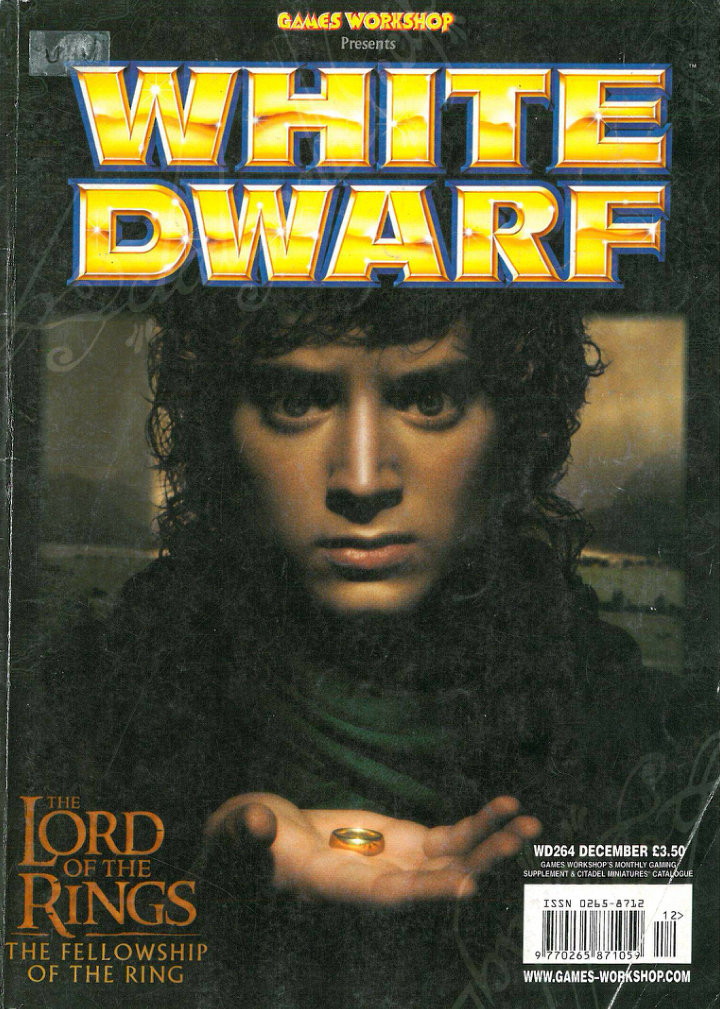
EditorialWD 264 · The Lord of the Rings supplement, p. 1
Paul Sawyer anticipates the first film’s release and describes his longstanding interest in Tolkien’s books. He introduces the interview with Weta’s Richard Taylor and explains plans for further interviews with cast members as the magazine’s coverage develops.
Middle-earth Strategy Battle Game
EditorialWD 264 · p. 2
Paul Sawyer considers the patience and practice involved in improving miniature painting. He distinguishes the practical satisfaction of completing an army from the pursuit of individual display pieces, using Golden Demon as evidence of how far either interest can develop. Store demonstrations, the website and the magazine provide different routes to learning.
CommunityWD 264 · pp. 2–3
The news introduces the Index Astartes compilation and a revised Grand Tournament structure with qualifying heats. It also previews Forge World Land Raider doors for several Chapters and explains the rebuilding of Warhammer World’s gaming hall as an Empire town square, developed from concepts by the Perry twins.
Warhammer 40,000Warhammer Fantasy Battles
PaintingWD 264 · The Lord of the Rings supplement, pp. 4–5
Tammy Haye reinforces the Cave Troll’s heavy joints with pins before building the skin from blue-grey and flesh mixtures. Highlights follow the sculpted folds, while a paler chest contrasts with the scaly back and dark-glazed extremities. Separate recipes cover cracked leather, cloth, rusty metal, nails and teeth, and the tutorial shows how layered markings give the eyes their distinctive appearance.
Middle-earth Strategy Battle GameMoria16 paint colours
PaintingWD 264 · The Lord of the Rings supplement, p. 5
Dave Thomas uses a dark red-brown skin mixture and restrained highlights to capture Lurtz’s appearance. Roughly applied metallic edges and coloured ink glazes weather the armour, shield and sword, while leather, hair and bow receive separate dark treatments. The white hand on his face is constructed from a simple hand outline and filled detail; bone-coloured arrows and teeth provide smaller points of contrast.
Middle-earth Strategy Battle GameIsengard16 paint colours
CommunityWD 264 · pp. 6–8
Space McQuirk reports on a packed Birmingham Games Day, where participation games ranged from the linked Albion battlefields to an Imperial city under attack. Club tables, artist demonstrations, Black Library signings and designer discussions offered different ways into the hobby. Early computer-game demonstrations and a first look at the Lord of the Rings game also drew attention.
Warhammer 40,000Warhammer Fantasy Battles
InterviewWD 264 · The Lord of the Rings supplement, pp. 7–12
Richard Taylor discusses Weta’s growth from a small effects workshop into the team creating the trilogy’s creatures, armour, weapons, prosthetics and miniatures. He explains the emphasis on convincing materials and physiology, the logistical strain of remote locations and the actors’ adaptation to cumbersome equipment. Digital doubles and MASSIVE complement the physical work, while the Cannes presentation and his Games Workshop visit reveal how the project began reaching a wider audience.
Middle-earth Strategy Battle Game
ShowcaseWD 264 · pp. 9–27
The Golden Demon report presents category winners with accounts of their construction, painting and sources of inspiration. Christian Blair’s Slaaneshi warband takes the Slayer Sword, while Mike Anderson earns four silvers. Throughout the gallery, sculpted detail, carefully staged relationships between figures and inventive reuse of familiar components explain how the entries developed beyond their starting models.
Warhammer Fantasy BattlesWarhammer 40,0002 paint colours
ShowcaseWD 264 · p. 10
Christian Blair’s Nurgle Lord combines extensive sculpting with a slate weapon and a base textured using kitchen spices. Joe Hill’s Master Inquisitor reworks Commissar Yarrick around Adrian Smith’s imagery, including a caged skeleton representing a defeated daemonhost. The captions explain the contrasting development of these gold and silver entries.
Warhammer 40,000Chaos Space Marines
ShowcaseWD 264 · p. 11
Neil Thomason’s gold-winning Seraphim receive additional purity seals, fleur-de-lys and eagle details in an Ebon Chalice scheme. Jeremie Bonamant’s bronze Blood Angels combine their own range with Dark Angels components and other parts. Both entries show how repeated conversion details can give a squad a coherent identity.
Warhammer 40,000Sisters of Battle
ShowcaseWD 264 · pp. 12–14
Mark Tait’s elaborate Preacher Sentinel wins gold with a pulpit, rail-mounted gun and handmade wooden fittings. Kevan Downey’s Centurion recovery vehicle transports a damaged tank and carries extensive rivet and weathering work. Guy Carpenter’s Baneblade adds a Rhino-derived dozer blade, real glass, netting and an individually constructed scenic base.
Warhammer 40,000Imperial Guard
ModellingWD 264 · The Lord of the Rings supplement, pp. 14–15
Dave Cross and Wayne Elliot construct a durable Weathertop board from layered insulation foam on chipboard. Shallow gradients support miniatures, while strips of grass mat hide the contours’ joins. Sand-textured roads, embedded rocks and a cliff beneath the ruined tower establish the landscape; poured layers of coloured paint and gloss varnish create a pond with apparent depth and surface ripples.
Middle-earth Strategy Battle Game12 paint colours
ShowcaseWD 264 · p. 15
Matt Kennedy wins with a Necrarch Vampire chosen for its robes and sculpted detail, in his final year of eligibility for the category. Joost Fibbe’s Grimgor Ironhide and Tommy Juskus’s Commissar Yarrick take silver and bronze. Their profiles connect the finished models with the time spent painting and the young entrants’ developing ambitions.
Warhammer Fantasy BattlesWarhammer 40,000Vampire Counts
ShowcaseWD 264 · pp. 16–17
Jeff Wilhelm’s Ork Warboss uses a restrained, gritty palette. Mike Anderson’s mounted Death Korps standard bearer draws on historical horse protection and combines Steel Legion, Attilan and Empire components. Robbie Crawforth updates the original Leman Russ figure using extensive putty work, parts from several character models and a specially constructed harness for the wolves.
Warhammer 40,000Orks
ShowcaseWD 264 · p. 17
Joe Hill keeps the conversion of his Skink Hero relatively simple so that shading and blending carry the result. Jeremie Bonamant’s Chaos Magister instead involves a long conversion process and more than a hundred hours of work. Bonamant identifies Hill’s painting as an influence on the finished colour scheme.
Warhammer Fantasy BattlesLizardmen
ShowcaseWD 264 · pp. 18–19
Christian Blair’s Slaaneshi warband develops an all-female army concept into an unsettling sacrificial scene, using converted Sisters of Sigmar and carefully linked gestures and props. The ensemble earns the Slayer Sword. Paul Capon’s silver Ostermark Free Company combines metal Mordheim figures and other models, taking its painting and conversion references from earlier magazines and the Mordheim rulebook.
Warhammer Fantasy BattlesWarriors of Chaos
PaintingWD 264 · The Lord of the Rings supplement, p. 18
Dave Thomas aligns and pins Gwaihir’s wings before painting successive feather layers from dark brown towards warmer highlights. Pale markings are symmetrical beneath the wings and tail but more irregular across the upper surface. The guide treats the crest, head, beak, eyes, legs and claws separately, producing a natural-looking eagle while keeping the sculpted feather patterns clear.
Middle-earth Strategy Battle GameThe Great Eagles11 paint colours
PaintingWD 264 · The Lord of the Rings supplement, p. 19
Dave Thomas builds Gandalf’s robes from a brown-black foundation, introducing grey gradually so the folds remain sombre. Warmer highlights define the face and hands, while the staff and belt use contrasting brown recipes. His hair begins with a grey-brown mixture and is lightened in successive stages, separating it from the darker clothing without relying on pure white throughout.
Middle-earth Strategy Battle GameThe Fellowship10 paint colours
PaintingWD 264 · The Lord of the Rings supplement, p. 19
Saruman’s white robes are built over a carefully muted flesh-grey foundation, with ivory highlights and brighter tassels preserving the depth of the folds. Dave Thomas separates the face and white hair through their shading, then contrasts both with a dark staff. A grey-highlighted black palantír and plinth receive gloss varnish to suggest polished surfaces beside the soft cloth.
Middle-earth Strategy Battle GameIsengard8 paint colours
ShowcaseWD 264 · pp. 20–21
Jasper Kuipers combines both Giants of Albion with wire mesh, spare parts and putty to create a Nurgle Chaos Giant. Mike Anderson reshapes another Giant into a Beastlord with a sculpted axe and Celtic-inspired tattoos. Adam Clarke’s Ogre Standard Bearer features a fully sculpted banner, flushed flesh and a putty base impressed with real stone.
Warhammer Fantasy BattlesWarriors of Chaos
ShowcaseWD 264 · p. 22
Jakob Rune Neilsen’s Panther Hunt stages an Araby horseman and an Empire knight in a spiralling composition visible from every side. Mike Anderson’s Desertion’s Reward depicts a Commissar executing an officer, using converted heads and a Praetorian casualty. Its wet mud combines two named colours with gloss varnish.
Warhammer Fantasy BattlesWarhammer 40,000The Empire2 paint colours
ShowcaseWD 264 · p. 23
Matt Parkes updates Orion with extra detail intended to match the newer Warhammer range. His cloak is built from mesh, putty and individually cut paper leaves, while curved card supplies the shield. Originally planned as a birthday present, the model is entered at colleagues’ encouragement and wins the Open award.
Warhammer Fantasy BattlesWood Elves
ShowcaseWD 264 · pp. 24–25
Robbie Crawforth recreates Adrian Smith’s artwork in Chaos Attack!, extensively converting the main figures and adapting unexpected parts for the surrounding warriors. Mark Lifton’s Undead Ambush contrasts High Elves with skeletons emerging through detailed ground. Simon Dunkley’s Fast Enough? pairs a Juggernaut rider with new Tyranids, adjusting the model’s previous colours to suit the scene.
Warhammer Fantasy BattlesWarhammer 40,000Warriors of Chaos
ShowcaseWD 264 · pp. 26–27
Tue Kaae’s Inquisitor Havoc transforms Artemis through extensive sculpting inspired by Paul Dainton’s Grey Knight art and Renaissance imagery. Mike Anderson combines Eisenhorn, Covenant and Gruss components for Inquisitor Benedictus. Jeremie Bonamant’s Inquisitor Pustus explores a new colour scheme on a rapid conversion assembled from several creature and character kits.
InquisitorInquisition
TacticsWD 264 · pp. 30–34
Pete Haines and Phil Kelly explain how different Tau septs organise and equip Crisis teams. The examples connect weapon combinations with particular opponents, battlefield roles and support from the rest of the army. Background passages describe the training, prestige and psychological risks of Battlesuit service, while the practical conclusion encourages commanders to identify gaps in their army before choosing equipment.
Warhammer 40,000Tau Empire
TacticsWD 264 · pp. 31–32
Vior’la’s standard three-suit teams concentrate on a single task with matching weapons. Death Rain teams strip Ork transports at range, Sun Forge teams hunt heavy armour with fusion weapons, and Burning Eye teams punish elite infantry and light vehicles with plasma fire. A lone Monat supplies a contrasting, flexible response to situations that the specialised teams cannot handle.
Warhammer 40,000Tau Empire
TacticsWD 264 · p. 32
Sa’cea favours different equipment for each member of a team, enabling the unit to adapt when an enemy or battlefield changes unexpectedly. A battle against Slaaneshi forces illustrates how complementary plasma, flame and fusion weapons can respond to an unforeseen threat while the pilots exploit their mobility.
Warhammer 40,000Tau Empire
TacticsWD 264 · pp. 32–33
Tau’n refines mixed teams into repeatable configurations and experiments with smaller units working alongside Stealth teams. The Brightwind arrangement offers several ranges and target types but requires careful protection. Darkfall teams use darkness, short-range weapons and defensive equipment to draw Orks into a planned ambush.
Warhammer 40,000Tau Empire
TacticsWD 264 · pp. 33–34
T’au’s teams concentrate fire through matching configurations. Fireknife suits combine plasma rifles and missile pods against mobile armoured enemies, while Blinding Spear teams use plasma and burst fire to break Tyranid attacks. The close-range Soul Cleanse configuration is effective but dangerous, illustrating the psychological as well as tactical cost of isolated service.
Warhammer 40,000Tau Empire
CommunityWD 264 · pp. 35–37
A retrospective marks fifty issues of Warhammer Monthly, tracing its developing cast of recurring characters and the artists, writers and letterers behind them. It describes how comic creations such as Malus Darkblade and Kal Jerico crossed into miniatures and games. The anniversary issue combines introductions for new readers with fresh stories for established series and a forthcoming Space Wolves strip.
Warhammer 40,000Warhammer Fantasy Battles
FictionWD 264 · pp. 38–40
Chaos raiders draw the castle’s main force away and attack its depleted garrison. Meinkop repairs the stranded Old Reliable with improvised components and uses debris as ammunition to defend the breach. A final sortie and the returning army save the fortress, but the abduction of its lady turns the victory into a family tragedy.
Warhammer Fantasy BattlesThe Empire
LoreWD 264 · pp. 38–41
Anthony Reynolds presents two histories of the Empire’s surviving Steam Tanks. Old Reliable becomes the improvised centre of a castle defence, while Deliverance accompanies a disastrous religious expedition against a Vampire. Both accounts show how the machines’ endurance and their engineers’ ingenuity can alter battles whose commanders have badly misjudged the danger.
Warhammer Fantasy BattlesThe Empire
FictionWD 264 · pp. 40–41
A zealot duke pursues Davargos into a night ambush that destroys most of his expedition. At the survivors’ final stand, the Vampire kills the duke before an engineer brings Deliverance into action against it. The machine defeats the creature, but the handful of survivors return deeply scarred by the campaign.
Warhammer Fantasy BattlesThe Empire
LoreWD 264 · pp. 44–51
Graham McNeill traces Guilliman’s discovery on Macragge, the overthrow of his adoptive father’s enemies and the creation of a disciplined, prosperous realm. The account follows the Ultramarines through the Great Crusade, their stabilising role after the Heresy and Guilliman’s creation of the Codex Astartes. Descriptions of Ultramar’s worlds, Chapter organisation and recruitment connect this history with the Ultramarines’ enduring insistence on discipline and doctrinal continuity.
Warhammer 40,000Ultramarines
LoreWD 264 · p. 47
During the final assault of the Corinthian Crusade, Galatan repeatedly rallies the Imperial attackers in a prolonged struggle for the breach. After an Ork Warlord severs his arm, he kills the enemy commander and raises the banner again. He survives only long enough to see the fortress taken.
Warhammer 40,000Ultramarines
LoreWD 264 · p. 50
Captain Idacus’s bridge-demolition mission becomes a desperate defence when Night Lords reinforcements arrive and destroy his extraction craft. With his detonation party lost and the surviving Ultramarines nearly overwhelmed, Idacus reaches the charges himself. He orders Uriel Ventris to withdraw the survivors and sacrifices himself to block the Chaos advance.
Warhammer 40,000Ultramarines
RulesWD 264 · p. 51
David Gausebeck introduces an elite squad assembled from veterans of the Tyrannic Wars. An auspex and a flexible selection of anti-swarm and armour-piercing weapons support its specialist role. The hunters can reroll failed wound rolls against Tyranids, subject to weapon exclusions, and can only be deployed against that enemy.
Warhammer 40,000Ultramarines
CommunityWD 264 · pp. 56–57
A preview of the forthcoming High Elf army book presents an elite force whose specialised units must cooperate to compensate for their small numbers. New plastic infantry and cavalry are introduced alongside forthcoming character and elite-unit miniatures. An accompanying battlefield extract shows Tyrion driving a mounted assault through Dark Elf troops and surviving an assassin’s attack.
Warhammer Fantasy BattlesHigh Elves
RulesWD 264 · pp. 62–71
Andy Chambers and Phil Kelly introduce experimental Imperial Guard variants shaped by the Armageddon war and prolonged city fighting. They distinguish the jungle-adapted Ork Hunters, the penitential Death Korps and improvised urban forces. The lists are explicitly optional and require agreement; the conclusion suggests starting with one converted squad before attempting a complete themed army.
Warhammer 40,000Imperial Guard
LoreWD 264 · pp. 63–64
Survivors of the equatorial jungle campaigns are reorganised as specialists whose knowledge can train other regiments. Their effectiveness comes with an unsettling adoption of Ork weapons, trophies and behaviour. A mess-hall confrontation with Mordian soldiers makes their growing cultural estrangement visible, while Andy Hoare’s converted models illustrate their scavenged equipment.
Warhammer 40,000Imperial Guard
RulesWD 264 · p. 65
This variant combines entries from the Imperial Guard and Catachan lists with jungle movement, cover and infiltration abilities. Special rules improve the hunters’ combat against Orks and even reproduce the momentum of an Ork charge. Captured shootas, sluggas and choppas supply distinctive equipment options, with corresponding limitations.
Warhammer 40,000Imperial Guard
LoreWD 264 · pp. 66–67
The Death Korps’ devotion to sacrifice originates in the prolonged atomic destruction of their own rebellious world. Their equipment and imagery reflect an expectation of serving in the harshest war zones. An accompanying story on Hubris IV demonstrates this resolve as infantry and augmented cavalry fight a daemonic invasion, and a tank crew destroys a Greater Daemon by detonating its ammunition.
Warhammer 40,000Imperial Guard
RulesWD 264 · p. 68
The Death Korps variant requires Commissars with its command sections and models the troops’ resolve through reliable morale and fearlessness in close combat. Victory obliges them to pursue rather than consolidate. Death Riders receive bionic resilience and improved movement through difficult ground, distinguishing their altered mounts from ordinary Rough Riders.
Warhammer 40,000Imperial Guard
RulesWD 264 · pp. 69–71
Veteran Guardsmen, local gangs and improvised specialists form a force shaped by prolonged urban war. The list trades unrestricted equipment and armour for improved terrain use, stationary fire and mandatory defensive preparations. Guerrillas gain random urban battle honours, concealed snipers can disappear from the battlefield, and militia and enlarged infantry squads represent depleted units combining with civilian defenders.
Warhammer 40,000Imperial Guard
CommunityWD 264 · pp. 74–79
Space McQuirk covers the first Grand Tournament played with sixth-edition Warhammer. Painted armies, background knowledge and sportsmanship contribute alongside battlefield results, and a dispute over missing painting forms is resolved by allowing a second assessment. Geoff Porritt’s Daemon Host defeats John Dale’s Orcs in the decisive encounter and wins the event; the report also introduces several unusually themed armies.
Warhammer Fantasy BattlesDaemons of Chaos
ShowcaseWD 264 · p. 76
Darren Ivey gives his Vampire Counts a consistent northern identity through furs, boots and skins on the skeletons. A bat-like Vampire Thrall uses brass rods and sculpted putty, while converted Giant Bats and Ungor-based Ghouls extend the same approach across the force.
Warhammer Fantasy BattlesVampire Counts
ShowcaseWD 264 · p. 77
Peter Seyfarth combines older Bretonnian models into an army painted in two weeks. Compatible parts support the conversions, while small narrative additions such as hunting dogs accompanying the Squires give the army character beyond its knights.
Warhammer Fantasy BattlesBretonnia
ShowcaseWD 264 · pp. 78–79
A travelling band of scrap collectors provides the theme for Paul Gayner’s Night Goblins. The army’s improvised machinery includes a Troll-powered mobile Squig Lobba, while oversized converted Squig Hoppers extend the idea beyond the tournament force itself.
Warhammer Fantasy BattlesOrcs & Goblins
RulesWD 264 · pp. 84–88
Kevin J. Coleman presents an untested Dark Elf City Garrison army list for defending Naggaroth’s fortified settlements. Its defining formation mixes repeater crossbows in front with spearmen behind, allowing surviving rear-rank troops to replace fallen shooters. A restricted selection of commanders, cavalry, war machines and scouts shapes the force around its defensive role; Gav Thorpe requests feedback before any official adoption.
Warhammer Fantasy BattlesDark Elves
CommunityWD 264 · pp. 92–93
Che Webster describes how more than thirty clubs and informal groups broadened Games Day’s range of games and scenarios. The contribution award considered accessibility and the way games were presented alongside appearance. Tim Eagling’s lively ship-boarding game won because its original setting, attractive models and welcoming teaching worked together.
CommunityWD 264 · p. 93
Tim Eagling connects his teaching work with hobby activities by developing games that fit a school lunchtime. At Games Day, he, Heidi and their friends ran a Warhammer boarding-action game whose enthusiastic presentation made it easy for newcomers to join. The profile credits this approach to teaching and participation as the reason for the club award.
Warhammer Fantasy BattlesWarhammer 40,000
LoreWD 264 · pp. 94–98
Graham McNeill examines Kroot physiology, sensory abilities and the inheritance of traits through consuming other creatures. Shapers guide this process, while Krootox, Hounds and more dangerous branches show its risks. The history of Pech moves from technological expansion and war with the Orks to a deliberate return to traditional life, sustained by mercenary service. Kindred loyalties, ancestral inheritance and the Tau alliance complete the portrait.
Warhammer 40,000Kroot
LoreWD 264 · p. 98
Khibala Yusra survives a disastrous expedition into the Ygothlac Forest by killing the monstrous predator that slays his twin. After recovering, he preserves his brother’s inheritance through the kindred’s funerary practice. His later care for his warriors and success as an independent mercenary win him a warsphere command and respect across Pech.
Warhammer 40,000Kroot
RulesWD 264 · p. 99
The Albion miniatures gain a continuing role as Dogs of War after the campaign ends. The rules specify which armies may hire Truthsayers or Dark Emissaries and the combined character and Rare slots they consume. An army employing either may also recruit a limited group of Fenbeasts as a Rare choice.
Warhammer Fantasy BattlesDogs of War
CampaignWD 264 · pp. 99–100
Gav Thorpe turns the campaign’s unresolved struggle for Albion into further gaming opportunities. Established army enclaves, new Lizardman jungles and a corrupted north support different terrain and scenario choices. He proposes encounters on the Lost Road, ship thefts, grave robbing, monster hunts and conflicts awaiting returning armies, while preserving the campaign’s final magical balance.
Warhammer Fantasy BattlesLizardmen
RulesWD 264 · p. 101
A larger attacking army approaches from opposite ends of the battlefield to dislodge defenders occupying an Ogham stone circle. Victory depends on the surviving units inside the circle when the variable-length game ends. The stones double the magical dice generated by eligible models within them, but prevent new Undead from being raised in the sacred ground.
Warhammer Fantasy Battles
Battle reportWD 264 · pp. 103–118
Lichtenstein’s search for forbidden knowledge leads his warband into a subterranean temple, where Kessel waits to stop him. The confrontation unfolds through duels, a burning fuel tank and a dangerous struggle around the suspended monolith. Opening it reveals a warp breach rather than the promised library; Kessel closes the rift while Lichtenstein escapes, leaving Dimitri apparently dead. The participants discuss improvisation, campaign consequences and the possibilities opened by those injuries.
InquisitorInquisition
RulesWD 264 · pp. 106–107
Graham McNeill explains how the previous game’s consequences and the elaborate temple scenery shaped this encounter. Rival radical Inquisitors share some beliefs but disagree over the limits of controlling Chaos. Darkness changes awareness tests, Lichtenstein’s cautious approach constrains his early movement, and a concealed endgame surprise tests both warbands once the monolith opens.
InquisitorInquisition
LoreWD 264 · p. 107
An earthquake exposes an ancient portal whose protective obelisk and geomantic temple have slowly accumulated daemonic power. Lichtenstein believes it can lead him to the Librarium Hereticus, while Kessel recognises the danger of releasing its energy. Their competing interpretations explain both the confrontation and Kessel’s plan to reseal the breach through his daemon-bound sword.
InquisitorInquisition
Contents-listed articles and substantial separately titled features are indexed. Advertisements, release catalogues, store directories, event listings and art-only pages are excluded.