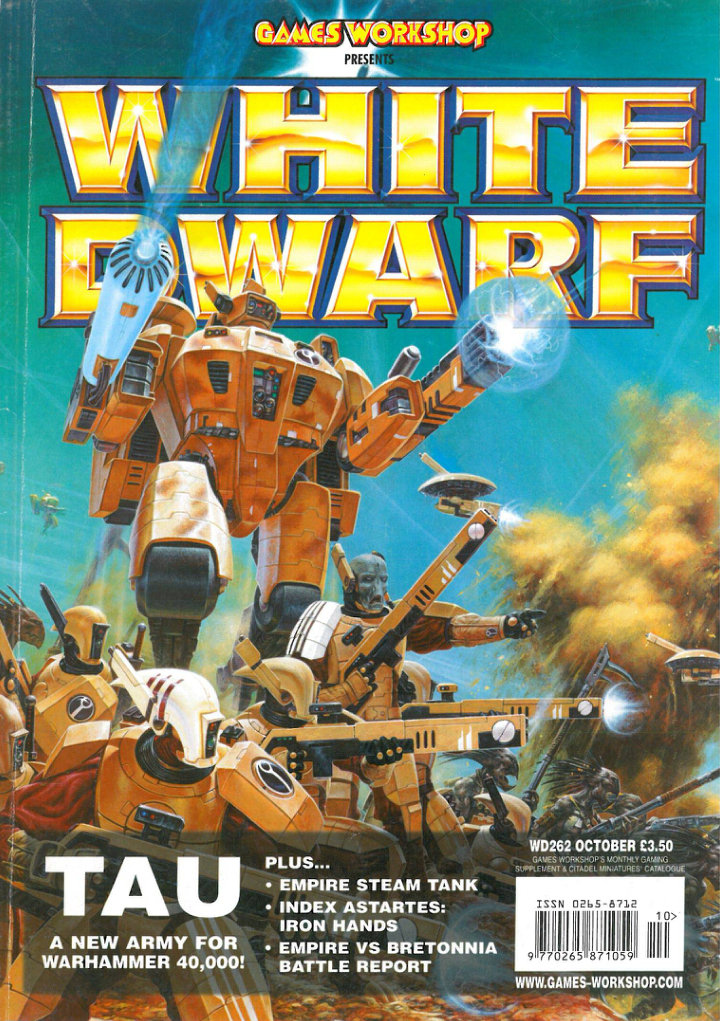
CommunityWD 262 · pp. 1–3
News introduces Forge World’s heavily armed Ork Battle Fortress and Sabertooth’s Warhammer 40,000 collectible card game, set on Pandora Prime. Further reports describe new quests and client software for the Wolfenburg online adventure, Warhammer World’s renovation and the Black Library art calendar.
Warhammer 40,000
EditorialWD 262 · p. 2
Paul Sawyer welcomes the Tau after watching their development from concept sketches to finished miniatures in the studio. Their powerful shooting gives the new army a distinct character. He also previews the forthcoming High Elf and Skaven ranges and the launch of The Fellowship of the Ring game.
Warhammer 40,000Warhammer Fantasy Battles
CommunityWD 262 · p. 2
The first public Games Workshop Grand Tournament using sixth-edition Warhammer ends with Geoff Porritt’s Daemonhost defeating John Dale’s Orcs and Goblins. The report notes the event’s friendly atmosphere and relatively few rules disputes, and recognises Jeppe Danning’s converted Lizardmen army, Alan Thompson’s sportsmanship and Andrew Stevenson’s generalship.
Warhammer Fantasy Battles
RulesWD 262 · pp. 10–13
Andy Chambers explains how two proposed alien races became a single army: the technologically advanced Tau and their adaptable Kroot allies. He follows the creation of castes, weapon roles and specialist units through repeated playtests. Battlesuits prove especially difficult to balance, requiring changes to their durability, unit size and movement so that fire-and-manoeuvre tactics remain powerful without becoming overwhelming.
Warhammer 40,000Tau Empire
ShowcaseWD 262 · pp. 14–15
Development artwork traces the combination of the Tau’s clean technological appearance with the Kroot’s more savage visual character. The accompanying account explains how Jes Goodwin, Andy Chambers and John Blanche refined the shared direction before final illustrations and miniatures were produced. Sketches show alternative equipment, armour and caste identities within that developing design.
Warhammer 40,000Tau Empire
InterviewWD 262 · pp. 16–17
Jes Goodwin describes a collaborative design process in which drones, tanks and infantry feed ideas back into one another. Domed forms, concealed technology, asymmetric lenses and subtly historical armour give the Tau a coherent appearance. Fire Warrior anatomy and equipment then influence the poseable Battlesuits, whose interchangeable weapons and support systems accommodate the developing army rules.
Warhammer 40,000Tau Empire
InterviewWD 262 · p. 17
Brian Nelson explains how athletic proportions, an evolving beak and stiff quills established the Kroot silhouette. Their avian ancestry, mercenary role and ability to absorb traits through diet guided details such as tiptoe poses, bladed rifles and butcher’s equipment. Discussions with the background writers also produced the related Kroot Hounds and Krootox.
Warhammer 40,000Kroot
ShowcaseWD 262 · pp. 18–19
A city battlefield display places the new Tau range against an advancing Imperial armoured column. Pathfinders occupy elevated ruins while infantry, Battlesuits and skimmers cover different approaches. The arrangement illustrates the range’s coordinated combined-arms appearance, with orange armour tying widely different unit shapes together.
Warhammer 40,000Tau Empire
InterviewWD 262 · pp. 20–25
Graham McNeill follows Tim Adcock’s creation of the Tau grav-tank from initial drawings through a large master model to mould-ready components. The process balances a curved alien silhouette with manufacturing constraints, interchangeable Hammerhead parts and room for drones and infantry. Photographs and explanations show how repeated refinement turns a recognisable concept into a practical plastic kit.
Warhammer 40,000Tau Empire
LoreWD 262 · pp. 26–30
Graham McNeill introduces the Tau as a rapidly expanding power on the Eastern Fringe, whose unified society combines advanced technology with an evangelical belief in collective progress. The account follows their sudden development, contact with the Imperium and alliances with other species. It then examines the castes, Ethereal authority and specialised military organisation, while Imperial uncertainty leaves important aspects of Tau society unresolved.
Warhammer 40,000Tau Empire
LoreWD 262 · p. 29
An Imperial encounter in Koloth Gorge demonstrates the danger of pursuing Tau forces into prepared terrain. Concealed troops and coordinated fire turn the constricted route into a killing ground. The account supplies a practical example of the Tau preference for positioning, ranged force and cooperation between specialised units.
Warhammer 40,000Tau Empire
LoreWD 262 · p. 30
The account follows Farsight from aggressive Fire caste officer to a commander isolated from Ethereal guidance. Fighting Orks and surviving the Damocles Crusade builds his reputation, but the encounter on Arthas Moloch and the death of his accompanying Ethereal mark a break with the empire. Rumours of independent colonies leave his motives and allegiance uncertain.
Warhammer 40,000Tau Empire
RulesWD 262 · p. 30
A compact profile compares Fire Warriors’ limited close-combat ability with their disciplined battlefield role and advanced ranged weapons. Pulse rifles provide powerful long-range fire, while carbines exchange range for mobility and the ability to pin opponents. Both weapon profiles accompany the Fire Warrior and Shas’ui characteristics.
Warhammer 40,000Tau Empire
ShowcaseWD 262 · pp. 34–35
Detailed photographs compare Steam Tank variants and their decorative treatment. Tammy Haye’s Conqueror and Von Zeppel combine elaborate heraldry, inscriptions and warm metallic fittings, with the latter carrying an exposed fighting platform and crew. The spread demonstrates how different weapon arrangements and ornamentation give the machines individual identities.
Warhammer Fantasy BattlesThe Empire
LoreWD 262 · pp. 36–37
Anthony Reynolds describes the surviving Steam Tanks as repeatedly repaired descendants of Leonardo da Miragliano’s largely irreplaceable originals. Their limited steam supply forces engineers to balance movement and weapons, while experimental refits have produced machines with distinctive names and roles. The account contrasts cannon-armed tanks with volley-gun, mortar, ram and fighting-platform variants.
Warhammer Fantasy BattlesThe Empire
LoreWD 262 · p. 37
A biographical sidebar places Leonardo da Miragliano’s inventions within the Empire’s engineering tradition. His exceptional mechanical insight produces machines later engineers can maintain and modify without fully reproducing their original construction. The account explains why the surviving Steam Tanks are treated as unique treasures rather than ordinary equipment.
Warhammer Fantasy BattlesThe Empire
PaintingWD 262 · pp. 40–41
Tammy Haye assembles the heavy metal Steam Tank in stages, keeping one side and obstructing details accessible while painting the interior. Layered metallic drybrushing distinguishes steel from bronze, with ink washes adding depth and age. The guide treats wood, shields, scrollwork, oily machinery and the engineer separately, and explains how planning lettering from its centre helps fit inscriptions onto curved scrolls.
Warhammer Fantasy BattlesThe Empire28 paint colours
ModellingWD 262 · pp. 44–45
Paul Rudge finishes his industrial battlefield with smaller fittings that make its large structures convincing. Mesh-covered vents, improvised chemical barrels and mechanical doors reuse household containers and kit components. Overflow pipes lead into shallow pools, while crates and previously built storage tanks fill the remaining spaces; stained metallic finishes unite the pieces.
Inquisitor10 paint colours
TacticsWD 262 · pp. 46–53
Pete Haines examines urban warfare from both sides of the attack. An attacker must concentrate force, protect movement routes and use supporting fire to isolate buildings before assaulting them. A defender benefits from layered positions, covered approaches and carefully timed counter-attacks rather than scattering troops across every ruin. The discussion relates army composition, reconnaissance and weapons to the restricted lines of sight and close engagements of Cityfight.
Warhammer 40,000
CommunityWD 262 · p. 54
Che Webster explains how a few committed players can turn informal gaming into a club. Suitable premises, a regular meeting time and activities that involve newcomers matter more than an elaborate organisation at the outset. The article points to libraries and community venues as sources of local information and encourages members to share the work of keeping a group active.
CommunityWD 262 · p. 55
An introduction to the club tournament system explains how local events can connect with a wider Hall of Heroes. A tournament pack offers an organising framework and guiding principles, while Valour points recognise participation and results. The scheme aims to support regular club competition without requiring every organiser to invent their own procedures.
Warhammer Fantasy BattlesWarhammer 40,000
Battle reportWD 262 · pp. 56–61
Phil Kelly’s Skaven face Mark Raynor’s Blood Dragon army in the concluding Dark Shadows scenario. Lightning, competing guardians and escalating magic disrupt the open battlefield. Phil draws Undead units away from their general, uses expendable troops to absorb danger and attacks the enemy’s magical support. The Skaven eventually overwhelm the Blood Dragon and Black Coach, securing victory and concluding the six-battle campaign.
Warhammer Fantasy BattlesSkaven
LoreWD 262 · pp. 64–70
Anthony Reynolds traces the Iron Hands’ ideals through the legends of Ferrus Manus and the harsh clan society of Medusa. The Primarch’s fate at Isstvan and the Chapter’s contempt for weakness help explain its increasing reliance on bionics. Independent clan companies, mobile fortresses and a council of leaders replace a conventional Chapter structure, while Iron Fathers combine spiritual authority with the knowledge of the Adeptus Mechanicus.
Warhammer 40,000Iron Hands
LoreWD 262 · p. 70
The Iron Hands suppress a Slaaneshi uprising across the Contqual sub-sector, advancing towards the corrupted capital of Shardenus. Librarians help close its warp rift, but military victory does not bring mercy. Punitive executions among the surviving population illustrate the Chapter’s belief that weakness and failure must be answered with exemplary violence.
Warhammer 40,000Iron Hands
RulesWD 262 · p. 71
The Iron Hands variant modifies Codex: Space Marines around bionic augmentation, Iron Fathers and respected Dreadnought veterans. Veteran sergeants may take Terminator armour, while the Iron Father combines command duties with servitors and protective machinery. A Venerable Dreadnought can lead the force, bringing special benefits to initiative and survival.
Warhammer 40,000Iron Hands
ShowcaseWD 262 · pp. 72–73
Studio miniatures and Golden Demon winners show different approaches to Space Marine armour and heraldry. Jonathan Taylor-Yorke’s Grey Hunters, Stuart Witter’s large Captain Invictus and Darren Latham’s Wolf Lord sit alongside Salamanders, Dark Angels and other Chapter examples. The photographs emphasise banners, individual character details and the variety possible within power-armoured armies.
Warhammer 40,000Space Marines
CommunityWD 262 · pp. 74–77
The preview introduces a miniature game built around the first film’s characters and dramatic encounters. Recognisable heroes, Ringwraiths, Elves and warriors of Gondor establish its initial scope. Plans for successive releases tied to the three films explain how the rules and model range will expand as the story moves beyond the Fellowship’s first journey.
Middle-earth Strategy Battle Game
LoreWD 262 · pp. 80–81
Graham McNeill recounts the struggle for a hive captured by Orks arriving beneath Armageddon’s Boiling Sea. Imperial counter-attacks bring Tycho’s final assault, bitter factory fighting and the seizure of Zephyr Gate, but rival commanders and fresh Ork reinforcements undermine the offensive. Attempts to cut the invaders’ supply route fail to restore the situation, leaving a costly and unresolved front.
Warhammer 40,000Orks
RulesWD 262 · pp. 86–91
Alessio Cavatore presents revised Steam Tank rules built around steam generation and a pool of Hull Points. Spending steam drives movement, ramming and weapons, while damage progressively reduces the engineer’s safe operating margin. Detailed procedures cover hard and vulnerable hit locations, close combat, magic and unusual movement situations. The accompanying construction options let players equip distinct named variants.
Warhammer Fantasy BattlesThe Empire
RulesWD 262 · p. 91
A construction chart starts from a basic ram-equipped hull and trades points and structural capacity for weapon fittings. Cannon, volley gun, mortar, steam gun and fighting-platform options produce different battlefield roles. A platform crew can carry experimental weapons, from long rifles and repeaters to specialised close-combat equipment.
Warhammer Fantasy BattlesThe Empire
CommunityWD 262 · p. 94
Gav Thorpe outlines Inquisitor’s move towards continuing support through Fanatic and the new Exterminatus magazine. Proposed material combines rules, modelling and campaign resources, while a developing website separates accessible background from information intended for gamesmasters. He invites contributions and presents the game as a setting that can keep growing through its players.
Inquisitor
RulesWD 262 · pp. 96–97
A gifted Arbitrator becomes dependent on the drug Crash, falls into a corrupt bargain and eventually kills his way out of the law he once enforced. Damian’s subsequent life as a bounty hunter makes his former tracking skills valuable to smugglers and Inquisitors alike. His profile includes customised firearms, specialised shotgun ammunition and a stimulant whose immediate benefits carry escalating physical risks.
InquisitorAdeptus Arbites
CampaignWD 262 · pp. 98–99
Gav Thorpe structures a campaign like a television season, with individual scenarios contributing to a larger story. Beginning with the intended climax, he works backwards through a branching plot tree to identify what the characters must learn or obtain. The framework accommodates player choices, visiting participants and new ideas while helping the gamesmaster prepare briefings, consequences and time between encounters.
Inquisitor
RulesWD 262 · pp. 100–101
Jan rises from resistance leader on Chiros to celebrated opponent of Cardinal Bucharis, then receives a Rogue Trader commission that conveniently removes a troublesome hero from Imperial politics. Exploration gives way to plunder, declining health and dependence on alien medicine. His game profile combines inherited swordsmanship and unusual weapons with lung disease and a powerful but limited Hrud restorative.
InquisitorRogue Traders
Battle reportWD 262 · pp. 103–120
Anthony Reynolds’s Empire army tests the new Steam Tank and Cursed Company against Alessio Cavatore’s Bretonnians. An opening cannon shot drives off a major knight unit, but the Duke’s Hippogriff soon exposes the Empire flank. Stubborn infantry hold the centre while the Cursed Company redeploys to stop the Questing Knights. The Steam Tank survives with a single Hull Point as the Empire secures victory despite losing its general in combat.
Warhammer Fantasy BattlesThe Empire
Contents-listed articles and substantial separately titled features are indexed. Advertisements, release catalogues, store directories, event listings and art-only pages are excluded.