EditorialWD 261 · p. 1
Paul Sawyer outlines plans to extend existing armies with new units, miniatures and background. The Cursed Company and the returning Empire Steam Tank illustrate the approach for Warhammer, while Gaunt’s Ghosts and further First Founding releases promise new options for Warhammer 40,000. He also introduces the planned Index Astartes compilation books.
Warhammer Fantasy BattlesWarhammer 40,000
CommunityWD 261 · pp. 2–3
The news desk previews Brian Nelson’s Gandalf and Boromir miniatures, explaining the approval process involving the film company and actors. It also introduces Imperial Armour II’s alien vehicles, a large Forge World Ork sculpture and events in the online world of Wolfenburg. The Lord of the Rings update describes Rick Priestley’s rules approaching completion alongside the miniature range.
Middle-earth Strategy Battle GameWarhammer 40,000
RulesWD 261 · pp. 10–13
Andy Chambers, Jervis Johnson and Pete Haines explain the successive stages of Cityfight’s development. Experiments with alternating actions gave way to familiar turn structure supported by abstracted buildings, cover and assaults, reducing awkward model placement. The later work shaped scenarios, terrain guidance and the Vogen narrative into a supplement intended to support many armies and cities rather than prescribe a single campaign.
Warhammer 40,000
LoreWD 261 · pp. 15–17
An Imperial historical account divides Horus’s assault on Terra into the capture of the spaceports, the advance on the Palace and the struggle through its defences. It contrasts Angron’s direct assaults with Perturabo’s siegecraft and follows the White Scars’ seizure of Lion’s Gate. The analysis argues that loyalist resistance bought the time that forced Horus into his final confrontation with the Emperor.
Warhammer 40,000Blood Angels
FictionWD 261 · pp. 18–19
A short introduction describes the close-combat purpose of the Furioso pattern before Chris Allen and Graham McNeill follow one into action. Sergeant Toombs’s retreating Guardsmen encounter Brother Protheus as Dark Eldar pursue them through a ruined city. The ancient Dreadnought destroys a Talos at close quarters and advances through burning vehicles as Space Marine reinforcements descend.
Warhammer 40,000Blood Angels
Battle reportWD 261 · pp. 22–23
Five Giants ambush Phil Kelly’s Skaven from several directions, threatening to crush the column before it can escape. Rat Ogres and Giant Rats bring down individual monsters, but the Grey Seer’s own unit is devastated. A conveniently placed stone circle magnifies the Dark Emissary’s magic, enabling him to finish the remaining Giants and their Truthsayer ally.
Warhammer Fantasy BattlesSkaven
Battle reportWD 261 · pp. 22–25
Phil Kelly’s Skaven continue their Albion expedition through two contrasting Dark Shadows scenarios. Space McQuirk surrounds the force with Giants, while Dylan Owen defends a fortified gateway with Dogs of War. The linked account combines fictional narration with Phil’s practical conclusions: the unpredictable monsters are overcome, but the limited siege equipment makes the castle assault much harder than expected.
Warhammer Fantasy BattlesSkaven
Battle reportWD 261 · pp. 24–25
Phil Kelly attacks Dylan Owen’s mercenary garrison with infantry, ladders and grappling hooks, hoping numbers will exhaust the defenders. Norscans, duellists and Dwarfs hold the walls long enough to inflict ruinous losses. Skaven characters eventually force a breach, but too few attackers remain to exploit it, and fresh defenders preserve the castle for the Dogs of War.
Warhammer Fantasy BattlesSkaven
ModellingWD 261 · pp. 26–27
The workshop builds cairns, boulders, dolmens and stone circles for Albion from real stones, modelling clay or polystyrene. Sturdy circular bases support the larger arrangements, with small rocks helping to anchor upright monoliths. Flock, moss and grass soften the finished forms, while carved or painted runes give the standing stones their Dark Shadows character.
Warhammer Fantasy Battles6 paint colours
PaintingWD 261 · p. 28
Dave Thomas builds the Dark Emissary’s weathered leather from brown and black, using thin ink glazes to tie successive highlights together. Spiral horns, a cold grey cowl and muted red robes provide distinct surfaces without losing the sombre scheme. The back plate receives a green-brown metallic glaze, and bright gems and carefully painted staff decoration supply small focal points.
Warhammer Fantasy BattlesDark Emissaries17 paint colours
PaintingWD 261 · p. 29
Kirsten Mickelburgh starts with the Truthsayer’s exposed flesh, developing it from a dark flesh mixture to pale highlights. The hair is painted in successive layers rather than drybrushed to keep its surface smooth. Pencil guidelines help position tattoos and embroidered details before painting, and carefully shaded red gemstones contrast with the warm metallic jewellery. A damp-looking base ties the figure to Albion.
Warhammer Fantasy BattlesTruthsayers20 paint colours
PaintingWD 261 · p. 29
Kirsten Mickelburgh pins the Fenbeast’s separate arm and prepares the head and back separately before painting. Its vegetation progresses from a near-black green to pale, decaying highlights; rock, wood and bone are treated as distinct materials embedded in the creature. Selective gloss varnish and ink-stained ground make the model appear wet and freshly emerged from an Albion bog.
Warhammer Fantasy BattlesFenbeasts12 paint colours
FictionWD 261 · pp. 30–31
The Truthsayer Dural Durak confronts Kh’nar amid the ruins of an Albion village. After surviving a regenerating Fenbeast, he pursues the Dark Emissary into a cave and faces a mysterious gauntlet powerful enough to shatter his staff and the surrounding rock. The cave’s collapse leaves the relic buried and sends Dural to warn the guardians at the Forge of the Old Ones.
Warhammer Fantasy BattlesTruthsayers
LoreWD 261 · pp. 36–43
The Blood Angels’ history begins with Sanguinius’s discovery on the irradiated moons of Baal and follows his people into the Great Crusade. Recruitment through ordeal, the blood of the Sanguinary Priests and a year inside a sarcophagus transforms vulnerable aspirants into warriors. The article connects the Primarch’s death to the Black Rage, then examines the Chapter’s assault-oriented organisation, artistic ideals and attempts to understand and restrain its inherited curse.
Warhammer 40,000Blood Angels
LoreWD 261 · p. 39
A boxed account explains how memories of Sanguinius’s death overwhelm some Blood Angels before battle. Chaplains identify those who cannot recover their self-control and gather them into the Death Company. Their black armour and red crosses mark warriors directed towards a final battle, where the strength and fury of the Black Rage make them formidable and expendable.
Warhammer 40,000Blood Angels
ShowcaseWD 261 · pp. 44–45
The Blood Angels gallery places richly decorated heroes beside units of Terminators, Assault Marines and the black-armoured Death Company. Dreadnoughts and a bannered vehicle extend the red, black and gold scheme across different scales. Group photographs show how helmet colours and specialist heraldry retain unit identity within a recognisable Chapter palette.
Warhammer 40,000Blood Angels
ModellingWD 261 · pp. 46–51
Paul Rudge expands his industrial board with foamboard buildings and removable overhead gantries, planning standard gaps so the terrain can be rearranged. Card strips, filler and textured wallpaper turn simple boxes into worn architecture. Railings, hanging cables and kit details furnish two levels of play, while geometric surface panels and stencilled markings keep the flat modular board visually interesting.
Inquisitor9 paint colours
ModellingWD 261 · pp. 49–50
Removable plasticard bridges connect Rudge’s buildings without fixing the battlefield into one arrangement. Right-angled strips stiffen the platforms, mesh supplies railings, and garden wire runs into short tubes to suggest heavy cables passing between structures. Metallic drybrushing and patchy ink stains give the gantries a worn industrial finish.
Inquisitor5 paint colours
ModellingWD 261 · p. 51
Three MDF panels form a portable playing surface that remains flat enough for freely positioned scenery. Shapes cut from textured wallpaper and plasticard break up the empty floor, and textured paint integrates their edges. Grey and metallic drybrushing pick out the industrial panels, with simple stencils adding graphic markings before varnishing.
Inquisitor3 paint colours
LoreWD 261 · pp. 54–57
Anthony Reynolds recounts a mercenary’s betrayal of his necromantic employer and the curse that makes his death temporary. Richter Kreugar continues his trade in undeath, gaining fresh skeletal followers whenever his company kills an enemy. An accompanying battle narrative follows an Empire engineer watching the regiment repel Chaos raiders, leaving its living allies victorious but deeply unsettled.
Warhammer Fantasy BattlesDogs of War
RulesWD 261 · p. 55
Rules allow many armies to hire Richter Kreugar and his skeleton regiment, with different selection slots for Dogs of War. The company acts independently, replenishes itself by killing living opponents in close combat and begins to crumble if its leader falls. Richter’s weapon and protective gem complement a banner that reduces the regiment’s losses from combat resolution.
Warhammer Fantasy BattlesDogs of War
CampaignWD 261 · pp. 60–63
Gav Thorpe distinguishes short campaigns, where urgent events leave little time for study, from investigations lasting months or years. Experience tests reward actions taken in play, while accumulated training points support new skills, psychic powers and recovery from permanent injuries. The rules include limits and failures, a campaign record sheet and advice to keep advancement subordinate to the scenarios themselves.
Inquisitor
RulesWD 261 · p. 62
Subdue gives a character a controlled close-combat action intended to capture an opponent alive. A successful head strike can stun the target, and another can render an already stunned foe unconscious. The rules retain a chance of recovery, making a prisoner someone the warband must continue to guard.
Inquisitor
LoreWD 261 · pp. 64–65
Gav Thorpe supplies a range of Imperial and heretical sects as material for Inquisitor campaigns. Their beliefs range from silent hereditary assassins and obsessive relic collectors to advocates of terror, resurrection and transformation. The examples show how religious ideas can produce distinctive appearances, motives and methods, including cults whose apparent devotion masks allegiance to hostile powers.
InquisitorInquisition
RulesWD 261 · pp. 66–67
Gabrydon’s centuries of rebellion prompt a new governor to replace indiscriminate reprisals with teams trained to capture insurgents for interrogation. Lucretia Bravus earns an Inquisitor’s attention by continuing a pursuit alone after her team is destroyed. Her background and game profile present a resilient hunter equipped for tracking, close-range fighting and taking prisoners, accompanied by a cyber-mastiff.
InquisitorInquisition
CampaignWD 261 · pp. 68–69
Gav Thorpe develops recurring non-player characters who make a campaign world feel inhabited between battles. Suppliers, doctors and political figures can offer help with meaningful limitations, such as unreliable equipment or restricted medical facilities. The article then brings those contacts onto the battlefield as people to protect, rescue or pursue, using Karis Cephalon’s inhabitants as examples.
Inquisitor
LoreWD 261 · p. 69
Four contacts illustrate the competing interests of Karis Cephalon: the elusive surgeon Monque, the powerful puritan Cardinal Kodazcka, mutant organiser Lathesia and arms merchant Red Ivan. Each combines useful resources with complications, from limited surgical equipment to political leverage and personal grudges. Their connections create reasons for warbands to negotiate with the setting’s inhabitants rather than merely fight over it.
InquisitorEcclesiarchy
LoreWD 261 · pp. 73–75
An Imperial-styled preview introduces the expanding Tau empire through concept drawings, painted miniatures and a violent first encounter. Colonel Griffin’s Brimlock Dragoons survive a Kroot ambush only to face coordinated battlesuits, skimmers and concealed infantry. The fiction demonstrates the combined threat of Tau technology and their allies while the visual material establishes the new force’s appearance.
Warhammer 40,000Tau Empire
RulesWD 261 · pp. 76–85
Alessio Cavatore presents a developing Bretonnian army list intended to address problems with the Ravening Hordes version. The revisions centre on the wedge-shaped Lance and a blessing that rewards chivalrous conduct. Full character and unit entries, knightly virtues and a selection of magic items support an army whose mounted nobles depend on more fragile infantry and squires for other battlefield tasks.
Warhammer Fantasy BattlesBretonnia
RulesWD 261 · pp. 77–79
Detailed diagrams resolve how Bretonnian knights form, manoeuvre and fight in a pointed wedge. The rules address protected positions for Damsels, who can attack through the formation, rear charges and the removal of casualties. A special provision lets the Lance brush aside light units that would otherwise exploit its unusual footprint to trap it without a proper charge.
Warhammer Fantasy BattlesBretonnia
RulesWD 261 · p. 80
Bretonnian armies can surrender the choice of first turn to pray for protection against enemy shooting. The blessing can then be lost through actions judged unchivalrous, including refusing a challenge or directing missiles at certain opponents, as well as through particular battlefield losses. The mechanic links the army’s defensive advantage to its conduct throughout the game.
Warhammer Fantasy BattlesBretonnia
RulesWD 261 · pp. 80–81
The preview’s enchanted equipment reinforces the army’s knightly identity through monster-slaying weapons, protective armour and sacred relics. Some powers depend on retaining the Lady’s blessing, while others alter magical confrontations or the impact of a cavalry charge. Banners provide unit-level options, including protection from powerful missiles and improved reliability under pressure.
Warhammer Fantasy BattlesBretonnia
ShowcaseWD 261 · pp. 86–87
Mounted heroes, Damsels and knightly units demonstrate the heraldic variety of a Bretonnian army. Bright personal colours and decorated horse cloths distinguish the nobles, while larger formations bring their individual schemes together. The final army display extends that emphasis on banners and heraldry into an elaborate presentation setting.
Warhammer Fantasy BattlesBretonnia
InterviewWD 261 · pp. 94–95
William King discusses the origins and development of Gotrek and Felix as Vampireslayer approaches publication. A roleplaying campaign inspired the Slayer, but the contrast with Felix turned a proposed fatal adventure into an ongoing partnership. King considers the series’ mixture of humour and darkness, the influence of Prague on his settings and the expanding supporting cast, alongside profiles of the two protagonists and the new novel’s premise.
Warhammer Fantasy BattlesWarhammer Fantasy RoleplayDwarfs
TacticsWD 261 · pp. 96–97
Christian Augst recommends assigning Wolf Scouts a specific task before selecting their equipment. Anti-tank, anti-infantry and supporting roles demand different weapons and deployment choices; arriving behind the enemy is useful but too unreliable to underpin an entire plan. He emphasises isolated targets, coordinated pressure from the rest of the army and avoiding a spectacular attack that leaves the Scouts stranded in the open.
Warhammer 40,000Space Wolves
PaintingWD 261 · pp. 98–99
Martin Footitt plans the Magos’s mechanical limbs before assembly and paints the obstructing cables, parchment and tabard separately. Warm ivory robes and pallid skin surround three different metallic cable finishes, creating variety within the dense machinery. The guide also covers aged parchment, raised lettering, the cog design on the hood, enamel-like black weapons and selective gloss varnish on lenses, liquid and metal.
InquisitorAdeptus Mechanicus24 paint colours
CommunityWD 261 · pp. 100–101
Che Webster visits the Crazy Bear and Ragged Staff group as they build a modular urban battlefield in a single intensive session. Salvaged computers, a photocopier and packaging become industrial structures on MDF bases, designed to work with both Warhammer 40,000 and Inquisitor miniatures. The account shows how shared planning, complementary skills and a consistent painted finish turn miscellaneous materials into a convincing demonstration game.
Warhammer 40,000Inquisitor
CampaignWD 261 · p. 101
The Crazy Bear and Ragged Staff participation scenario takes place around a processing plant attacked through an Eldar webway portal. Players receive mission cards tailored to their squads, combining objectives such as retrieving items, eliminating enemies and securing locations. Completing a personal set of tasks provides a simple victory condition for a busy demonstration table.
Warhammer 40,000Eldar
Battle reportWD 261 · pp. 103–118
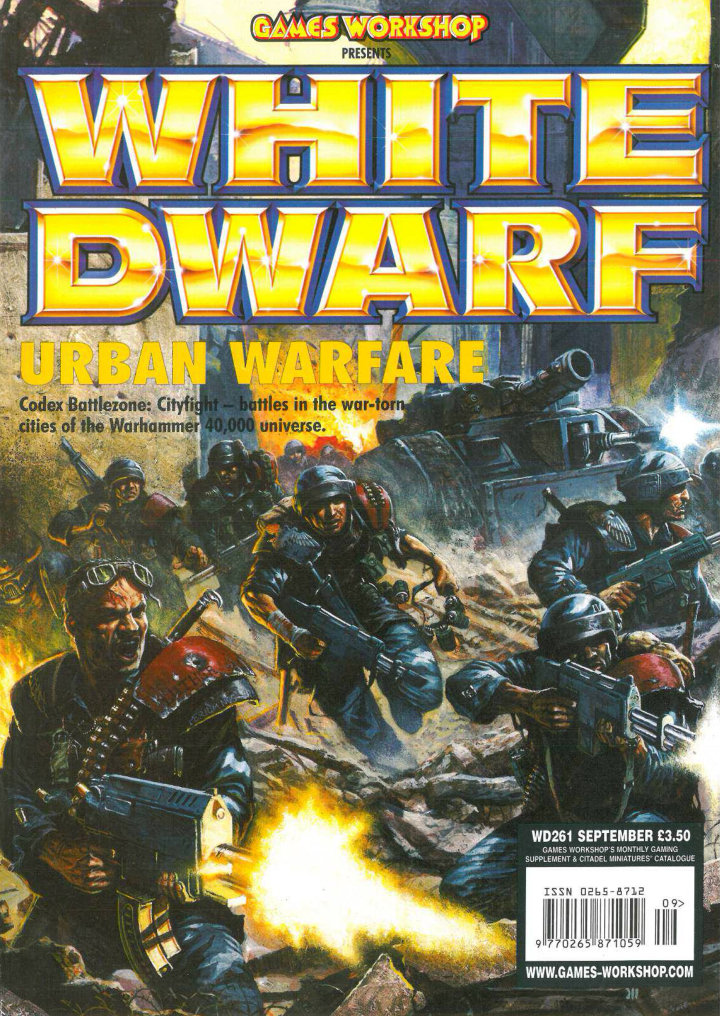
Graham Davey’s Night Lords fight Rowland Cox’s 122nd Cadians for an Arbites precinct tower in a Cityfight Take the High Ground mission. Elevated Chaos fire support and mobile attackers dismantle the Guard’s vehicles and divide its advance. Although the Cadians briefly reach the tower, their short-ranged equipment cannot suppress the defenders, and Gorsameth’s devastating assaults complete a Night Lords victory. Pete Haines’s commentary and rules examples explain how the urban terrain shapes each decision.
Warhammer 40,000Night Lords
Contents-listed articles and substantial separately titled features are indexed. Advertisements, release catalogues, store directories, event listings and art-only pages are excluded.