EditorialWD 260 · p. 1
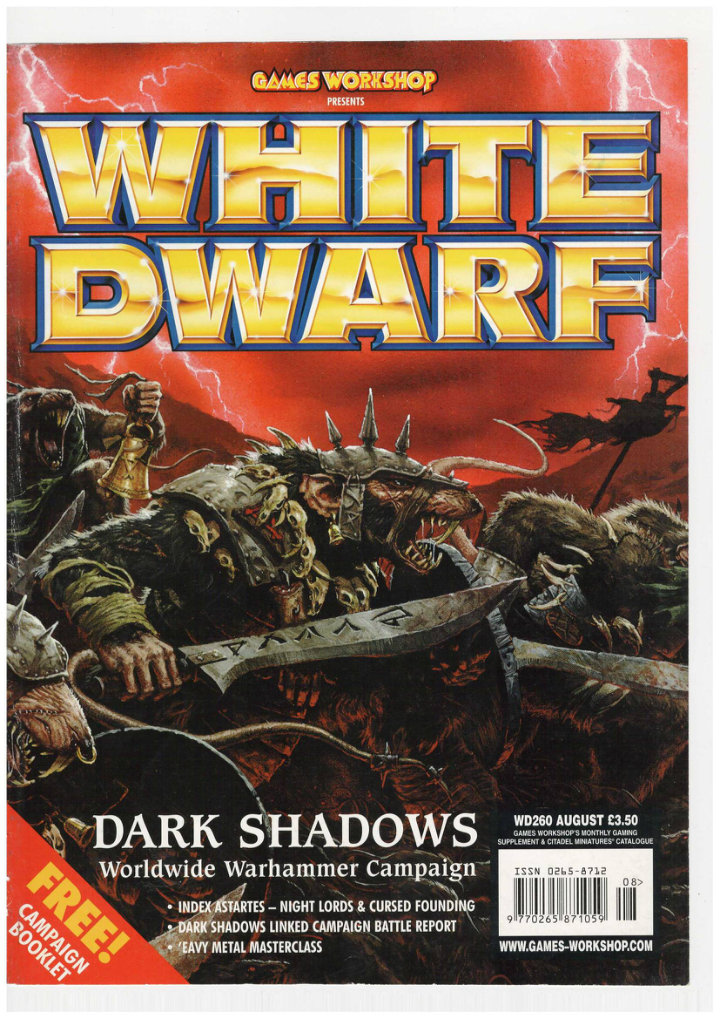
Paul Sawyer introduces the Dark Shadows campaign and its struggle between Truthsayers and Dark Emissaries for control of Albion. He outlines the accompanying campaign booklet and the issue’s expansion of its setting into Warmaster, then looks ahead to Cityfight and the arrival of the Tau.
Warhammer Fantasy BattlesWarhammer 40,000
CommunityWD 260 · p. 1
A preview of Games Day describes two large participation tables: an Imperial city under assault and the stone circles of Albion contested by opposing armies. It also highlights opportunities to meet artists, writers and miniature designers, alongside an early look at the forthcoming Lord of the Rings project.
CommunityWD 260 · pp. 2–3
The news pages preview the plastic Moria Goblins, Elves and Men of Gondor being developed for the Lord of the Rings game, alongside Adrian Smith’s forthcoming Tau cover artwork. They also report on the Dutch Grand Tournament in Arnhem’s Eusebiuskerk and introduce the expanded magic coverage of Hogshead’s Realms of Sorcery supplement.
Middle-earth Strategy Battle GameWarhammer 40,000
LoreWD 260 · pp. 8–9
The mists around Albion recede to reveal a prize that draws armies from across the Warhammer world. Rumours of treasure conceal a struggle over ancient stone circles and the magical forces they contain. Truthsayers warn the invaders of the danger, while Dark Emissaries recruit followers for an unknown master, turning the island’s conquest into a conflict with consequences far beyond its shores.
Warhammer Fantasy BattlesTruthsayers
LoreWD 260 · pp. 10–14
Space McQuirk follows the first landings on Albion through campaign reports and short narrative scenes. Orcs seize an Empire beachhead at Muddy Point, Dark Elf scouts discover the dangers of the marshes, and a Truthsayer-led High Elf force encounters unexpected sorcery among the standing stones. The accounts establish the foul weather, hidden Lizardmen and contested magical sites that will shape the invasion.
Warhammer Fantasy BattlesOrcs & Goblins
LoreWD 260 · pp. 16–23
The history of the Night Lords traces Konrad Curze’s rise from a feral child on Nostramo to a ruler who enforces order through terror. The Emperor’s arrival brings him into the Great Crusade, but the return of corruption on his home world, brutal recruits and prophetic visions deepen his isolation. His destruction of Nostramo and allegiance to Horus culminate in a Legion whose campaigns favour fear and helpless victims over honourable battle. Later sections examine its beliefs, tactics and unusually stable gene-seed.
Warhammer 40,000Night Lords
LoreWD 260 · p. 22
An Imperial investigation reconstructs the Night Lords’ destruction of an isolated world from its surviving buildings and abandoned communications network. The report describes attacks on communications, broadcasts designed to spread panic and an artificial darkness that precedes the final killings. Its forensic framing illustrates how the Legion turns the collapse of resistance into a deliberate instrument of war.
Warhammer 40,000Night Lords
RulesWD 260 · p. 24
The army variant reshapes Codex: Chaos Space Marines around fast attacks, infiltration and night fighting. It allows additional Raptors and trades heavy support capacity for mobility, while restricting allegiance to Chaos Undivided. Terror attacks interfere with enemy reserves and communications, and new equipment strengthens the army’s ability to exploit cover and close quickly.
Warhammer 40,000Night Lords
PaintingWD 260 · pp. 26–27
Dave Thomas explains the preparation and painting of the large Eisenhorn miniature, including pinning heavy components and leaving obstructed details separate until painted. Purple and black robes frame a bright white inner layer; carefully placed pale flesh highlights suggest an older face. The guide develops marble by stippling and fine veins, creates worn gold with repeated ink washes, and finishes with a dusty debris base. Different varnish finishes reinforce the contrast between cloth, metal and polished stone.
InquisitorInquisition17 paint colours
CampaignWD 260 · pp. 28–30
Gav Thorpe explains how the success of the Armageddon campaign led to a worldwide Warhammer event centred on Albion. Players can support either supernatural faction, submit ordinary battles as well as the themed scenarios, and influence both the wider story and the rewards available to their race. The article distinguishes the restorative magic of Truthsayers from the destructive practices of Dark Emissaries and explains how the campaign’s stages, weather and results are shared.
Warhammer Fantasy BattlesWarmasterTruthsayers
RulesWD 260 · pp. 34–40
Space McQuirk, Andy Chambers and Pete Haines develop an optional army for Ork tribes that grow from spores left behind by a departing Waaagh! Their low technological base makes hunters, animal handlers and unpredictable psykers central to the force. The list combines Huntas, Wildboyz and Madboyz with Boarboyz, salvaged Junkatrukks and Squiggoths, supported by rules for traps, psychic outbursts and Pigdok modifications. The authors explicitly present it as recommended optional material rather than a competitive-play list.
Warhammer 40,000Orks
CampaignWD 260 · pp. 42–45
Gav Thorpe moves from a planet’s overall identity to the specific locations in which a campaign unfolds. He recommends a manageable initial set of distinctive places, reusing terrain layouts and a few unique features to suggest a larger world. Examples from Karis Cephalon include palace ruins, catacombs and an ambush site, while maps serve both as preparation aids and as information the characters can discover during play.
Inquisitor
RulesWD 260 · p. 48
Rules adapt Truthsayers, Dark Emissaries and a Fenbeast to Warmaster, with both guardians able to contest control of the same creature. The accompanying Black Bog scenario uses hidden deployment, restricted visibility and a stone circle that only the surviving guardian can enter. Its objectives make the fate and positioning of the guardians matter alongside the normal destruction of enemy units.
WarmasterTruthsayers
Battle reportWD 260 · pp. 48–55
Rick Priestley’s Orcs face Steve Hambrook’s High Elves in an Albion battle where fog reduces missile effectiveness and both sides struggle to command the Fenbeast. The Elves recover from early command failures and punish the Orc centre, but a Giant breaks through their defensive line. Steve’s decision to pursue vulnerable Goblins instead of eliminating the Giant leaves the threat intact, allowing the Orcs to force an Elven withdrawal.
WarmasterOrcs & Goblins
LoreWD 260 · pp. 58–59
Graham McNeill recounts Tyrus’s survival of a daemonic attack on Loressa and his apprenticeship under Witch Hunter Covonis. Their later encounter with the same daemon kills his mentor and turns Tyrus’s devotion into an uncompromising campaign of purges. The article follows his rise as a Monodominant Inquisitor and the recruitment of Sergeant Stone, Malicant and Barbaretta, linking his personal history to the Karis Cephalon campaign.
InquisitorInquisition
RulesWD 260 · pp. 64–65
Hieronomus Tezla is introduced as a runic priest whose curiosity draws him into the Xenarites, a secretive Mechanicus sect studying alien technology. His investigations range from a crashed Fra’al craft to Ork force fields and suspected Eldar portals. A character profile equips him with specialised bionics, scanners and a temporal phase distort generator, bringing that unorthodox background into Inquisitor games.
InquisitorAdeptus Mechanicus
TacticsWD 260 · pp. 66–68
Mike Walker recounts successive attempts to defeat a friend’s Bloodthirster, treating each failure as a lesson in army design. Static shooting founders against flight and Terror, artillery needs protection from fast attackers, and Dwarf resilience can discourage the monster without finishing it. His eventual Lizardmen solution combines mobility with repeated poisoned attacks, illustrating why a plan must address the daemon’s supporting army as well as its formidable profile.
Warhammer Fantasy BattlesDaemons of Chaos
LoreWD 260 · pp. 70–71
Graham McNeill traces Cherubael’s atrocities and his capture by the radical Inquisitor Quixos, who traps the daemon inside a prepared mortal host. Maintaining that bondage requires fresh bodies and increasingly corrupt practices, eroding the Inquisitor’s humanity. Quixos’s execution by Eisenhorn transfers Cherubael into another master’s service and leaves the article questioning whether the new relationship will repeat the same descent.
InquisitorInquisition
RulesWD 260 · pp. 74–77
Jake Thornton turns the Giants’ contests at Albion’s stone circles into a self-contained arena game. Players secretly allocate fighting effort between attacks and defence, while knockbacks, stunning and falling create opportunities for dramatic reversals. Thrown rocks and an impatient crowd prevent prolonged inactivity. Optional standing records and tournament variants let clubs turn individual brawls into a larger contest.
Warhammer Fantasy BattlesGiants
ModellingWD 260 · pp. 78–79
Tyranid Warrior components become the Royal Hydra’s unnatural armour, with head plates and carapace pieces fitted around its body and gaps filled with modelling putty. Erik Mogensen stresses pinning the long necks before painting. Chris Bone’s dark green scheme keeps the hide subdued while pale, ink-aged bone plates and luminous green eyes emphasise the mutations described in the accompanying background.
Warhammer Fantasy BattlesDark Elves6 paint colours
RulesWD 260 · pp. 78–82
Erik Mogensen expands the Dark Elf War Hydra into three distinctive variants, combining background, optional game rules and conversion guides. Royal Hydras acquire armour and corrosive blood through Malekith’s rituals, Spellthirsters protect nearby troops against magic, and veteran beasts develop unpredictable battlefield habits. The examples demonstrate how spare parts, scars and trophies can make the different profiles recognisable on the table.
Warhammer Fantasy BattlesDark Elves
ModellingWD 260 · p. 80
The Spellthirster is made physically frailer by omitting heads and filling the unused sockets, while filed scars represent wounds left by Morathi’s ritual. A limited blue palette gives its hide a cold magical appearance. Pale bone ridges, raw red scars and bright green eyes distinguish the altered creature without competing with the dominant blue-black body.
Warhammer Fantasy BattlesDark Elves8 paint colours
ModellingWD 260 · pp. 81–82
A veteran Hydra carries the accumulated evidence of battle: embedded weapons, a severed arm, skeletal trophies and chains assembled from spare plastic components. Its aged grey hide is darkened with thin ink, with a lighter belly providing contrast. Bronze treatment turns an unfortunate Elector Count and horse into preserved trophies, and burning red eyes complete the impression of a long-serving monster.
Warhammer Fantasy BattlesDark Elves13 paint colours
RulesWD 260 · pp. 82–83
Gav Thorpe corrects and expands the developing Lizardmen list previously published in issue 256. Revised Saurus Warriors and a new Saurus Cavalry entry accompany clarification of Cold-blooded tests and shooting at Kroxigor emerging through Skink screens. Temple Guard gain a shield option, while Tichi-Huichi’s Raiders retain their separate Regiment of Renown profiles.
Warhammer Fantasy BattlesLizardmen
ModellingWD 260 · p. 83
Darren Latham combines a plastic Saurus Warrior and Cold One with a metal spear arm to make cavalry before dedicated models are available. Removing the original tail, adjusting the legs and repositioning the feet allows the rider to sit naturally; modelling putty supplies a replacement tail. Related turquoise and green mixtures distinguish mount from rider, with bronze weapons and shield completing the scheme.
Warhammer Fantasy BattlesLizardmen5 paint colours
CampaignWD 260 · pp. 84–85
Gav Thorpe extends the consequences of an Inquisitor game beyond the final turn. Campaign organisers can track time between encounters, lingering wounds, permanent physical damage and psychological effects, with treatment or replacement limbs offering routes back into action. The discussion encourages injuries to create continuing stories while giving characters meaningful reasons to seek medical help or avoid another fight.
Inquisitor
RulesWD 260 · p. 85
Tezla’s experimental device lets him phase partly out of normal space, reducing the effect of attacks but limiting his ability to interact with solid objects. The protection varies with the force of the incoming blow, and a malfunction can intensify injury instead. The rules distinguish firing a weapon from close combat and make movement through solid barriers a dangerous decision.
InquisitorAdeptus Mechanicus
CommunityWD 260 · pp. 88–91
An introduction to Hogshead’s Warhammer Fantasy Roleplay line explains its emphasis on vulnerable adventurers, careers and a dangerous Old World. Reviews place the Doomstones and Enemy Within campaigns alongside the two Apocrypha collections, distinguishing extended adventures from optional rules and setting material. Forthcoming books, including Realms of Sorcery, show how the revived line is expanding beyond its reprints.
Warhammer Fantasy Roleplay
CommunityWD 260 · pp. 92–93
Che Webster reports from the Student Nationals at De Montfort University, where a broad programme of roleplaying and wargames combines competition with a social weekend. Open-format gaming encourages participants to try unfamiliar systems, and former students continue to return alongside current societies. Bangor earns the right to host the next event, while a charity raffle raises money for the Rainbows children’s hospice.
Warhammer Fantasy BattlesWarhammer 40,000
CommunityWD 260 · p. 93
Space McQuirk describes an Inquisitor demonstration at the Student Nationals, staged around a fuel depot on Keylene. Three warbands pursue conflicting goals involving a data terminal, with judging rewarding objectives and roleplaying as well as destructive action. The account highlights how a compact scenario can accommodate radically different character decisions and still produce a memorable shared story.
Inquisitor
ModellingWD 260 · pp. 94–97
Paul Rudge begins a four-part Inquisitor board with industrial storage tanks for a sinister underground complex. Food containers become the main vessels, strengthened and dressed with card panels, pipework and kit components. Wire-mesh walkways, ladders and carefully spaced rivets give the large structures a convincing scale, while metallic drybrushing over black unifies the mixed materials.
Inquisitor2 paint colours
FictionWD 260 · pp. 98–102
Letters and recovered records follow Magos Marco Pteronus’s expedition into a concealed laboratory on Incunabla. Preserved giants, an unsettling autopsy and the base commander’s log reveal an attempt to improve the Space Marines through accelerated, manipulated development. The discovery leads to psychic disturbances and the disappearance of the expedition; the final Imperial response leaves the origin and fate of the experiments deliberately unresolved.
Warhammer 40,000Space Marines
FictionWD 260 · p. 100
Genetor Quincus examines one of the immense preserved subjects found by the Incunabla expedition. His report identifies enhanced organs, unusual tissue and evidence of artificial intervention in the subject’s growth. The clinical account supplies a disturbing physical counterpart to the expedition’s increasingly speculative interpretation of the laboratory.
Warhammer 40,000Adeptus Mechanicus
FictionWD 260 · p. 101
The laboratory commander’s records describe Project Homo Sapiens Novus and pressure to deliver improved Space Marines despite mounting problems. Reports of mutations among related Chapters undermine the programme’s apparent success, while a small group of extraordinary subjects attracts particular interest. The recovered log turns the abandoned facility into evidence of a deliberate and deeply compromised experiment.
Warhammer 40,000Space Marines
Battle reportWD 260 · pp. 103–118
Phil Kelly leads a Skaven invasion through three linked Dark Shadows battles, beginning with a dangerous landing and advancing towards a source of magical power. Narrative scenes are interwoven with the players’ plans and battlefield results. The sequence shows the same force adapting to a defended shore, an Empire blockade in the fens and a struggle with Dark Elves for an Ogham circle, with weather and supernatural allies changing the value of familiar units.
Warhammer Fantasy BattlesSkaven
Battle reportWD 260 · pp. 106–109
Phil Kelly’s Skaven attempt to establish a beachhead against Paul Sawyer’s small Dwarf garrison and its artillery. The landing force is much larger, but the guns destroy the ships and the defenders resist successive attacks. The extraordinarily long struggle ends with a surviving Dwarf holding the shore, demonstrating how the scenario’s terrain and objectives can outweigh simple numerical superiority.
Warhammer Fantasy BattlesSkaven
Battle reportWD 260 · pp. 110–113
A smaller Skaven army must escape through Graham McNeill’s Empire force in Albion’s marshes. Fog disrupts the defenders’ firepower and charges, while Rat Swarms hold cavalry in place and Giant Rats exploit an exposed flank. Rat Ogres break a second section of the line, allowing the surviving Skaven to flee in the direction their general actually wants and secure a decisive scenario victory.
Warhammer Fantasy BattlesSkaven
Battle reportWD 260 · pp. 114–117
Matt Hutson’s Dark Elves race into an Ogham circle to exploit its increased magical power, while Phil Kelly’s Skaven manoeuvre to surround them. The battle turns on supernatural interventions as much as fighting: reanimated casualties disrupt the Elves, the Truthsayer kills the Dark Emissary, and a magically propelled Skaven character drives the Truthsayer away. The collapse of the remaining defenders leaves the Skaven in control of the stones.
Warhammer Fantasy BattlesSkaven
Contents-listed articles and substantial separately titled features are indexed. Advertisements, release catalogues, store directories, event listings and art-only pages are excluded.